Colombia listed as ‘vacation bargain’


A new article at the Minnesota Star-Tribune highlights the reasons for heading to Colombia and other parts of Latin America for vacation.  Medical Tourism isn’t mentioned – it’s strictly a vacation article but it’s nice to see Colombia get a bit of the spotlight it deserves!

I’ve been adding a few links with information about Colombia here at Bogota Surgery – just take a look around.

More criminal malpractice, and patient deaths: in my own backyard…


Phoenix, Arizona –

In a case of criminal malpractice that sickens and horrifies health care personnel like myself – ‘self-proclaimed’ plastic surgeon, Peter Normann was able to delay sentencing after being found guilty earlier this summer in the deaths of three of his patients  – in three separate incidents.

The details of each of the cases are quite frightening, and highlight reasons why trained observers like myself are critical for objective and unbiased evaluations for potential patients.  In one case, another ‘homeopathic’ doctor working with Mr. Normann (not a licensed plastic surgeon) participated in a liposuction case that resulted in the death of a patient.  In two cases – patients died because Mr. Normann failed to intubate the patients correctly (and tore the esophagus of one of the patients.)

In all cases,  there was no intra-operative monitoring during cases – and Mr. Normann’s only assistant was a massage therapist (not an anesthesiologist, not a surgical nurse or trained surgical team.)  Horrifying – completely criminal, and unforgivable and unacceptable.

Additional Links on this case:

Homeopathy in Arizona covered for doctors’ mistakes

‘Homeopathic’ doctor kills patient performing liposuction.

The Times: Surgical Roulette

Diabetes – Global epidemic, part II


As reported at Medpage – the latest Diabetes estimates were released by the International Diabetes Foundation (IDF) this week at the EASD (European Association for the Study of Diabetes) as the news was even grimmer than predicted just a few short months ago: Researchers now estimate 366 million people HAVE diabetes worldwide – greatly surpassing all previous estimates – causing 4.6 million deaths every year.

Leading physicians at this year’s conference continued to stress the importance of Early diagnosis and treatment of Diabetes to prevent serious complications (and death).  This is something we’ve talked about here at Cartagena Surgery – the need for early diagnosis, prompt treatment and aggressive risk reduction.

Preventing diabetes remains a key element of this strategy, but one which we are failiing miserably.  Simple dietary changes such as reducing the consumption of sugar-laden beverages appears to be impossible to implement as we are hopelessly entrenched in American diets (and Indian, Chinese and other nations – as they adopt our fast-food habits).

As many of my face-to-face patients already know, one of the best lines of defense is also one of the oldest in our arsenal of oral anti-glycemics.  For all of my patients who have heard my metformin spiel in person, feel free to skip ahead.  As we’ve discussed in lectures and presentations – Metformin, that simple drug from the 1970’s (one of my $4 faves) has so many side benefits – and the potential cancer benefits are encouraging.. [what’s not encouraging  – is the difficulty getting patients to take their medications regularly – even humble Metformin which is one of the safest, most effective – (clinically proven!) and cheapest diabetes drugs available.]

*as many readers and patients know – this is the one topic where even Cartagena Surgery gets overwhelmed at times.. There is just so much disease/ disability and suffering but it seems like no one is listening or cares enough about themselves to change their habits.**  Please – dear readers – prove me wrong, and write me letters to let me know how you are taking control of your diabetes and your health..

Goodreads Giveaway ends Sept 18th!


Just a reminder – your chance to win a free autographed copy of (the newly revised) Bogotá! a hidden gem guide to surgical tourism ends September 18th.  You can still enter here!

If you aren’t familiar with Goodreads – it’s an on-line ‘Book Club’ that allows people to share their reviews of their favorite (and not so favorite books.)  It also allows readers to catch up with and connect with their favorite authors..

Sugary drink follow up (as promised!)


If you remember, in my blogs about the health benefits of coffee (here, here and here) as well as a previous blog on the health risks related to sugary soft drinks, I promised to bring you more information about our favorite devil-in-disguise, Starbucks.  (I will give them credit for making this information easily accessible, even if it is tiny print.)

I call Starbucks this because on initial consideration..

Coffee: Good!      Big super-sized coffees: Even Better!  and look – a Regular black coffee, no cream, no sugar, any size (including their super-size Venti) is only FIVE calories..

Coffee loaded with cream and sugar:  Not so good.  (How bad is it – you ask? or you should be asking)

well once you start drinking their specialty drinks (and I must be the only person who drinks regular coffee anymore) – that’s when you get into trouble.. so knowing that everyone loves their super-sized coffees, I’ve skipped right to the “Venti” calorie counts..

Cafe Latte with skim milk: 170 calories

Cafe Latte with 2% milk:  240 calories and NINE grams of fat

Cafe Mocha (without whipped cream in these examples)

with nonfat-milk: 280 calories

with 2% milk: 340 calories and 10 grams of fat (that’s a reasonable sized salad with a vinaigrette dressing and maybe cheese or not-so-healthy add-ons)

Vanilla (or other flavored) Lattes:

with non-fat milk: 250 calories (all sugar)

with 2% milk: 320 calories and eight grams of fat

Even the ‘skinny’ lattes have 160 calories..

The specialty espressos are no better (in fact – some are worse, as you will see)

Carmel macchiato:

 with non-fat milk: 240 calories, one gram of fat

with 2% milk:  300 calories, 8 grams of fat

White chocolate mocha (without whipped cream – I think they were afraid of putting the whipped cream calorie counts on this brochure)

with non-fat milk: 450 calories and 7 grams of fat (that’s a decent meal’s worth of calories!!)

with 2% milk: 510 calories and fifteen grams of fat – for a ‘coffee’ !  (I think you can see here how a few of these coffees a week can certainly pile on the pounds.)

Now, if you think that’s no big deal – go on over to www.Fitday.com (and don’t lie to yourself about your exercise) and put in your information (they have free accounts) and figure out how much walking, jogging or aerobics you have to do to equal out that one coffee.. Hint: It’s a lot more than you’d think – or we wouldn’t be in this mess!

The other items on the menu (including the teas) are no better once you pile in the milks, sugars and other garbage.

What about coffee with soy milk?  Isn’t that supposed to be good for you?  Well, in theory, perhaps.. But actually, for some products, the fat and calorie counts for Starbucks products with soy milk go way, way up.

Cafe Latte with soy milk: 220 calories, 6 grams of fat

Cafe Mocha (no whipped cream) with soy milk: 320 calories, 8 grams of fat

Vanilla Latte with soy milk: 300 calories with 6 grams of fat

Carmel macchiato with soy milk: 280 calories with 6 grams of fat

White chocolate mocha: (no whipped cream): 490 calories, 12 grams of fat

all of this – for a little eye-opener in the morning – time to stick with the regular coffee!

In fairness – I am not picking on Starbucks, they are just the most popular.  Even the local 7 – 11 has a coffee flavored slushy drink that is packed full of sugar and calories.  Of course it’s delicious – but really, that’s besides the point.  Obesity and diabetes are just a mathematical formulation – and it seems many of us are failing the subject entirely.

The Lancet, a well reputed medical journal has just published a series on Obesity, and the numbers are frightening – researchers estimate that by 2030 – (really not that far away) over 165 million Americans will be obese.

The costs of this to society are enormous, and frankly staggering.  Bloomberg published a story estimated an additional 66 BILLION dollars PER year in obesity related costs.  That isn’t just a threat to our health as a nation, but our financial future.

Bariatric surgery and cardiovascular risk reduction: Meta-analysis


The American Journal of Cardiology just published a new meta-analysis (a study looking at a collection of other studies) that evaluates the effectiveness of bariatric surgery for cardiovascular risk reduction.  As we’ve discussed before, meta-analyses are often used to sort through large numbers of studies to look for trends and weed out aberrant results or poorly designed studies.  (This is particularly helpful when a poorly designed study gives conflicting results in comparison to the rest of the existing studies.) So, we are going to talk a bit more about the meta-analysis.

In this case, the authors started with 637 studies to evaluate, but ended up using the data from only 52 studies involving almost 17,000 patients.  The first step of a meta-analysis is to find every single study even remotely related to your topic. So the authors pulled out, printed and looked at every single study they could find talking about bariatric surgery.

Then the authors start eliminating studies that aren’t relevant to their topic because once you take a closer look; a lot of the studies initially gathered aren’t really related to your topic at all.  (For example: If the authors gathered all studies talking about Bariatric surgery outcomes – on closer examination – a study about the rate of depression in bariatric surgery patients wouldn’t have any information usable to evaluate cardiac risk in these patients.)  Otherwise it would be like comparing apples to oranges.

Once authors have narrowed the pool to studies that are only looking at relevant topics, with measurable results – the authors then examine the studies themselves.  The authors evaluate all aspects of the studies: what is the study design, what does it measure, (is it designed to measure what it is supposed to measure?), what are the results?  (were the results calculated correctly?)  what are the conclusions?  what are the limitations of the study?

Then the authors summarize all of the findings, and draw conclusions based on the results. (if 50 studies involving 16,900 people show one thing – and 2 studies involving 100 people show something completely different – the authors will discuss that.)

The strengths of meta-analyses are that they summarize all of the existing studies out there – and provide readers with fairly powerful results because they involve large numbers of people.

For researchers, meta-analyses are cheap – particularly in comparison to designing, conducting a large-scale study with hundreds or thousands of subjects.  A meta-analysis doesn’t require federal grants or institutional permissions.  It just requires a computer and journal access (along with a good knowledge of study design, statistics).

As you can imagine, the downside of meta-analyses is that they don’t generate NEW knowledge, since they are summaries of other studies.  Meta-analyses are also limited by the AMOUNT of data already published.  If few researchers have written about a topic, then a meta-analysis isn’t very effective or powerful.  (A meta-analysis on three studies involving only 25 total patients, for example).

Now that we’ve discussed the purpose and function of the meta-analysis, let’s discuss the results of Heneghan’s reported results.

Now, readers need to be very careful when reading blogs, and other articles like mine reporting results such as this – because this is filtered, third-hand information by the time it’s published on blogs, or newspaper articles.  (First source is the meta-analysis itself – which as we’ve discussed is actually a summary evaluation of other work).  Secondary is the Medscape article which summarizes and discusses the results of Heneghan’s study.

Now, that means that anything you read here is essentially third-hand information – if it’s based on the Medscape article.  That’s why we provide links to our sources here at Cartagena Surgery – so readers can read it all first-hand.  This is important because just like the children’s game of telephone, as information is passed from source to source, it is edited, filtered and subtly changed (for reasons of space, editorial preference etc.)

heneghan’s meta-analysis results showed significant reductions in weight, blood pressure, cholesterol and hemoglobinA1c (blood glucose levels) after bariatric surgery.  The Framingham risk score (a score developed based on the landmark Framingham study) which predicts the risk of cardiovascular events (heart attacks, strokes) also showed a significant reduction (which would be expected if all the risk factors such as hypertension were improved).

Framingham Risk Score Calculator

Now, a lot of readers might say, “Wait a minute – isn’t this self-evident?  If you lose weight – shouldn’t all of these things (glucose, blood pressure, cholesterol) improve?”

Yes .- logical reasoning suggests that they should – but in medicine we require hard data, in addition to logical reasoning (ie. A should lead to B versus a study with ten thouand patients proving A does lead to B.)

We need to be particularly careful when suggesting or assuming causality from treatments (surgery) for conditions.  A good example of this is liposuction.  Since liposuction involves the removal of subcutaneous fat – and may result a (a small amount) of weight loss – many consumers assumed that this limited weight loss conferred additional health benefits associated with traditional weight loss.  Wrong!

Sucking fat out of your behind (liposuction) will not lower your blood pressure, cholesterol, or blood pressure and does not replace the health benefits of weight loss or exercise.  I can hear readers snickering now – but that’s because of my phrasing.  For years – many people, some health care providers themselves thought that weight loss, any weight loss lead to the above mentioned health benefits, and that included liposuction related weight loss.  It took several studies to disprove this.  So, in medicine – nothing is obvious – until we prove it is obvious!  (Remember: much of what was “obvious” in 1950’s medicine – is now considered absurd.)

Original Research Article Citation:

Heneghan HD, et al “Effect of bariatric surgery on cardiovascular risk profile” Am J Cardiol 2011; DOI:10.1016/j.amjcard.2011.06.076.  (abstract only – article for purchase).

Medpage Summary Article:

Bankhead, C. (2011). Medical News: Bariatric Surgery gets high marks for CVD risk reduction. Medpage Today.

Medical Tourism backlash


One of the trends I’ve seen in the last few months is a growing assortment of medical propaganda that can only be termed ‘medical tourism backlash’.  Frighteningly, these writers are often willfully misinformed and published on websites that give the appearance of legitimacy.  I’ve included an example here – published on a website called News Junky Journal.  The junky part is certainly accurate.

This article is a thinly disguised ad for a US based plastic surgeon – Dr. Delgado and persists in spreading misinformation, untruths and some blatant lies.  The author, Charles Hale makes no effort to distinguish between medical tourism destinations, much less the facilities and surgeons themselves but uses a blanket brush to depict all non-US surgeons as poorly trained uncredentialled hacks operating without consideration for patient outcomes due to a lack of fear for repercussions.  He presents his ‘facts’ as absolutes – and as all educated consumers know – there are no absolutes.  Yes, there are bad surgeons (everywhere – and quite a few unlicensed frauds in the USA as well, as we’ve documented over at Cartagena Surgery as part of a series explaining how to evaluate medical and surgical providers.)

But there are also well-educated, kind, caring EXCELLENT surgeons like the ones we’ve identified during this project.  Fear-mongering is not the way to drum up patients or protect people from adverse outcomes.  Objective, and honest research is.

There are several other blatant inaccuracies in the above mentioned article – including statements that insurance companies NEVER pay for medical tourism – as we’ve discussed here, and in the book – several American health care companies such as Blue Cross actually have medical tourism divisions to help patients find providers overseasThis medical tourism company helps people use their Health Savings Accounts for medical travel.

He also ignores ‘complication insurance’ as offered by many of the providers interviewed in Bogotá – which explicitly covers the treatment of any surgical complications whether at the destination or after patients return home.

As I’ve mentioned numerous times, I do think that the medical tourism industry should be regulated – ‘tour operators’ shouldn’t sell the services of people they’ve never met, but to disregard medical tourism as simply a plaything of indulgent people wanting to have surgery while frolicking on the beach, as implied in his last paragraph is ignorant and insulting to the very people who rely on medical tourism as their only option outside of complete financial devastation.

Sadly, I think scare articles like this are only the beginning; as American surgeons (particularly plastic surgeons who rely on elective procedures for their income) continue to feel the effects of a poor economy.  But slandering an entire industry and hundreds of thousands of hard-working medical professionals, and terrorizing patients is not the answer.

All apologies


to my dear readers and loyal supporters.  On reviewing the most recent batch of books, I noticed several heinous spelling errors!  I find this horribly disturbing – as I mentioned previously – I had several edits, with different proof-readers including a PhD in English.

Perhaps it’s a case of too many cooks in the kitchen, but in any case – I am absolutely horrified – and am re-reviewing the entire manuscript for re-submission.  Abject apologies..

Bogota! a guide to medical tourism


is mentioned on another site – talking about finding reputable and safe surgeons for medical tourism. 

It’s a website (Escape from America) that helps Americans find information about living and retiring overseas.  Pretty nice to be recognized for our hard work.

Of course, the irony of it – is that my parents are ex-pats themselves and were just recently awarded permanent citizenship for their contributions to their new community.  Not this writer though, I love to travel but I love my country for all it’s faults – it is my home.  I may leave for months at a time on projects like this one – but I will always return.


The App Store: Android Market


For anyone traveling to Bogotá or Cartagena, I have created some FREE mobile apps for Android phones. (Still working on iTunes versions).  These apps contain maps, local resources, travel links, and emergency information.  Where to go if you are experiencing chest pain?  Got you covered.. Where to stay?  also covered.. Cheapest flights – in the app..  Where to get a good meal – it’s in there too.. The apps will also keep you connected to the blog where I post all updates to the books, and news about the destination.

Bogotá Apps:
Bogotá Surgery – primarily based on the blog – for those who can’t stand to miss a post.

The Bogotá Companion– maps, travel resources and references, emergency information.

Cartagena app:
The Cartagena Companion – chock full of information, including short videos about Cartagena.

You don’t have to be a medical tourist to enjoy these apps – best thing is, they are all FREE..

Long-term outcomes with TAVI


As many readers know, I advise caution to patients prior to pursuing TAVI (or transcatheter aortic valve implantation, primarily because there is no long-term data on durability or long-term effects.

One of these days, I may have to eat my words – and when that day comes; I will be happy to do so (and will do it with a 14-point font).  But that day is not today.

As reported by Reed Miller over at Heartwire, there are the first results of a very small Canadian study with average follow-up 3.7 years after implantation..  Unfortunately, its way too small of a sample – and mean follow-up falls short of the five-year mark.

But given the rate of implantation in Europe (Germany, in particular) and the fact that these valves are used in younger patients over there – we should have some large (thousands of patients enrolled) studies with five-year data in just a year or two.. One of two well designed studies with a large study population would sure make a lot of us over here (in the USA) feel a lot more comfortable about the safety and efficacy of these devices in our patients.

Now, I bet most of you have gotten pretty good at picking through these Heartwire articles to get to the bit of truth inside – and the experts quoted here do a much better job at providing straight forward answers (unlike the cast of characters quoted for many of the articles regarding the stent scandals.)

(I’ll re-post below so you can see for yourself.)  I’ve also included links to our little collection of TAVI articles here – or the ‘TAVI library” for first-time readers to catch up.

1.  Aortic Stenosis – more patients need surgery  – for some background on the issue (more articles on Aortic stenosis under cardiology)

2.  TAVI  – ‘a new stent scenario’ – discussing concerns with the widespread adoption of this therapy

3.  TAVI recommendations and guidelines –  the most recent established US guidelines for therapy

4.  TAVI – an overview – getting back to the basics

5.  TAVI – mortality data – this had some pretty frightening results, another reason for caution.

6. TAVI and FDA approval: what does it mean? – talking about the implications of FDA approval, and the history of FDA approval of medical devices.

CoreValve TAVI maintains durability out to four years in small study

(Reed Miller)

[Bold type from original article]

Paris, France – The longest follow-up of patients implanted with the CoreValve (Medtronic) transcatheter aortic-valve implantation (TAVI) device presented so far suggests that it is reliable and durable in high-risk patients, according to the study investigators [1].

“In due time, I’m sure we will see a gradual decrease in the average patient age, treating patients with less comorbidity than was done in the beginning, strengthened by these types of results showing the durability of the implants,” study lead-investigator Dr Peter den Heijer (Amphia Hospital, Breda, the Netherlands) told heartwire.

Here at the European Society of Cardiology 2011 Congress, den Heijer presented long-term follow-up results from 52 patients implanted with the second-generation version of CoreValve in 2005 and 2006 in Europe and Canada. All of the patients in the study were at least 80 years old with a logistic EuroSCORE over 20 or over 65 years old with at least one high-risk comorbidity. All of the patients had severe aortic stenosis and an aortic-valve annulus diameter between 20 mm and 24 mm. Two-thirds of the patients had NYHA class 3 heart failure and almost 20% had class 4 heart failure.

Four-year follow-up data was collected on 20 patients, but 26 patients died, including 13 cardiac deaths. Overall survival was 58.5% at two years and 45.1% at four years. At four years, the surviving patients showed significant improvement in heart-failure symptoms, with 61% in class 1 heart failure and 22% in class 2. Nearly a third of patients showed grade 2 or 3 aortic regurgitation at baseline, but after four years 57% showed no regurgitation and 43% showed grade 1 regurgitation. The mean valve gradient decreased from 41 mm Hg at baseline to 12 mm Hg at 30 days and 10 mm Hg at four years.

There were no strokes reported in the study population between three months and four years and no frame fractures, valve migrations, valve endocarditis, or structural valve deteriorations leading to stenosis or regurgitation. “That’s important, because the goal of this treatment is to provide patients with severe aortic stenosis, a severely life-limiting disease, with a better prognosis, and it appears to be not at all hampered by the structure of the valve,” den Heijer told heartwire.

In a 70-patient study by Dr Ronen Gurvitch (University of British Columbia, Vancouver) colleagues, the Sapien (Edwards Lifesciences) transcatheter aortic valve showed no structural valvular deterioration, stent fracture, deformation, or valve migration over a mean follow-up of 3.7 years [2].

CoreValve is available in Europe and is being tested in a major US clinical trial that Medtronic says will be completed in 2012. The FDA is expected to approve Edward’s Sapien TAVI device soon, following a positive appraisal by its advisory committee.

Still much too early to assess long-term TAVI results

Surgeon Dr Craig Miller (Stanford University, CA), one of the investigators of the pivotal PARTNER trial of Sapien, told heartwire that while the four-year results with CoreValve are “decent,” the clinical community will “need much larger numbers of patients followed at two, three, and four years for the hemodynamics to mean much.”

PARTNER investigator Dr Michael Mack (Medical City Dallas Hospital, TX) told heartwire, “Although it’s reassuring that there are now results out to four years and there’s no sign of structural valve deterioration, it really adds minimal information to what we know already.

“There’s only 20 patients alive at four years, so how do you know what happened to the other 30 patients [in the trial]? Some died of cardiac death and some died of unknown causes. How do you know they didn’t die of structural valve deterioration?” he said. “A better way of doing this study for all aspects is that all the information should be on matched patients.”

Mack said that the real long-term durability of transcatheter valves will become more clear with more data from the SOURCE registry and the long-term follow-up of PARTNER trial, which will include annual core-lab-adjudicated echocardiography follow-up out to five years.

In an email to heartwire, Dr Grayson Wheatley (Arizona Heart Institute, Phoenix) pointed out that although the study had a high percentage of cardiac-related deaths, the arrhythmia-related deaths were a smaller proportion than in some other recent studies. But Mack and Wheatley also pointed out that because there was no echocardiographic core lab in this study, the functional assessments of the valve may not have been always accurate.

Wheatley also pointed out that this study used an older version of the CoreValve, so “this study doesn’t relate too well to real-world use of the CoreValve due to new design changes in the valve system, but it does show that, in general, TAVI procedures can be used in high-risk cardiac patients and that there will be long-term survivors.”


TAVI overseas –

As mentioned above, TAVI has rapidly been implemented in Europe.  Latin American medicine has begun to embrace this emerging technology as well.  In fact, US physicians are travelling outside the country to perform this procedure on their patients (since it’s not FDA approved.)

From a statement by the University of Miami Medical School – International Medicine Institute: [verbatim]

“New Technology Treats Aortic Heart Valve Disease Without Surgery

 At 86, Dr. Isaac Hariton is back to walking three miles a day since getting a new aortic valve this past June. To avoid surgery, this retired surgeon traveled to Cali, Columbia, for his procedure.  Hariton’s doctor is Eduardo de Marchena from UHealth – University of Miami Health System, who traveled with him to implant a valve not FDA approved for use in this country.”

E-formats and other things..


Still working on creating the e-formats of Bogotá!  Due to my unstoppable love for footnotes, re-formatting the manuscript for electronic formats is a slow, tedious and painstaking process.  After several days of working at it (25 + hours so far – I am only on about page 80) but as annoying as re-formatting is – it’s also necessary so that my e-reader using buyers have a high quality, easy-to-read book.

I’ve hired a translator to start working on creating a Spanish version of the book, for all the native Bogotanos (only seems fair that they should be able to use my book) – as well as my other Spanish readers.  Should be about a month to complete – and then I’ll start formatting that book into electronic formats as well.  So there is still a lot of work ahead of me, but that’s the life of the independently published writer.  I don’t have an army of minions to do these things for me; I am writer, investigator, fact-checker, publicist, graphic artist, typesetter, publisher and the IT department all rolled into one.

It’s definitely been an interesting process this time around, and I don’t regret self-publishing because I like having creative control.  I think that’s essential in a project like this when your integrity, and your honesty is the basis for the product.

More photos from Bogota event


Back stateside, and bracing for Irene.  We are pretty far inland so probably just a lot of rain and refugees from the storm but the sky is black and still – so you never know.  I missed the recent earthquake – safe in Colombia! and despite being a historic home, it was a small quake (5.8) so we made out just fine.

I have some more pictures – sent over from Author’s Cafe that I thought I’d share.  Readers will recognize most of the players – since it was a ‘thank you’ party to everyone that participated in the book.

with Ximena Reyes, RN


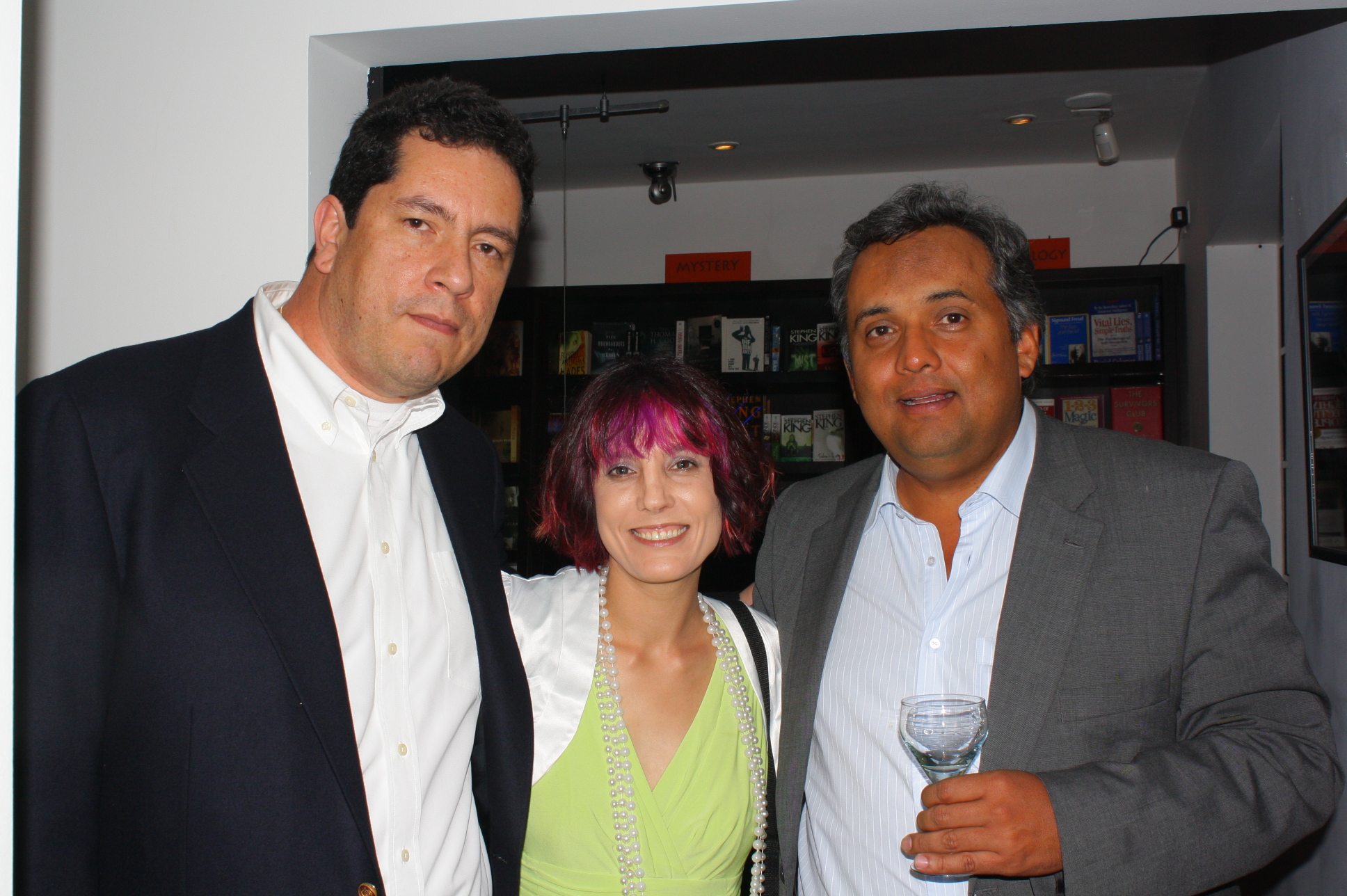
Dr. Gamboa looks really stern, but that’s not his nature at all – they just caught him in-between laughs.

with Dr. Gamboa and a friend

with Dr. Francisco Cabal, Orthopedic Surgeon, Medical Director of Clinica del Countrywith Ximena Reyes, RN

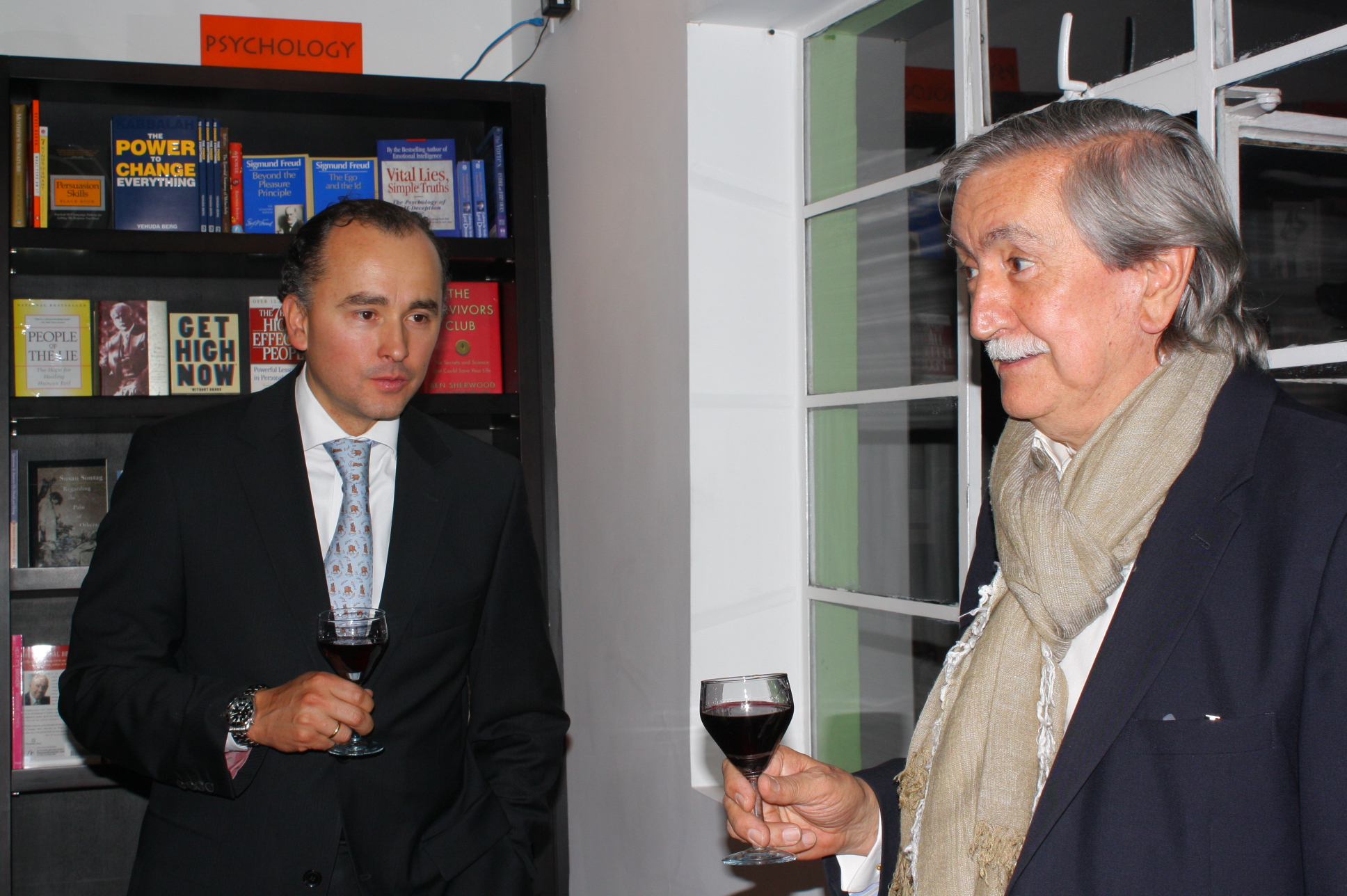
Dr. Roosevelt Fajardo (left) and Dr. Francisco Holguin

Talking with Frankie Jazz


As I mentioned before, Colombia is rich country for arts and culture.  I had the pleasure of speaking with Frankie Jazz (Jose Vergara) while in Cartagena about what he’s doing now.

For people who aren’t familiar with Frankie Jazz, the name comes from a children’s book character created by Vergara and his brother while they were in school. (Very cool.. I don’t know what you were doing in school but Cartagena Surgery wasn’t writing books yet.)

These days, the almost thirty year old Vergara is clean cut, and working as the publicist for the House of Design for Ketty Tinoco, a well-known Cartagena designer (and incidentally, his mother.)

His influence on the house of design is apparent – the website, and promotional materials have a slick, professional and modern feel. His talents are certainly being put to good use – though I am certain that his devoted fans would love another album.

I’d like to Thank both Mr. Vergara and Ketty Tinoco for taking the time to talk to Cartagena Surgery.

Talking with Ketty Tinoco


Cartagena’s Fashionable Best

One of the things that I really enjoy about Colombia is the accessibility to arts, literature, entertainment and to those that provide  these contributions to local culture.  As a small country of only 45 million, there’s just a greater chance to encounter these national treasures.

Today was another example of that – as I had the opportunity to talk to one of Cartagena’s home grown fashion designers, the fabulous Ketty Tinoco and her son, Jose Vergara.

This wonderful chance encounter with the queen of elegance with her trademark crisp cool linens was absolutely thrilling.  As long time friends and readers know – medicine/ surgery are my life, and my obsession – but clothing design and fashion are a close second.  It all stems from an elective course at Dalhousie University many (too many!) years ago when I was just a few classes short of graduation.
Dalhousie University is well-known to everyone (except this gringa) for its costume studies program – and after taking one class – I was hooked forever with a love of design, fashion and fabric.
Some of you have read about my love of native Bogotano fashion, and how I
haunted the shop windows during the months I lived in Bogotá.  Now, I turn my eyes to the coast..

So here I am, sitting next to Ketty Tinoco as she gives me a sneak peek of her upcoming collection – coming out September 1st.   (Yes – the collection is luscious, beautiful – and no – all of you will have to wait – no sneak peeks here at Cartagena Surgery.)  Ms. Tinoco speaks just a little English, and while looking at her lovely, lovely pieces, all of my adjectives in Spanish just desert me.  I am speechless with wonder as I look at the way the fabric is soft, yet crisp, simply elegant yet beautifully detailed.
All the fancy terms I learned in school – are instantly erased – I have no words to describe the loose drape, the relaxed yet classic looks.

Her clothing evokes images of romantic evenings in the steamy Cartagena heat – a return to the glamour of the past. Lauren Bacall, Casablanca, Marlene Dietrich and Katherine Hepburn in those fabulous trousers, this is what it makes me think of.  A time when people dressed to impress and dressed for dinner.  And these clothes  make me long for that.

While all the pieces are beautiful, there is one piece of such classic beauty that my heart just stops – this dress it calls to me, it speaks to me, it evokes images of screen legends and black and white films, of forgotten eras.  This dress is so amazingly beautiful and brings to mind such lovely feelings – that tears come to my eyes.  And that is fashion, my friends.

from the Ketty Tinoco Collection

Now that I’ve had a chance to share my lovely afternoon with you – let me share a little more about the charming, elegant, talented Ms. Tinoco.  She started sewing at home over thirty years ago (just barely 52, and certainly doesn’t look it!)

Since then she has earned a reputation for her style and extensive use of washed linens in her work, as one of Cartagena’s best known designers.

Ketty Tinoco

 (Centro Historico)

Calle Baloco, Edif.
Pineres Local 1

Cartagena, Colombia

57 5 664 0525


Ketty Tinoco’s boutique in historic El Centro

Hotel Hilton Cartagena, Local H

Cartagena, Colombia

57 5 665 0660 ext 217

Website:  http://www.kettytinoco.com

This video is in Spanish – but you certainly don’t need to know Spanish to love her style!

Dr. Richard Eljadue Martinez, DDS


My readers may remember Dr. Richard Eljadue Martinez, DDS one of the dentists profiled in Hidden Gem.   He still maintains an active dental practice in the heart of Cartagena.

Dr. Eljadue also has a small hotel, Portal de San Diego in the middle of the historic district of the El Centro district.  (This is where I have been staying during my return visit to Cartagena – and as you should know by now, No – not for free – that’s not my style*.)

Portal de San Diego

Calle 2nd (segundo) de Badillo No 36 – 17

email: portaldesandiego@gmail.com

Portal San Diego is a charming hotel, a typical property with just a few rooms in the heart of one of the most interesting areas in Cartagena.  It is more than miles away from the high rises of Bocagrande and the modern, all access beach resorts lining the coastal highway – it is a world away.  The rooms are clean, comfortable and European in style – fast internet, hot water and air conditioning make it the perfect hideaway for a writer like myself with a myriad of nearby restaurants and cafes to supplement the complimentary breakfast.  It’s been such a nice place to relax and write while I’ve been here in Cartagena that it would be a crime not to mention it.

Since my first visit to interview Dr. Eljadue – he has added a small bar, Bar del Portal aside the hotel.  It’s a cozy, intimate sort of place, with a retro early 1960’s feel; everything is sparkling clean with crisp lines, and cool lighting.  Frank Sinatra or any of the Rat Pack would be perfectly at home in its relaxed atmosphere.  Normally the music is pure Colombiano – but for me, they’ve added a bit of Puerto Rican Reggeaton to the playlist.

One of the bartenders, Jesus (not pictured) looks a lot like the singer, Prince when he was younger and we joke about that as we sip Aguila and enjoy the evening.

Bar del Portal

*I do not accept gifts, payments or gratuities from any of the physicians or dentists profiled.  *

Another beautiful Sunday in Bogota


where ten million people stop to enjoy the day, walk and ride bikes – spend time with their families.  My friends are off flying kites today.  How old were you when you last flew a kite?  (I know I was about ten years old – and had some keen idea about combining it with my skateboard.  Needless to say – it didn’t go well.)  That’s Bogotá in a nutshell – where traditional so-called ‘small town’ values like Sunday afternoons with family is enmeshed with big city sophistication.

El Dorado Airport,  Avianca terminal –

waiting for my plane to Cartagena.  Leaving Bogotá always breaks my heart just a little – all of Colombia has this effect, but particularly Bogotá.  Colombia is a country looking forward, full of hope and opportunities for the future.  Some of my  fellow American friends here liken it to The United States in the early 80’s kind of feel – and that’s very true.  You don’t realize how much that feeling is now missing in the United States until you come here.  The daily weight of inflation, unemployment and our continuing recession drag down on all of us so deeply that we miss the small pleasures all around us.

But Bogotá, and Bogotanos still have that zest for living – with continuing economic growth, and expanding financial opportunities.  Everywhere you turn – there is expansion, improvement and new ventures being created.  It’s an exciting time to be in Bogotá.  The medical industry here in no way exempt from all of this – several hospitals unveiling new programs, expansion plans and new technologies.  It’s refreshing to see after several years of watching continuous downturns, program closures and economic hurt at home.

Of course, as a very large city, Bogotá struggles with many of the same problems as its global counterparts – poverty, inequity, and other social problems remain commonplace.  But for the medical tourist – and medical writers like myself – it remains an interesting and fascinating place for opportunities for state-of-the-art health services and medical care.

Dr. Palaez, same surgeon, new role


Attended the monthly thoracic surgery meeting this morning to discuss cases.

The rest of the morning was spent with Dr. Palaez, rounding and seeing patients.  It was an interesting contrast – at Cardioinfantil, we saw consults and patients in his role as Vascular Surgery fellow before proceeding to Clinica del Country to see patients in his role as the attending Thoracic Surgeon.  It was a different perspective for me and I asked Dr. Palaez about it.

He explained that while many of his colleagues thought it was interesting that he would return to training at this stage in his life (he is 49 and has been a practicing thoracic surgeon for many years), that he was really enjoying his training.  He believes strongly in lifelong learning but is very pleased to be close to the completion of his vascular surgery training.  He has enjoyed the experience but is looking forwards to being a practicing vascular surgeon.  (He is currently training with Dr. Jaime Camacho, who is himself, a hybrid surgeon with training in both vascular and cardiac surgery.

During rounds, we saw several post-operative patients as well as consultations in the emergency room with a wide variety of vascular disease.

In the operating room with Dr. Mauricio Palaez, thoracic surgeon


Clinica del Country,

Caught up with Dr. Palaez one evening to accompany him to the operating room. As we previously mentioned, he is completing his vascular surgery fellowship this fall, and is a busy fellow indeed.  He has an upcoming trip to Barcelona, Spain for two months training in endovascular surgery prior to completing his fellowship this Nov/Dec.

When I caught up to him, Dr. Palaez was seeing consulting in the emergency room prior to heading to the operating room for a bilateral sympathectomy.

In the operating room,  all standard time out, and pre-operative protocols were followed.  Anesthesia in attendance with good heart rate control – and appropriate hemodynamics, no hypoxia.

Case completed quickly, surgical sterility maintained. No intra-operative issues.

Surgical apgar score 10 at completion of case.

Book Party!


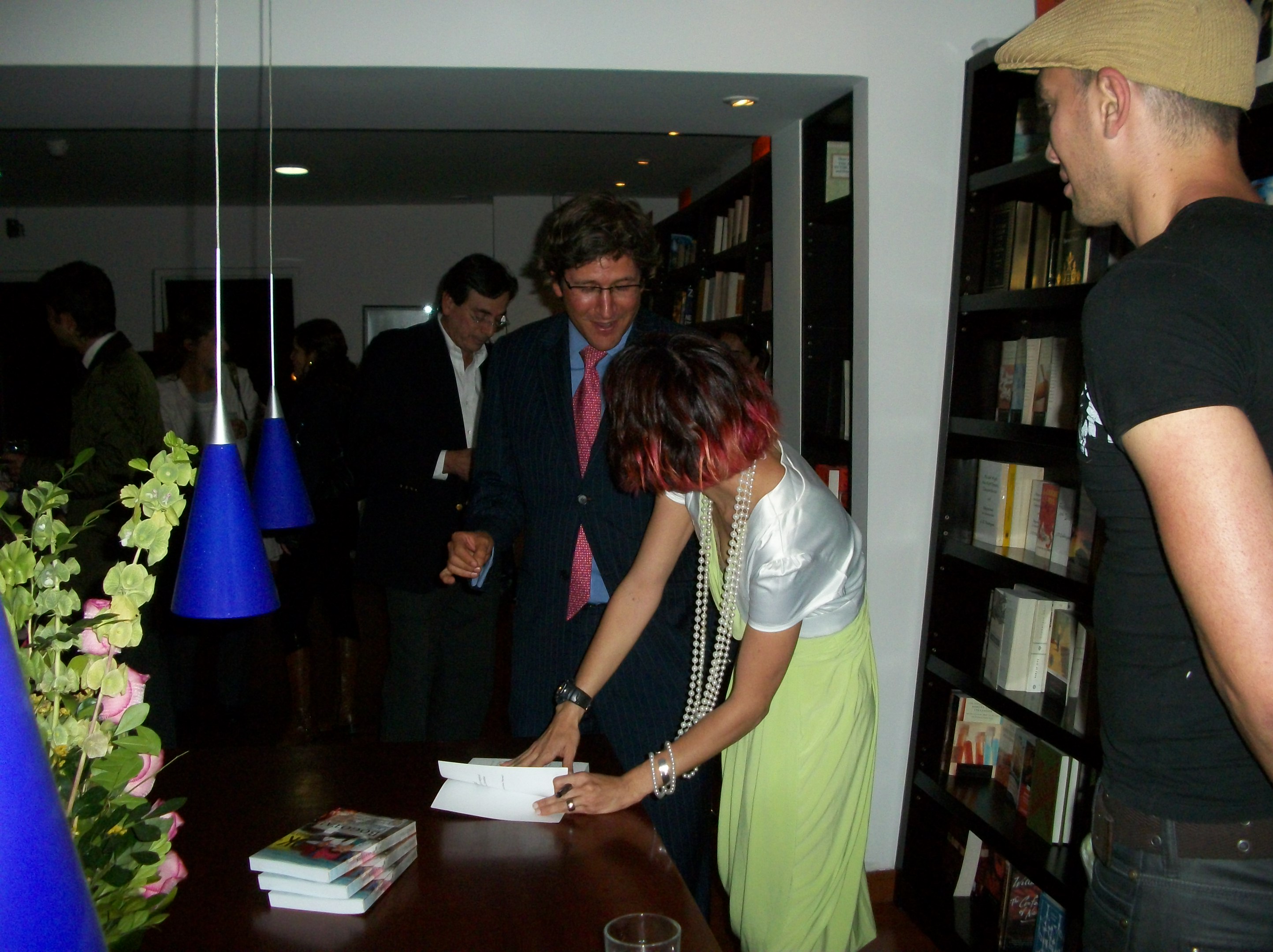
Signing a book for Dr. Freddy Sanabria


Author’s Cafe,

Bogotá, Colombia

Had a wonderful event to share my book with and thank all of the people who made it possible.  (No surgeons, no book).  It was wonderful to see everyone – and I want to thank all the surgeons – who literally came straight from surgery to give their support of this project.  Some of the great friends I have made from all walks of life (outside the hospital) were also there – which means a great deal – I know that I live and breathe writing and surgery, but I also know that this is not true for most people.

That’s been the theme of all of my visits to Colombia; kindness, caring and support.  So many people; from surgeons, nurses, to taxi cab drivers and even random strangers in passing have been kind to the little (sometimes lost) American.

What’s next?

About 1/3 complete on formatting the e-version.  It’s a tedious job, but once it’s complete – it will give me the freedom to do instant book updates as needed.

Also hoping to translate the book into Spanish versions. It’s been difficult to find someone due to the technical/ medical language.

Now that the Bogotá project is essentially complete – I anticipate that this blog may change in focus – similar to Cartagena Surgery.  There will be more of a focus on medical tourism and medical news, now that interviews will be few and far between.  (Never done entirely.)


More scrutiny for medical tourism and patient safety.


Another article detailing the importance of investigative medical writing projects such as the Bogotá book.  Hopefully, this increased scrutiny will bring more attention to projects such as this – and the need for a comprehensive, detailed review of services by qualified individuals.

Maybe this will bode well for a possible Cali book in the future.

Another fraudulent surgery clinic


this time in Los Angeles, where several individuals were posing as licensed physicians.  A sting operation was conducted after several patient complaints – and injuries.  The story in the Manila paper is here. The LA Times initially broke the story.

Notably, the clinic operators had posted fake degrees and credentials on the walls.  (This is why it’s important to independently verify credentials with state licensure boards).  Anyone with a scanner, and basic computer literacy can print up and fake any document they want..

I’ll keep posting these stories as a reminder for people to use credible sources for information about their doctors (such as well researched books like mine) or licensure boards.

(While most of the stories appear to originate in the United States I think this is probably just a result of our media interests – and what makes national and international headlines.  There are frauds everywhere, who just want people’s money – they don’t care if people get hurt or die in the process.

Unfortunately, many of these people operate for years before they get caught, if ever.

In international news, the need for investigation and medical scrutiny of medical tourism is becoming more and more apparent.  (I told you that Cartagena Surgery was a trendsetter.)  Now, if only we could translate that into book sales.

Putting your money where your mouth is..


or more accurately, less money – more like putting your health in the hands of the people I’ve spend the last year writing and talking about.

Many people have asked me that question – “Gee – but would you go to Colombia and have these physicians take care of you?”  And, it’s a legitimate question, after all – it’s all well and good to send other people to far off places (foreign countries!) when it isn’t your own health and well-being at stake.  But what would the writer do in a similar position?  So I’d like to answer that question here.

Yes, Yes, I would and yes, I have.  In fact, this very question is what prompted my investigations into health, medicine, surgery and surgeons in Bogota.  I don’t usually disclose this information because I don’t think it is germaine to the majority of the discussions (it is briefly mentioned in the book) – since most of my previous posts have been more on the basis of rational inquiry then personal accounts.  It’s also difficult for me to talk about private matters – but today, for the purpose of legitimacy and credibility, I’ve decided to set my privacy aside.

I usually omit the ‘personal experience’ because I find it less than helpful for patients since our experiences are not objective, but are rather colored with previous experiences, our culture and upbringing as well as our expectations.  I don’t believe in “patient testimonials”, per se because I feel it gives a false representation.  After all, a charismatic individual may not be as skilled or talented surgically as someone who is less loveable, so to speak.

But, I do think that it’s important in this instance for me to share some of these experiences with readers, because it speaks to the validity of my research – I have interviewed and been in the operating room with these individuals, and have knowledge that many of you (the readers) are not always privy to.  And knowing all of this, I elect to return to Colombia to see my surgeon here.

This week, I am having another CT of the abdomen to follow-up on a medical ‘issue’ I experienced while living on the island of St. Thomas.  Immediately after being diagnosed with this problem – when I had the choice of seeing doctors in nearby Puerto Rico, or Miami (where Caribbean patients often seek care) or going home to Duke – I chose to come to Bogotá.  I didn’t do it for cost – though as a person with very poor health coverage, that was certainly a factor, I did it as both part of my research and because of the absolute confidence I had in one of the surgeons I had met during the writing of the first book, in Cartagena.  (Dr. Hector Pulido).

After a month of worry (okay, to be honest – terror) while I wrapped up my life in the Virgin Islands – my first peace came as our plane landed in Bogotá.  I still had worries about my health, but I felt calmer than I had in weeks – since the first, fateful CT scan showed a rare abnormality.  This sense of security and well-being only increased with my interactions with the staff at Santa Fe de Bogotá, and under the care of my surgeon, Dr. Roosevelt Fajardo.  He had already communicated with me prior to my arrival by email, viewed my medical records and conferred with several other specialists.

Now, admittedly, my experience is colored by the outcomes, and I was extraordinarily lucky, for someone in my position.  I had been tentatively diagnosed (at my home hospital) with a serious malignant illness – and was gifted with a new diagnosis of a rare, but benign condition instead, which has made no impact on my daily life.  I take no medications, there is no sequelae or complications – and it appears that it is just a variation of ‘normal’ that woud have never been discovered if I hadn’t originally become ill in St. Thomas and had a CT scan*.

But, I know, in my heart of hearts, that had the outcomes been different – I still would have been in great hands – with caring, compassionate individuals who understood my fears and concerns.  That is worth its weight in gold – but being in Colombia, the entire experience cost considerably less than that.

I can also say – that if I ever needed heart surgery, lung surgery or any number of procedures (who know?  plastic surgery may be in my future..) that I wouldn’t hesitate to place myself in the care of any number of the fine surgeons profiled in my book.

* Transitory illness, now fully recovered and unrelated to current care.

Now in today’s litigious society, I probably need to put some sort of disclaimer that my results are not typical – usually people turn out to have the maladies they were originally diagnosed with.  But as I said – it’s a rare circumstance, and I had the benefit of having multiple specialists confer in my case – so as I said, I was lucky.  I also probably need to make a statement about safety and surgery, such as surgery always carries risk – and that bad things can happen no matter how great your surgeon is, or how good the facility is.  I hate having to put this stuff because people comes to me for answers, but unfortunately, there are no guarantees when it comes to things like this.  I hope I haven’t offended my readers, and I apologize because I feel that having to make these disclaimers cheapens the message.

Update:  18 August 2011

Dr. Fajardo contacted me this afternoon a few hours after my CT scan.  Results of my follow up CT scan show everything is indeed unchanged and remains a benign, if uncommon variation of normal.   This is greatly relieving, but more than that – part of a consistent pattern of genuine care and excellence in medicine.

Sorry to my friends at the paper – whom I had promised an in-operating room exclusive, if the situation had changed.  (Sorry for them, not for me!)

I hope that by sharing this more personal experience, I have been able to give some of my readers a little different perspective than what they are used to seeing here at Bogota Surgery.

Back to Bogota


Raleigh – Durham Airport (RDU) – A more personal post today for readers –

The nice thing about traveling to Colombia is that even though the distances are pretty far geographically, flight times are pretty short.  After a one hour flight to Miami, it’s just three short hours to Bogotá.  Despite that – Bogotá is certainly a world away from my quiet life in Virginia.

– Now I am here in the airport, beginning my journey back to Colombia, starting with a week in Bogotá, my favorite of all Colombian cities (so far!)  My adoration of Bogotá came as quite of a surprise to me – and still surprises me after all these months.  I’d enjoyed Cartagena – that beautiful, historic but steamy coastal city, but I expected that.  It has architecture, museums, monuments along with the ocean, and a latin-caribbean feeling that I like so much.  Anyone can love Cartagena with its elegant fortresses, warm sunny weather and welcoming residents.  No – Bogota is different.  It’s high mountain elevation (8000 ft) gives it a unique climate (eternal fall) with distinct rainy seasons. The city sprawl extends the entire basin of the foot of the mountains – the city itself is surrounded by a haze mix of cloud, smog/ pollution from its inhabitants..

No, my enjoyment of Bogotá was a complete surprise.  I had expected to tolerate the city, to endure the bustle, rush, the traffic and the very condensed humanity that is a city of ten million people.  It was, in my mind, a necessary evil as part of my research for writing the book.  I am many things, but a city girl?  Not hardly.  A more rustic/ rural / redneck gal could not be found, in northern Nevada, West Virginia and now, in the smallest of urban cities, a mere hamlet of southern Virgina.  I expected to be intimidated by the sheer volume of people; after all, I hate crowds, and busy public places. But somehow, it was the complete opposite – it was invigorating, intoxicating.

The very sophistication, the people, the life of the city was addicting in a way I never expected.  As three months turned to four, and then five – I kept expecting for my love affair with the city to fade or flame out.  But it hasn’t, and I am already mourning my return to the USA.

In Bogota Surgery news:

The New York Times has recently published an article talking about the HIPEC procedure as “bringing hope to patients**”.  In typical media fashion, they manage to interview the one surgeon who talks about the procedure in an exceedingly cavalier fashion – and the author of the article reinforces this with his terminology (which I find disturbing.)   Did he really need to describe the surgery thusly:

“After slicing the man’s belly wide open, he thrust his gloved hands deep inside, and examined various organs, looking for tumors. He then lifted the small intestine out of the body to sift it through his fingers.

As he found tumors, he snipped them out. “You can see how this is coming off like wallpaper,” Dr. Lowy said as he stripped out part of the lining of the man’s abdominal cavity.

After about two hours of poking and cutting, Dr. Lowy began the so-called shake and bake. The machine pumped heated chemotherapy directly into the abdominal cavity for 90 minutes while nurses gently jiggled the man’s bloated belly to disperse the drug to every nook and cranny. ”

Blatent sensationalism in my opinion – certainly guaranteed to sell papers.  If they terrorize a few patients in the process, I guess they don’t care..  Using patient friendly terminology doesn’t mean writing an article like a Stephen King novel..  But then – I am guessing that Andrew Pollack has never had a close family member or friend facing this sort of illness.

The author also does a poor job researching his sources or the actual clinical indications for the procedure, but Bogota Surgery readers will be interested to note the cost of the procedure in the USA ranges from 20,000 to 100,000 – which certainly provides plenty of incentive for medical tourism.

However, despite this fantastic language – the authors voice serious concerns about the effectiveness and appropriateness of this procedure.  As you know, I have been following the available research and will continue to do so – to bring readers more information about this procedure; it’s feasibility and effectiveness.

** Since publishing my initial article on HIPEC with hope in the title, there have been a spate of articles using that terminology, as well as several blatent rip-offs of my original article.  The success of this article has been surprising, as well as the level of plagerism with on-line media, including large, well-known media outlets.

Another sad story


of a preventable/ unnecessary plastic surgery death in a young woman in Massachusetts.  In this instance – yet again – the ‘surgeon’ performing the breast augmentation wasn’t a surgeon at all – he was a “family practitioner”.

He may be a doctor – but specialty specific training is an absolute must – along with board certification.  Medical doctors (in medicine specialties) as opposed to surgeons spend only a very limited time in the operating room during medical school, primarily as observers.  This is not adequate preparation!

Board certified specialty trained surgeons on the other hand, spend years training in the operating room – performing surgeries under the direct supervision of more experienced surgeons before completing their surgical residencies.

Please do your homework – as we’ve discussed in several previous posts; research your physician and evaluate all health claims.  Your life, health and well-being are a stake.


Interview


Just had a really nice visit with James Gherardi, and his cameraman from the local TV station, WSET – 13 to talk about the book.  Now if only all my poise hadn’t suddenly fled – leaving me an awkward mess!  Gratefully, all my loyal readers know that despite all outward appearances, I really am a capable, competent individual with full use of my faculties.

Lets hope viewers are as kind.

It is scheduled to air as just a quick segment this evening at 6pm.. and let me warn my devoted readers – yes, I had a hair tragedy, but it’s only temporary (and for a good cause!)..

The Chicago Tribune, Medical Tourism and Patient Safety


The Chicago Tribune recently published an article about medical tourism  by Alexia Elejalde Ruiz that quotes Joseph Woodman pretty heavily.  He writes about medical tourism and quality but from more of a statistical and policy perspective (no medical background.)

The article was written to give tips to potential medical travelers, and mentions JCI accreditation and standards etc.  I think this shows a growing awareness among the media and consumers that there is a need to regulate this industry to protect patients from harm.

Unfortunately, this article did not go into more detail, and despite mentioning Colombia in the article subtitle, there was nothing further about Colombia in the article.

Too bad – as my long time readers know – my entire purpose and mission in writing and researching this book was to provide consumers with exactly this sort of information  – from first hand observation.

“Hospitals riskier than airplanes”


It looks like our last post,  Reputation, Rankings and Objective Measures was more timely than I ever expected.  While I always feel urgency over patient safety issues – now the news media has joined in after the release of the latest World Health Organization report.  For more about this report – see our posting at Cartagena Surgery.  Hopefully, this media attention will help the public to understand why books such as this are needed.

In other news – the first shipment of books for transportation to Bogotá has arrived!

World Health Information & Patient Safety


As Bogotá Surgery readers know, we were just talking about the  relevance of hospital rankings, and scorecard criteria for patient safety and optimal patient outcomes.  In particular, we were talking about the use of this criteria  (along with Core Measures) as just one of the ways surgeons, hospitals and surgical programs are evaluated for Bogotá! a hidden gem guide to surgical tourism.

Now several news outlets have picked up the story under the headline, “Hospitals riskier than airplanes.”

Reputation, Ranking and Objective Measures:


Reputation,  Rankings and Objective measures

The top-10 heart and heart surgery hospitals (according to US News 2011) were as follows:

  1. Cleveland Clinic
  2. Mayo Clinic
  3. Johns Hopkins
  4. Texas Heart Institute at St Luke’s Episcopal
  5. Massachusetts General
  6. New York Presbyterian University
  7. Duke University Medical Center
  8. Brigham and Women’s Hospital
  9. Ronald Reagan UCLA Medical Center
  10. Hospital of the University of Pennsylvania

(US News, July 19, 2011)

The First shall be First..

Well, the latest US News hospital rankings are out – and as usual, John Hopkins is at the top of the list – as they have been for the last seventeen years.  Or are they on the top of the list because they were ranked #1 for the previous sixteen years?

How much do these or any rankings actually reflect the reality of the health care provided?  What are they really measuring?  These are important questions to consider.  While US News uses these rankings to sell magazines, other people are using these results to plan their medical care.

 So, what do these rankings or studies show[1]?  The answer depends on two things:

1.  Who you ask.  2. The measure(s) used.

Reed Miller, over at Heartwire.com reported the results of a study by Dr. Ashwini Sehgal over at Case Western Reserve examining the US News Rankings back in 2010 (and re-posted below.)  Dr. Sehgal explains that much of what the US News is measuring is not scientific, nor objective data – it’s public opinion, which as we all know, may have little basis in actual facts.  Ask any fifteen-year- old girl who is the most qualified candidate for president – now imagine Justin Bieber in the White House[2].  An extreme example, to be sure – but one that fully illustrates the pitfalls of relying on this sort of subjective data.

News versus Tabloid

This isn’t the first time that the magazine has come under scrutiny for the methodology of their ‘ranking’ practices.  Teasley (1996) exposed similar flaws in their ranking schemes almost fifteen years ago.  Green, Winfield, Krasner & Wells (1997) explained in JAMA that there
were additional limitations to US News approaches due to a lack of availability of standardized data, despite the magazine using what they considered to be a strong conceptual design.  They cite the same concerns with the weight given to reputation as a majority deficiency.

However,  these significant oversights does not prevent the media and hospitals from continuing to present their results as a legitimate measure of  performance. In fact, more people know about these rankings than they do about government data collected for the same purpose.

Core Measures

Compare this well-known ranking, with governmental attempts to quantify and compare American hospitals.  Medicare and Health and Human Services quantifies and ranks hospital  performance using a ‘score card’ scenario known as “Hospital Compare.”

While this government system is far from perfect since it relies heavily on individual physician documentation, it is an evidence-based measurement tool, making it far more objective.  The government rating system uses a series of specific criteria called Core Measures.  These core measures are used to evaluate adherence to accepted treatment strategies for different conditions such as heart failure, heart attack, and pneumonia.  This data is then published on-line for consumers.

The advantages to measurement tools such as Core Measures is that it an easily applied checklist type scoring system.

For example, the core measures used to evaluate the appropriateness of treatment for an acute myocardial infarction (heart attack) are pretty clear cut:

– Amount of time in minutes for patient to receive either cardiac cath or thrombolytic drugs “clot busters”

– How long (minutes) for patient to receive first EKG after presenting with complaints consistent with AMI

– Did patient receive aspirin on arrival?

– Did patient receive ACE/ ARB for LV dysfunction?

– Did patient receive scripts for beta blockers, ACE/ ARB, aspirin at discharge?

As you can see – all of these measurements are clear, easily defined and objective in nature.  The main problem with core measures in many institution is getting doctors to clearly document whether or not they instituted these measures.  (But that too reflects on the institution, so hospitals with multiple staff members not adhering to the national guidelines will have lower scores than other facilities.)  In fact, this is the main criticism of this measurement tool – and this criticism often comes from the very doctors that omit this data.  (In recent years – hospitals have tried to address this shortcoming by making documentation an easier, more streamlined process – and allowing other members of the health care team to participate in this documentation.)

Then this data is compared to other hospitals nationwide, with subsequent percentile ratings, and status.  Ie. a hospital may rank higher or lower than national average for death rate or re-admission for heart attack, pneumonia, post-surgical infection or several other diagnoses/ conditions.  Consumers can also use this database to compare different facilities to each other (such as several hospitals in a local area).

The accessibility and publication of this data for health care consumers is a very real and meaningful public service.  This allows people to make more informed choices about their care, without relying on third-party anecdotes, or reputation alone.

How does this tie in with surgical tourism?  (or what does this have to do with Bogotá Surgery?)

As part of my efforts to provide objective, unbiased information on the institutions, physicians and surgical procedures in Bogotá, Colombia, I applied the Core Measures criteria as part of my evaluation.  I used these measures not on an institutional level, but on an individual provider level – to each and every surgeon that participated in this project.

However, core measures (NSQIP) was not the only tool I used during my assessment.  I also used several other measurements to get a fair/ well-balanced evaluation of the providers listed in my publication.  (Other criteria used  as part of this process will be discussed more fully in a future post.)

Surgical tourism information needs to be clear, objective and meaningful to be of use to potential consumers.  Reputation alone is not sufficient when considering medical treatment either in the United States or abroad – and consumers should seek out this information to help safeguard their health.

Article Re-post from Heartwire.com

Popular best-hospital list tracks subjective reputation, but not quality measures

April 20, 2010 | Reed Miller

Cleveland, OHUS News & World Report‘s list of the top 50 hospitals
in the US reflects the subjective reputations of the institutions and not
objective measures of hospital quality, according to a new analysis [1].

The magazine’s ranking methodology includes results of a survey of 250 board-certified physicians from across the country, plus various objective data such as availability of specific medical technology, whether the hospital is a teaching institution or not, nurse-to-patient ratios, risk-adjusted mortality index based on Medicare claims, and whether the American
Nurses Credentialing Center has designated the center as a nurse magnet.

In his analysis of the US News rankings system, published April 19, 2010 in the Annals of Internal Medicine, Dr Ashwini Sehgal (Case Western Reserve University, Cleveland, OH) points out that previous investigations have compared the US News rankings with external measures and found that highly ranked cardiology hospitals had lower adjusted 30-day mortality among elderly patients with acute MI, but that many of the high-ranked centers scored poorly in providing evidence-based care for patients with MI and heart failure. Also, performance on Medicare’s core measures of MI, congestive heart failure, and community-acquired pneumonia were frequently at odds with US News rankings.

Sehgal sought to examine a broader range of measures internal to the US News system and “found little relationship between rankings and objective quality measures for most
specialties.” He concludes that “users should understand that the relative standings of US News & World Report‘s top 50 hospitals largely indicate national reputation, not objective measures of hospital quality.”

Sehgal performed multiple complementary statistical analyses of the US News & World Report 2009 rankings of the top 50 hospitals in the US, as well as the distribution of reputation scores among 100 randomly selected unranked hospitals.

He examined the association between reputation score and the total score and the connection of objective measures to reputation score. According to Sehgal’s analysis, the statistical association is strong between the total US News score and the reputation score. The association between the total US News score and total objective scores is variable, and there is minimal connection between the reputation score and objective scores.

The majority of rankings based on reputation score alone agreed with US News overall rankings. The top five heart and heart-surgery hospitals based on reputation score alone were the same as those of the US News top five heart hospitals (Cleveland Clinic, Mayo Clinic—Rochester, Johns Hopkins University, Massachusetts General Hospital, and the Texas Heart Institute), and 80% of the 20 heart and heart-surgery hospitals with the best reputation scores were also on the US News top-20 heart and heart-surgery centers.

Objective measures were relatively more influential on cardiology centers’ total scores than in some other categories, but reputation still carried a lot more weight than objective measures. Sehgal used the nonparametric Spearman rank correlation p value to assess the univariate associations among reputation score, total objective-measures score, and total US News score. The p2 value indicates the proportion of variation in ranks of one score that are accounted for by the other score.

Additional Resources and References

1.  Teasley, C. E. III (1996).  Where’s the best medicine? The hospital rating game. Eval Rev. 1996 Oct;20(5):568-79.

2. Green J,  Wintfeld  N., Krasner M.  & Wells C.  (1997).  In search of America’s best
hospitals. The promise and reality of quality assessment. JAMA. 1997 Apr 9;277(14):1152-5.

3. Sehgal, A. R. (2010). The role of reputation in U.S. News & World Report’s rankings of the top 50 American hospitals. Ann  Intern Med. 2010 Apr 20;152(8):521-5.


[1] US News may be the best known, and most widely published source, but there are multiple
studies and reports attempting to rank facilities and services nationwide.

[2] This is probably not a fair analysis given the current state of American politics.

Lifestyle Modification after Bariatric Surgery


Lifestyle modification after bariatric surgery is one of the cornerstones for successful and sustained weight loss, and healthy living.  However, the majority of emphasis is placed on dietary changes – as a result of the surgical alterations to stomach capacity.  While dietary modification for healthy eating (energy intake) is extremely important – we are also going to talk about the other part of the equation for both weight loss and healthy living: Exercise (energy expenditure).

Exercise and physical fitness are critical for multiple reasons – beyond initial weight loss, but many people often question the ability of the morbidly obese to exercise vigorously (and safely).  A new study by Shah et. al (June 2011) in Obesity magazine examines this concept.  Shah and his team of researchers divided gastric bypass patients and gastric banding patients into two groups ;  a control group receiving standard therapy and a high intensity exercise group.  The findings confirmed that physical fitness is both possible and beneficial for these patients.

Since both the original article and several articles discussing these finds are paid/ subscription sites, I have re-posted from Medscape (which is more freely accessible for most people.)

For more articles on Bariatric Surgery, see the sidebar for our archives.

Rigorous Exercise May be Feasible after Bariatric Surgery

Laurie Barclay (Medscape)

July 15, 2011 — Rigorous exercise may be feasible and beneficial to maintain weight after bariatric surgery, according to the results of a randomized controlled trial reported online July 7 in Obesity.

“[W]e didn’t know until now whether morbidly obese bariatric surgery patients could physically meet this goal,” said senior author Abhimanyu Garg, chief of nutrition and metabolic diseases at University of Texas Southwestern Medical Center at Dallas, in a news release. “Our study shows that most bariatric surgery patients can perform large amounts of exercise and improve their physical fitness levels. By the end of the 12 weeks, more than half the study participants were able to burn an additional 2,000 calories a week through exercise and 82 percent surpassed the 1,500-calorie mark.”

The investigators studied the tolerability and efficacy of high-volume exercise program (HVEP) in 33 obese, postbariatric-surgery patients who had undergone Roux-en-Y gastric bypass and gastric banding. Mean body mass index (BMI) was 41 ± 6 kg/m2. Participants were assigned for 12 weeks to an HVEP (n = 21) or to a control group (n = 12). All participants were advised to limit energy intake, and the HVEP group was also counseled to take part in moderate-intensity exercise resulting in energy expenditure of at least 2000 kcal/week. Repeated measures analysis allowed determination of treatment effect.

In the HVEP group, more than half (53%) of participants expended at least 2000 kcal/week during the last 4 weeks of the study, and 82% expended at least 1500 kcal/week. Compared with the control group, the HVEP group had significant improvement at 12 weeks in step count, reported time spent and energy expended during moderate physical activity, maximal oxygen consumption relative to weight, and incremental area under the postprandial blood glucose curve (group-by-week effect: P = .009 – .03).

“We found that participants in the exercise group increased their daily step count from about 4,500 to nearly 10,000 so we know that they weren’t reducing their physical activity levels at other times of the day,” Dr. Garg said. “We also found that while all participants lost an average of 10 pounds, those in the exercise group became more aerobically fit.”

Some quality-of-life scales improved significantly in both groups. The groups did not differ significantly in changes in weight, energy and macronutrient intake, resting energy expenditure, fasting lipids and glucose, and fasting and postprandial insulin concentrations.

“HVEP is feasible in about 50% of the patients and enhances physical fitness and reduces postprandial blood glucose in bariatric surgery patients,” the study authors write.

Limitations of this study include short duration, small sample size, dropout rate higher in the control group vs the HVEP group, dietary and exercise counseling provided at an individual level and not at the group level, and use of an unsealed pedometer to measure physical activity.

“Whether a HVEP helps to maintain weight loss and improvement in comorbidities in these patients remains to be evaluated in long-term studies,” the study authors conclude. “The studies also need to assess how exercise over the long-term effects factors that influence energy balance including energy intake, nonexercise activity levels, body composition, metabolic rate, and gastrointestinal hormones related to satiety and hunger.” [end of article].

Interestingly, the exercise group did not lose more weight than the control group – but as many people know – exercise and physical fitness are important for more than just weight maintainance.

Aerobic exercise, in particular is important for cardiovascular health.  Physical activity is also important for bone and muscle strength and general performance status and maintenance of activities of daily living (ADLs).  All of these contribute to the overall quality of life for individuals.

Independent Authors & Writers


Excited to report that I have received “Book of the Day” on Independent Authors & Writers.org. You can check out their facebook site here.

I’ve also added a link to their blog, here at WordPress.

As many of my long-time readers know, it’s very difficult to get books like this published by commercial publishing houses – since it’s considered a ‘niche’ title with limited marketing potential.  Of course, I hope to prove them wrong but I am grateful to organizations like the Independent Authors for giving unknowns like myself a chance to be discovered by the reading public.

For all my Colombian readers, I am bringing copies down to Bogotá next month – they will be available at Authors Cafe – Calle 70, No. 5- 23.  (Otherwise, it’s about 30 dollars to have a copy of the book shipped from the US.)

Final drafts.


Looks like I am getting closer to the finish line; I submitted what is (hopefully) the last and final draft last week.  After one last round of review – it will be off to the publisher.. (This is the most frustrating part of the process – it’s all formatting issues – unrelated to content.)

Otherwise – the book looks pretty darn good!

Proof copies!

Proof copies!!


Peri-operative mortality with/after TAVI for aortic stenosis


More on TAVI: A newly published analysis of the existing/ reported data for peri-operative mortality after transcatheter aortic valve implantation looking at 12 previous studies was recently (June) published in the journal of Interventional Cardiology.  (While the study looks at the causes of death – we here at Cartagena Surgery – are going to talk about the rate of death in this study.)

Article information:

Causes of Peri-Operative Mortality After Transcatheter Aortic Valve Implantation: A Pooled Analysis of 12 Studies and 1,223 PatientsThe Journal of Invasive Cardiology 2011;23(5):180-184.

Raul Moreno, MD; Luis Calvo, MD; Pablo Salinas, MD; David Dobarro, MD; Jimenez Valero Santiago, MD; Angel Sanchez-Recalde, MD; Guillermo Galeote, MD; Luis Riera, MD; Isidro Moreno-Gomez, MD; Jose Mesa, MD; Ignacio Plaza, MD; Jose Lopez-Sendon, MD

Abstract re-posted below.

Background. In order to improve technique and to prevent serious procedural complications during transcatheter aortic valve implantation (TAVI), it is crucial to identify the causes of death of patients undergoing this procedure.
Objective. The objective of this study was to identify the causes of death during the procedure and at 1 month in patients with severe aortic stenosis undergoing TAVI.

Methods. 12 published studies with information about the causes of death in patients undergoing TAVI were selected. Overall, 1,223 patients were included in these studies, and 249 deaths were reported (119 at 1 month and 130 at > 1 month post-procedure).

Mortality during the procedure and at 1 month was 2.3% and 9.7%, respectively. The proportion of cardiac deaths was higher at < 1 month in comparison with > 1 month (56% versus 34%, respectively; p = 0.001). At 1 month, the most frequent causes of death were cardiac failure/multi-organ failure (24%), sudden death/cardiac arrest (17%), vascular and bleeding complications (17%), stroke (11%), sepsis (11%), and cardiac tamponade (10%). During the procedure, the most frequent causes of death were cardiac tamponade (39%), cardiac failure (21%), cardiac arrest (18%), and vascular and/or bleeding complications (18%).

In patients treated with the CoreValve system (Medtronic, Minneapolis, Minnesota) versus those treated with Edwards valves (Cribier-Edwards, Edwards-SAPIEN or SAPIEN XT valve, Edward Lifesciences, Irvine, California), deaths at 1 month due to vascular and bleeding complications were less frequent (3% versus 22%, respectively; p = 0.019), but those due to cardiac tamponade (26% versus 6%, respectively; p = 0.019), and because of aortic regurgitation (10% versus 0%, respectively; p = 0.03) were more frequent.

Conclusion. In this pooled analysis, mortality at 1 month after TAVI was 9.7%. The causes of death were widely variable, and of both cardiac and non-cardiac origin. There were some important differences between both devices in the cause of mortality.

How does this compare with conventional aortic valve replacement surgery (AVR)?

In cardiac surgery – surgeons use database calculators.  The most popular one is called the STS risk calculator to determine or estimate the surgical risk for specific patients.  This calculator is based on thousands and thousands of patients over decades of research to give approximate surgical risk of morbidity (post-operative complications) and mortality by looking at the planned procedure as well as patient risk factors (age, poor heart function, co-morbidities).  Other calculators include a European calculator called EUROscore, and a score used  by the VA (veteran’s hospitals.)

Well, how accurate are these calculators?

Interestingly enough – at the same time as the TAVI article, an article (Basreon et. al) discussing and comparing each of these calculators to actual results was published in the June 23 issue of the Annals of Thoracic Surgery.  (I’ve re-posted the abstract below.)

In their research – Basreon et. al. found the overall peri-operative mortality for aortic valve replacement surgery to be 5.9%  which is well under the 9.7% reported in the article by Moreno, et. al (re-posted above) for TAVI.

While the argument can be made that the higher than expected peri-operative mortality in the TAVI group may be secondary to other factors (patient condition at time of TAVI) without more information on patient demographics – it is hard to know.

I, for one, would like to know the average ages of patients in both groups – was the TAVI group made up of non-surgical fragile, 95 year-olds?  What specific factors raised their EUROscores? Was it overall heart function, or was it a specific co-morbidity?

It’s difficult to know since it’s a composite of other research data from multiple studies (and since TAVI is widely used in Europe, accounting for as many as 40% of all aortic procedures in Germany, for example) – this data may also reflect many of these patients (who are not frail elderly, for example.)

Reading through the Moreno study – there is little discussion of the actual patient population, except for one small paragraph (re-posted below). Both of these limitations are probably due to the nature of the study – where investigators were pooling the results of several different studies – which is a good strategy to get a wide overview.  However, this can make it impossible to go back and look at questions like ours, particularly if the investigators on the original, smaller studies didn’t record / report this information.

[my comments in brackets/ italics].  I have placed data within the article in bold or italics. 

“In this study, pooling the results of 12 series, mortality at 1 month in patients treated with TAVI was 9.7%, and mortality during the procedure was 2.3%. These data compare favorably with the predicted surgical mortality, since EuroSCOREs ranged from 12–28%.  [this is the risk calculator that Basreon et. al found that grossly overestimated risk in the study re-posted below.]

In the randomized PARTNER trial, a significant reduction (~20% absolute risk reduction) in the 1-year mortality was obtained for patients with severe aortic stenosis and considered not suitable for surgery due to a very high surgical risk when treated with TAVI in comparison with medical treatment. [as you know from previous discussions – medical treatment is exceedingly ineffective for this condition.  It would be more helpful if authors had better defined their ‘very high’ risk patient group since multiple studies show that cardiologists, etc. overestimate patient’s surgical risk.] 

Importantly, mortality significantly reduced through the years, from 2004 to 2010, probably reflecting not only the learning curve and the technical improvements, but also a better patient selection process. [meaning patients that are ineligible for surgery may also be ineligible for TAVI in some cases.]   This reduction in mortality over time has also been observed in single-center experiences.

Although not statistically significant, mortality at 30 days was higher in patients treated by transapical approach in comparison with transfemoral approach. Probably, the worse clinical profile of patients undergoing transapical TAVI justifies, at least in part, these findings.[7,12]

Ann Thorac Surg. 2011 Jun 23. [Epub ahead of print] Comparison of Risk Scores to Estimate Perioperative Mortality in Aortic Valve Replacement Surgery.

Source

Division of Cardiology, Veterans Administration Medical Center and University of Minnesota, Minneapolis, Minnesota.

Abstract  (bolding/ italics from original article)

BACKGROUND:

Transaortic valve implantation has recently been introduced as an alternative to aortic valve replacement (AVR) for high-risk patients with aortic stenosis. However, accurate assessment of surgical risk is critical for appropriate patient selection. We compared the accuracy of The Society of Thoracic Surgeons (STS) risk score, the European System for Cardiac Risk Evaluation (EuroSCORE), and the Veterans Administration (VA) risk score in predicting perioperative mortality after AVR.

METHODS:

We included 537 consecutive patients who underwent AVR for severe aortic stenosis at the Minneapolis VA Medical Center between 1997 and 2008. Observed and predicted perioperative (30-day) mortality rates were compared. Hosmer-Lemeshow goodness-of-fit test and receiver operating characteristic curves were performed to assess the performance of the scores.

RESULTS:

Perioperative mortality rate was 5.9% (n = 32). Predicted mortality rates for the EuroSCORE, STS score, and VA score were 15.6%, 3.6%, and 6.7%, respectively (p = 0.001). The EuroSCORE overestimated mortality in all patients, most notably among those with ejection fraction less than 35% (49% predicted versus 9% observed). The EuroSCORE had poor calibration (goodness-of-fit test p < 0.008), whereas the STS and the VA scores were well calibrated. However, all three scores displayed good discrimination characteristics per the areas under the receiver operating characteristic curves: STS score 0.73 (95% confidence interval: 0.69 to 0.77); VA score 0.66 (95% confidence interval: 0.62 to 0.70); and EuroSCORE 0.68 (95% confidence interval: 0.64 to 0.72; p > 0.05).

CONCLUSIONS:

The EuroSCORE substantially overestimates perioperative mortality risk in AVR, particularly in patients with low ejection fraction. These data have implications when deciding the appropriate intervention (transaortic valve implantation versus AVR) for high-risk aortic stenosis patients.

In general – the majority of the literature cites peri-operative mortality for AVR at 2.0 – 5.0% (but this is an average of ALL patients, making the calculators our best estimate of predicted risk.)

So what does this mean?

Clearly, when the data from Moreno et. al shows a thirty-day (peri-operative) mortality of almost 1 in 10 patients – it’s a signal we need to proceed with caution, and continue to follow the research.

1.  Since the authors report many of these patients at very high surgical risk (presumably due to cardiac status as well as co-morbidities) and 2. we know that in most people aortic stenosis progresses slowly  – it stands to reason that we need to consider intervening earlier in the course of the disease.  (Before the heart is significantly weakened).

For people with Aortic Stenosis – I’d want to get second/ third opinions from a cardiac surgeon before proceeding with any catheter based valve procedures.  I’d bring all of my information, and studies (echocardiogram results, lab results, medication lists) to have a serious talk to the surgeon about my surgical risk – (and ask him to calculate and show my risk based on the STS calculator).  I certainly wouldn’t let anyone make any decisions about my health/ care based on my age alone.  [we’ve talked about a ‘good 80’ versus a ‘bad 80’ or even a ‘bad 50’ before.]

Then, I would weigh all of the information – and do my best to make an informed decision.

Other posts about Aortic Stenosis/ TAVI/ AVR:

1. TAVI overview

2. TAVI: a stent scenario

3. TAVI recommendations

4. Aortic Stenosis and TAVI

5. Aortic Stenosis as Heinz 57

6. Aortic stenosis and surgery