Hello, my long lost friends..


Dear, dear friends and readers.. The last we talked – life had gotten a little messy..

I was in a dark place. I am sure that most of you remember, as I vomited all my pain and sorrow here. I ended up compiling all those painful, tortured writings into a personal diary of heartbreak and betrayal (now available here) as I made my way back to the surface.. It was devastating, a truly devastating and destructive experience..

But I’m like the unsinkable Molly Brown, I can’t stay down for long.. I am so fortunate to have an unbreakable, resilient spirit that always whispers, “You’ll be fine,” in my ears just when I need it. So, I’m back and doing okay. I bought a new motorcycle, got a new tattoo and I am making my way out in the world again.

People are going to hurt my feelings and do terrible things. That doesn’t reflect on me. But if I let these experiences change who I am, that does. So I won’t become hard or bitter – and I will certainly be hurt again. In the meantime, I am practicing riding my motorcycle – so I can start planning some new motorcycle trips around Colombia. (I had previously written about a motorcycle trip to Muzo, Colombia – but since it was during all of this drama – and involved some painful incidents, I deleted it.) I wish I hadn’t. Despite the unfortunate circumstances of the trip – the ride was breathtakingly beautiful – and challenging because the “road” is little more than a rock studded trail..

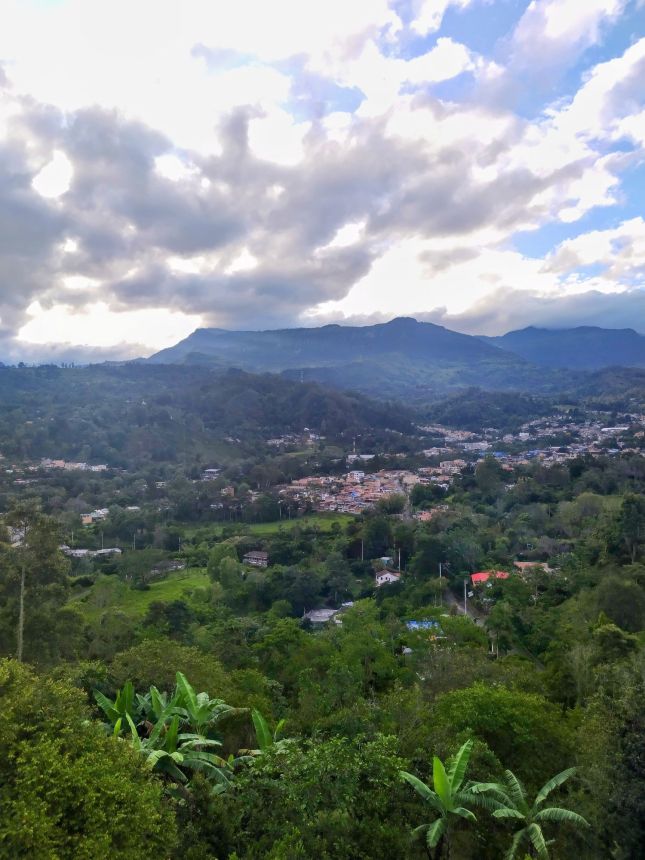
I’ve been spending more time out at Finca Ecklandia.. That’s the name of the finca that I am building up in the mountains.. Every time I go, the scenery takes my breath away..

I didn’t think that at 50 years of age, I’d ever post a picture of me in a swimsuit again – but anyway..

In the meantime, some random and wonderful things have happened too.. I had to work in the United States for a week – and as we were in line to board the flight – I recognized someone in the line. It was just after Avianca upgraded me to first-class.. So I ended up sitting only a few seats away from someone I have long desired to meet.

Of course, I didn’t want to be rude or gauche so I didn’t say anything other than a greeting as I took my seat.. But my delightful seatmate wouldn’t let my obvious fandom go – so when we were leaving, she took a picture of me with President Juan Manuel Santos..

He was delightful, charming and extremely gracious as I babbled to him, like a complete fool. I don’t care what folks think about him or his presidency – I’ve always been a fan.

So, I still struggle some days. This week was kind of rough for several reasons. But I am making my way – and I haven’t given up on my dreams – even if some of the biggest ones, like getting my citizenship was delayed. (I had hoped to get it this spring – but due to these particular circumstances, I am now not eligible for several years – and that’s one of the things that hurts the most out of all of this.) People will be selfish, hateful, and cruel but I will just keep on being me.

Las buenas y las malas: Or how Clinica Reina Sofia tried to kill my dad


Long time readers know that I have spent the last 13 years of my life evaluating, writing about and promoting medical care in Colombia. In addition to this blog, I have written multiple papers. presentations and books about my experiences and direct observations of care in the various facilities in Bogota, Colombia. The majority of experiences have been excellent.

I have been bringing clients here several years, including my own mother – who had a life-saving TAVR for critical aortic stenosis in 2019 at Fundacion Cardioinfantil. If she hadn’t had that procedure then, she would be most assuredly dead now. Instead, she is a vibrant 84 (almost 85) year old female who continues to run several miles every day, participate in a multitude of exercises (aerobics, zumba, dance etc.) and sports (pickleball, running group). 

Of course, when you are taking about something as vast and varied as health care, it’s never going to to be 100% all of the time, for every condition at every clinic, office or hospital. As part of the process of writing a book about healthcare and surgery in Bogota, I have spent literally thousands of hours in hospitals and hundreds of hours in the operating rooms around the city. I have interviewed hundreds of doctors and staff members. Some of these experiences have been so-so, some have been below average, and a very few have been bad.. Our recent experience at Reina Sofia on Calle 127 falls into the incredibly bad category. It was so bad and potentially life-threatening that it almost sounds like farce. Until it’s your dad. And the nurses that are ignoring the patient are ignoring your dad as he experiences crushing chest pain.. The clueless ER doctor is just irritated by your very existence because she wants to get back to chatting on What’s App – and continues to talk down to you. (I am fluent in medical spanish – and cardiology/ cardiothoracic surgery) and that seemed to anger her.)

When the nurse performing your dad’s EKG gets angry when your bradycardic, pale and dizzy dad doesn’t get his shirt back on fast enough so that he can dump you back in the waiting room and he can go on his break. Then when the cardiac enzymes are positive, they move you to the observation area and never check on him again. I had to check his chest pain/ vital signs/ everything while we wait, futilely for someone to help us. 

Nevermind oxygen saturations in the mid 80’s.. Seems like the plot of a bad 1980’s movie – as you realize that they are ignoring you, because you are a crappy old gringo, and that they would rather and leave….

Until you have to call a friend to help you leave the hospital so you take your family member to another hospital because the staff keeps ignoring you – and telling you “wait ten more minutes” hour after hour.. Until the so-called specialist rattles off a prepared speech, and doesn’t seem to listen when you dad explains that he still has chest pain (after receiving only tylenol in the ER). It was a devastating experience – and a terrible learning experience.

I freely admit it was my mistake. I initially wanted to go directly to Clinica Shaio when my mom called me – but after thinking about the distance – I made the (wrong) clinical decision that if my father’s clinical status looked poor – that I shouldn’t risk the trip – and should take him to the closest well regarded facility. Clinica Reina Sofia is just minutes from my house, and my dad looked eminently bad. So much so that I rode in the backseat of the car with him in case he needed CPR on the way.

Photo by Pixabay on Pexels.com

But I trusted that ER staff would know how to manage a common and basic emergency condition like this. After all – it’s part of basic life support classes – you know, the classes that lifeguards and babysitters take. That assumption almost cost my dad his life. It’s particularly hard for me because I have been to Reina Sofia before (in the operating rooms, etc.) and the care was pretty good – good enough that I took my dad there in the middle of the night. Maybe they (Reina Sofia) do know how to treat this very common emergency condition.Maybe they know that time is the essence.Most likely they do.Which means that they just don’t care.Because they certainly didn’t care about my dad.They just wanted him to sit down and shut up.

As I write this, I am waiting for the cardiologist to tell me about my dad’s cardiac catheterization – here at Clinica Shaio, where the care has been wonderful and immediate! 

Sightseeing in the age of Covid-19


While my headline in a little tongue- in -cheek In the spirit of the famous Colombian writer, Gabriel Garcia Marquez, our topic today is a bit more serious. I decided to spent yesterday downtown at some historic sites. As I may have mentioned in a previous post, Colombia has quite a few public holidays. Over 20 in fact, so at least once a month (and sometimes twice) there is a festival Monday, where offices and businesses are closed.

Yesterday was the Feast of the Sacred Heart. It was a lovely day, the ciclovias are open, and people are out. But this post is a little different than my usual posts on fantastic restaurants, delicious fruits, amazing natural beauty, indigenous cultures, artisanal crafts and life in Bogota. This is a post for people who want to know more about the hearts of Colombians.

A friend and I decided to go on a history tour with Descubre Bogota. Our guide was Jose Ayala, and our tour was about the some of the famous and ultimately tragic figures in Bogota’s history. I knew it would be sad, and I knew it would be hard to hear. I know because I come from a country that has it’s own painful past – and we often struggle to reconcile with it. We also struggle to change course, from “that’s the way it’s always been (no matter how ugly or unfair” to trying to do better, and move forward. Like Colombia, my country has faced a lot of upheaval that has only been exacerbated by the pandemic.

I’ve read quite a bit about Colombia in the past 12 years, but I still take every opportunity to learn more. I will never been an expert – I don’t have a poli-science bone anywhere in my body. But it doesn’t mean I can’t try and learn. It’s especially important for people from the United States, because many of us never step out of our bubble, yet would be mortally offended if a visitor from another country didn’t know who Abraham Lincoln, John Kennedy or George Washington was.

I don’t expect casual visitors to delve deep into Colombia’s past, but I do feel that they should try and get past all the narco stereotypes. They should know at least a little something about some of the people who represent what Colombia is/ was and can and will be. They should know that Colombians have many of the same ideals that we purport to represent. That seems like an easy concept, but after more than a decade of working / writing/ traveling here, I know that to many people it’s not.

But today we are going downtown to scratch the surface, just a little bit.

(I didn’t have my camera, just my phone so the pictures are not very good).

The first stop on our tour was the Museo National, where Jose talked about the 1000 days war, which occurred just at the beginning of the 20th century. At that time, the Museo Nacional was a fortress and prison.

Then we proceeded up to the former home of Jaime Garzon, who is a more recent entry in Colombia’s history. I’m adding several links about him for readers to learn more about him, if you are interested. He was journalist and political critic who specialized in political satire. He also played an important part as a political activist and peace negotiator who worked to free many of the FARCs hostages. It was this work that was believed to have led to his assignation. According to our guide (and several other sources), Garzon knew an attempt was to be made on his life, and (possibly) knew that he was going to be murdered in his car that day. (The possibly, is due to a couple of Spanish words I was unsure of during the tour). They say that he carried on with his scheduled activities to keep the assassins’ away from his home and family. The outpouring of grief among Colombians was immense, and overwhelming.

An homage to Jaime Garzon:

Jaime Garzon memorial webpage

Archives in national center

The next stop on our somber tour was to view some of the architecture of the area and to talk about how this particular style of architecture was developed to incorporate nature into the design. It was a pretty amazing building, built in a series of semi-circles (just above the stadium del Toros) but hard to get a photo that real demonstrated the effect up close. (I had noticed the building on the drive to the door, it’s pretty striking).

Much of the rest of the tour was devoted to Gaitan and the more traditional figures in Colombian figures. Jorge Eliecer Gaitan (not to be confused with the later politician of the 1980’s Luis Carlos Galan) was a polarizing figure in Colombian politics. A populist leader of the left, he was active in politics from the 1920’s until his assignation in 1948 outside his office building. He was a very skilled public speaker and drew extremely large crowds due to his fiery nature. Many believed he would be the next President of Colombia. His murder on April 9th, 1948 like that of John Kennedy in 1963, where the suspected assassin next made it to trial. Like John Kennedy’s murderer, Lee Harvey Oswald, the complete motivations of Juan Roa Sierra were never known, and there are multiple theories that link the murder to outside entities including Fidel Castro and the Soviet Union were behind the assignation. Others claim US involvement which is not such a far-fetched idea, given the now known history of US interference in Latin American affairs.

I’ve been looking for some English language information to link to, but please note, much of what I have found, particularly historical footage, shows a pretty obvious bias. Others are equally biased in other ways. I chose the one here because, because it’s one of the few in English that show Gaitan and let modern day views see his dynamic appeal.

His death set off a series of protests and riots called the Bogotazo that left between 500 to 3,000 people dead (figures vary) and parts of Bogota destroyed.

It also directly led to a ten year civil war called, “La Violencia.”

Obviously not a small topic – and covered by many many scholars, journalists and political analysts far better than I could.

There were several more stops – one being the Palace of Justice. This is a story that has been widely covered, pretty much everywhere, including the series ‘Narcos” that I personally detest. (I recommend watching Pablo: el Patron de Mal, if you want to watch that stuff.)

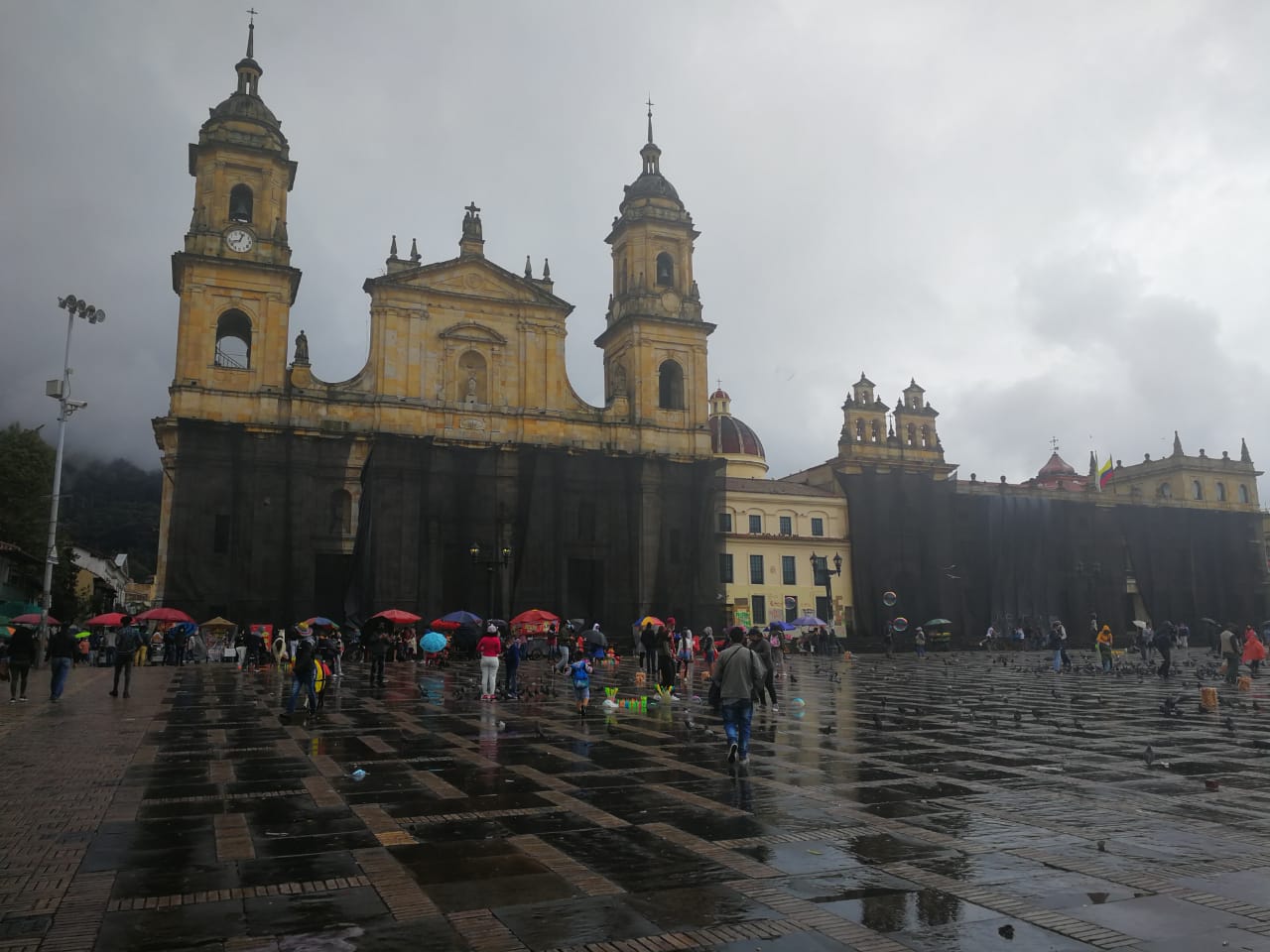
The last stop, outside the Palace of Justice in the Plaza Bolivar is the most pertinent for many people. It’s fairly quiet today, with a intermittent heavy rain. But it’s been witness to almost everything Jose talked about on the tour – and visible in most of the film footage – from the 1940s to last week. (Look thru the next several pictures and then click on some of the links and videos).

“Those who don’t remember the past, are condemned to repeat it.” We hear this quote endlessly recycled but we don’t talk about what it really means. It’s not about ONLY remembering the past, it’s about learning and moving away from the actions of the past. Yes, this requires knowing about our most painful chapters, whether it be a nation, a family or an individual. But it also requires changing course. Knowing is not enough – action is required.

That is what Colombia, the USA and so many nations have struggled with this last year – the realization that we need to change course, and then trying to find the path to do so.

Now I don’t have a strong opinion on the current Colombian protests – I don’t feel like I have a deep enough understanding of all of the issues to do so. But I do understand what’s we’ve been seeing.. It’s the same as what we saw last year at home.. We are watching a nation – and it’s citizens try and find their path forward – and I respect that.

For readers who would like to know more about the current protests in Colombia, I highly recommend the Colombia Calling podcast along with Colombia Reports.com

A long time gone..


Hello, everyone! It’s been a long time since I’ve even logged in here – and I won’t blame the pandemic. Well, it wasn’t entirely the pandemic.

As my previous subscribers know, I’ve been working and researching surgery, and medical travel options since 2010. It’s not just a passion, it’s something extremely serious to me (even though I am often very light-hearted over here!)

In late 2019, I finally took the leap to do what we all knew I needed to do. I always said, I’m just the researcher, I’m here to evaluate, I’m not here to run a medical travel company. But the longer I went around interviewing, observing and evaluating surgeons, hospitals and surgical practices, the more I realized that I was literally, the only person out there doing what I do. I was a one-woman Quality Assurance program; focused patient safety, and post-operative outcomes.

For everyone else, it’s just a job. It’s not that they were all heartless, hateful individuals – but they were not in a position to be able to care. They are travel agents, not medical providers (you’ve heard this part of the speech before) so they didn’t even know what they should be concerned about. You have to be aware of all the risks to understand them.

That’s not a dig at anyone, that’s a reality. If you aren’t trained and don’t have extensive experience in medicine and surgery, then you really aren’t qualified to be referring any potential patient/ client/ or even a friend to a surgeon. And even then – all that training doesn’t matter, if you don’t go thru the proper steps to fully evaluate someone.

A person can be a fantastic surgeon – maybe even your husband’s heart surgeon, but that doesn’t mean they know who the best surgeon is for your breast cancer. I might know some surgeons from around the hospital where I work – but if I don’t go into their operating room – and they are just a golfing partner, or a workplace acquaintance, then my recommendation really isn’t worth very much. A lot of medicine functions in exactly that. Referrals are made out of friendships, not merit.

It’s the same with a referral from a close friend. That isn’t because your friend isn’t a kind, caring person, but even if she had the exact same procedure that you want or need – her experience is not necessarily your experience. Great surgeons can have patients with terrible complications (often because they take care of sicker patients). Very mediocre, sloppy or unsafe surgeons can have good outcomes because if everyone they operated on died or had catastrophic complications, well, they (hopefully) wouldn’t be a surgeon for very long.

This is about training, techniques, protocols and odds rations. We have all run a red light, whether by accident,, because you were in a hurry or whatever. We don’t all get t-boned in the intersection, because sometimes we get lucky, and sometimes we get away with it.

But careful and safe drivers who pay attention, slow down when they seen the light turn yellow are much much less likely to run a red light, which in turn means that their risk of getting in that accident in the intersection is much less than someone else who routinely hits the gas when that light turns yellow.

What I do is look for the safe drivers. The people who do things the correct and proper way every single time. So that when you are unconscious, and powerless on that operating room, you don’t have to be lucky.

With that in mind, I started my own travel company in late 2019. I knew I would never get rich doing it – but I knew that I could really help some people. I set my personal goal at having a very small exclusive clientele – and having 5 to 10 clients per year for the first five years.

Now that doesn’t even cover overhead – so it means I’d be doing my “day job” for at least another decade. But that’s okay – not everything in life is about money. Sometimes it’s just about doing the job right and helping people, As a health care provider, that is something that I already do. This is just taking it to another level.

So – I opened the company, and our maiden voyage so to speak, I have four clients. (As part of quality control program to ensure that all the nonmedical aspects come together in a timely fashion, I had decided to do the first two years of operating as very small group travel. As a trial and error process to streamline the process (hotel, luggage, meals, sightseeing, all the things that go with traveling but are not related to patient safety). You can never make sure that all the logistics are perfect with out a couple trial runs. With that in mind, our first clients were offered our services as at fraction of the price. (My accountant was screaming and so was my wallet – but that’s just how it has to be sometimes.)

All that hard work paid off – not only did ALL of our clients get excellent care, they had a good time too! We saw off the last client just a week before Christmas 2019. It was exhausting, but I was exhilarated. I also realized that it was very unlikely that I’d ever make money doing this. To make money, I’d have to charge more, a lot more. So much of the money I collected went to enhance the client experience, that there was very little left over.

I wouldn’t make money the way other medical travel companies do – they make money two ways:

-sheer volume

-kickbacks on front/ and back end. They get paid by the hospitals, the providers and sometimes even by hotels, restaurants and such for steering the clients in a specific direction. A lot of times, they are actually a front for a hospital – b ut pretend to be an independent entity.

Obviously, my loyal readers know that this wouldn’t work for me. It violates everything I believe. In fact, it’s part of the mission statement on my “official” company page.

But in the meantime, Covid did happen. So I have had a year and a half to think about it. The company is closed, and I’,m at a decision point.. Carry on or shutter entirely.

Now this blog was undercover for about that long too – and that’s not a coincidence. That’s because I was worried that if people read this blog, and read about Colombian food, my various adventures and even just the random absurd little things that happen sometimes, that they wouldn’t think I was professional – and thus wouldn’t want to be a client.

But people are multi-faceted. You can be a nuclear physicist AND a mom. Electrical engineers play musical instruments. We all have the abilities, interests and talents to do more than one thing. So as I stayed inside, and watched the entire world stop, I had plenty of time to think, and make decisions about my own life and the life of my company.

My goals are the same. I want to come out of this pandemic and be able to help five to ten people each year.

My goals are the same, but my perceptions have changed. Now, I’m okay if it’s never more than five or ten people a year.

It’s okay that I won’t get wealthy doing this – and that I will never be able to surrender my day job. I don’t know if I could do that anyway – it’s too much a part of who I am. I just want to be able to help five or ten people every year without losing money. I’ll write off my time as being basically free – but I still need to make enough money to do all the nice things for the clients that I feel are important, and to be able to pay the people that help make it possible. That’s not an impossible goal, and I don’t feel it’s a foolish one. I’ve been fortunate in life, so I can decide to do something just because it makes me feel good. So that’s what I am doing.

And lastly, it’s okay if people seeing and reading this realize that I’m a person, a fully rounded person, who likes to take pictures, loves to travel, and to have new experiences. It’s okay if they know that I’m a cat lady, and I love to sew, especially dutch wax prints in bright colors. It’s even fine if they know I love to sing – but I’m always terribly off-key. It’s okay because I will be here to help the people who want my help. People who recognize my expertise and still see me as a professional (despite my singing) and not a servant. People who know me, friends, family and people who trust me, respect my abilities – and know that I will always put their health and safety first.

So, I’m back!

Miami plastic surgeon tied to multiple deaths


From the Miami Herald comes a terrifying story about a plastic surgery group tied to multiple patient deaths.  The surgical group which operated out of three different south Florida clinics are responsible for at least three deaths, including the recent death of a young woman from West Virginia, Heather Meadows, 29,  who had traveled to south Florida looking for cheap plastic surgery.

bandaid

In addition to this case, come reports that the group housed post-operative patients in a local horse stable.  The clinics; Encore Plastic Surgery in Hialeah, and two Miami clinics; Vanity Plastic Surgery and Spectrum Aesthetics have also been linked with multiple serious medical complications including the case of Nyosha Fowler who was comatose for 28 days after surgeons at the clinic accidentally perforated her intestine and then injected the fecally contaminated fluid into her sciatic nerve during a liposuction/ fat transfer procedure.  Ms. Fowler, who is lucky to be alive, is now permanently disabled and facing a two-million dollar medical bill for the life-saving care she received at an outside facility.

Now, Heather Meadow’s death has been ruled accidental, which is no comfort to her family or the numerous patients harmed by these surgeons. While the state of Florida has reprimanded two of the surgeons in the surgical group in the past, this hasn’t affected their practice, and the surgical clinics continue to accept new patients from across the United States and operate on unsuspecting clients.

money

Beauty, at any price?

While Florida state health officials issued an emergency restriction prohibiting one of the group’s surgeons, Dr. Osak Omulepu from operating, no charges have been made despite cell phone photographs documenting horrific conditions at the horse stables where patients were forced to stay while they recuperated from various procedures.  In fact, Dr. Osak Omulepu continues to have four star ratings on several online sites.  His license is listed as active on the Florida Medical Board, with no complaints listed under his profile page.  However, under the disciplinary actions page, there are eight separate listings that do not appear on his general profile.

One of these Complaints, (posted here) related to the death of a 31-year-old woman due to repeated liver perforation during liposuction.  The complaint also cites several other cases against the doctor and notes that Dr. Osak Omulepu is not a board certified plastic surgeon.  In fact, according to the complaints filed in March, the good doctor, holds no certification in any recognized medical specialty.

Related posts:

Plastic surgery safety & Buttloads of Pain

Patient satisfaction scores vs. clinical outcomes: The Yelp! approach to surgery

Is your ‘cosmetic surgeon’ really even a surgeon?

Patient Safety & Medical Tourism

Liposuction in a Myrtle Beach apartment

Patient satisfaction scores vs. clinical outcomes: The Yelp! approach to surgery


Patient satisfaction and clinical outcomes

Like Kevin MD says, “Patient satisfaction can kill“.  I’ve now seen several dramatic examples of this up close and personal.  For readers who feel like they are in the dark – there is a new ‘trend’ in healthcare, which financially rewards hospitals and physicians based on patient satisfaction scores..  Politicos, lobbyists and professional “patient advocates” have heralded this approach as the second coming.  A lot of these advocates try to lump patient satisfaction in with patient autonomy and patient rights.

Patient satisfaction is not the same as patient rights.

But it isn’t the same – and it’s stupid to pretend it is.  People have the right to determine if they want treatment X or not.  But giving people a “line-item veto” power on associated activities is a lazy clinician’s practice and recipe for disaster. (Not only that – it victimizes the very population we are trying to protect.  Anyone who is a parent understands this concept, but any degree of ‘paternalism’ in medicine is now viewed in a very negative light).

Instead of a new enlightened period of patient empowerment, informed consent and respect for patient rights, we have lazy attitudes (clinicians) and temper tantrums (patients) driving our clinical practices.  Doctors would rather ‘give in’ on critically important items than spend time to repeatedly try to explain key concepts of care to increasingly demanding ‘consumers’.  Overburdened staff are happy to go along with anything that decreases a workload which has tripled with recent changes in documentation.

It’s been a clinical nightmare and an  unprecedented fiasco in patient mismanagement which has lead to a dramatic rise in medical complications, length of stay and patient suffering.  I know, from first-hand observation and it’s been difficult to watch.  Even worse, it’s like a runaway train.  No one seems willing to reach for the brakes as it careens out of control and off the cliff.   It doesn’t seem to matter that there is ample evidence that this practice actually harms patients – the idea remains popular with payors, public relations departments and patients alike.

I work in cardiothoracic surgery so I guess I’ve been sheltered from this mentality.  It took a while for this concept to trickle down from the more ‘concerge-friendly’ specialities which have a high rate of elective procedures.  (No one really has elective cardiac surgery – when we used the term, we mean it’s not an active emergency).    I was first confronted with this concept when I started writing about plastic surgery.  People sent me numerous emails to complain about some of my reviews.  They didn’t care if conditions were sanitary or even safe.  Poorly staffed facilities, office-based surgeries with improper anesthesia, or a high rate of infections and post-operative complications didn’t concern them.   “Doctors” with falsified credentials didn’t daunt their enthusiasm.  The people writing to me only cared about two things; the doctor’s “bedside manner” and the price.  (Price was an important factor because we were often talking about procedures not usually covered by health insurance).

What is more important: a great surgeon or a great-looking one?

What is more important: a great surgeon or a great-looking one?  Patient satisfaction scores are often based on relatively superficial factors such as attractiveness, charisma or even whether the hospital has catered meals or hardwood floors..

I thought it was disturbing at the time, but I chalked it up to a lack of knowledge on the part of the “consumers”.  They just assume that these problems won’t happen to them.  Complications happen to other people.

Consumer or patient?

But it is this concept as consumers versus patients that is so very damaging.  It’s okay to use Yelp! to choose a restaurant, to google a hair dresser or  use tripadvisor for a hotel.  It’s even okay to use Angie’s List to find someone to trim your hedges and mow the lawn.  That’s because in the worst case scenario  – consumers have an unpleasant experience – the wait staff is slow, the haircut is ackward, or the hotel is noisy.  Maybe the gardener is late or leaves cut grass all over the sidewalk.  But no one gets hurt, and certainly no one dies.. Not from a bad haircut..

This is a photograph from a famous trainwreck in my home town in Virginia in 1903.  Somehow, it seemed appropriate for today's discussion.

This is a photograph from a famous trainwreck in my home town in Virginia in 1903. Somehow, it seemed appropriate for today’s discussion.

The problem with the consumer concept is the idea that “the customer is always right” or that the customer always knows best.   This means that customers are not only choosing their doctors based on this type of superficial data but also dictating the care.

  This is where it gets dangerous.

Aortic Valve Replacement

Aortic Valve Replacement – photo by K. Eckland, 2012

In cardiac surgery, we’ve long had a saying, “Cardiac surgery is not a democracy.”  This means that the surgeon has the last word, and is the highest authority when it comes to the care of cardiac patients.  The surgeon’s wishes trump mine, the anesthesiologists, the nurses, and even the patients and the patients’ family.  That’s because most cardiac surgeons have decades of medical and surgical training in addition to their individual years of clinical practice.  Surgeons and their support staff (like myself) are expected to use evidence-based practice.  This means we prescribe, and perform treatments based on years of research, and based on published guidelines.  These guidelines and protocols are then personalized or altered to suit each patient’s individual needs.  (Needs, not wants).

One of the biggest examples of this principle is:  Ambulation after surgery

Nobody wants to get out of bed and walk after heart surgery.  We’d all love to nap all day, get limitless pain medication and wake up six weeks later, rested and restored to health.  But reality doesn’t work that way.  Patients who get up and move, and do so in the early periods after surgery – do dramatically better than patients that don’t.  They have less complications, and they actually feel better  than patients who are allowed to take a more leisurely approach to cardiac rehabilitation.  Even a day makes a difference so this is where most surgeons draw rank.  Walking is not an “optional” part of post-surgical care.

In the ten years that I have been working in cardiac surgery, in massive academic facilities, average size hospitals and even small community programs – the guiding principle has been up and out of bed – and most programs do this at a fairly rapid pace.  For uncomplicated patients (no major immediate surgical problems, or advanced heart failure), the gold standard is out of bed to the chair on the evening of surgery (for patients who return from the operating room by mid-afternoon) or by 6 am the next morning (patients that arrive later, or who take longer to awaken from anesthesia).   These patients then take their first walk on post-operative day one to the nursing station and back, (usually around 50 to 200 feet) before lunchtime as a prerequisite for being transferred out of the intensive care unit to the step-down unit that afternoon.    For these patients, walking is not up for discussion.  It is the clinical expectation and part of the ‘package’ that goes with the operation.  Patients walk.  Period.

The majority of these patients will be discharged home on post-operative day 4.  Some will go home on post-operative day 3.  Not only that – but they will feel relatively good and will be clinically/ physically and psychologically* ready to go home by that time.

*Families are another story – the stress and anxiety of heart surgery is often worse for loved ones than for the patient and often does not clinically correlate with the patient’s actual physical condition.

Clinical Scenario of patient care driven by patient satisfaction scores$$$

In comparison, at a private, up-scale facility where I recently visited, the desire to please and get good Yelp! scores trumps the principles of patient care.  To start with, all patients automatically receive heavy doses of narcotics immediately after extubation via pca (patient controlled analgesia).  In theory, the pca allows patients to receive medication without lengthy delays to control pain to a ‘reasonable’ level.  (It is not reasonable to expect to be pain-free after major surgery.)

Patient satisfaction promise #1: You will be pain-free after surgery

But this hospital promises pain-free and they do their darndest to deliver.  Patients get on average 6 to 8 milligrams of dilaudid (hydromorphone) every hour after surgery by pushing their pca.  (If you think, “hey, after sawing my chest apart – that sounds like a great idea” then you are at risk for what happens next..

Nurses at this facility love this policy because it means they don’t have to attend to the patient as often and can catch up on computer documentation, facebook or whatever since the patient will be medicating himself into a semi-comatose state over the next few hours.  Semi-comatose is not an exaggeration.

Neurologically, some of these patients will develop delirium and vivid hallucinations.  Others will become agitated and combative.   Others will simply become confused and sleepy.

Since narcotics cause respiratory depression, sometimes these patients become hypoxic after using the pca heavily despite the supposed safeguards (lockouts are usually set ridiculously high – and despite policies against it – visitors, family and staff will push the pca button, even when the patient isn’t asking for medication).    Sometimes, patients end up on bipap or even re-intubated.  More often, they are just asleep – which as I said, suits the staff fine because it’s a lot less work for them.

But for the patient, it’s lost time – and puts them at risk for even more complications.  These people should be getting up to the chair, or walking for the first time.  Walking promotes respiratory expansion, prevents blood pooling (in extremities) and helps restore gastric function.

Instead, they are sleeping.  They should be performing pulmonary toileting to clear out all the secretions that built up during their lengthy surgery and reduce the risk of a post-operative pneumonia.  Instead, their lungs are building up more secretions.

Soon, the patient will want some water, after the intense mouth drying effects of the ventilator and breathing tube.  But the powerful narcotics have completely shut down bowel function.  No bowel sounds, no activity.  Water means nausea and vomiting, and more medications.  In many patients, this can cause an ileus, which adds several more unpleasant days (with a nasogastric tube) to their hospital stay.  For a fraction of these patients – they may need an emergent operation for a bowel obstruction as fecal material forms into hard, unpassable blockages in the GI tract.  Either way, the gross overuse of narcotics in these patients negatively impacts two of the most basic principles of post-cardiac surgery rehabilitation: ambulation and pulmonary toileting, and leads to increased risks of major/ unnecessary complications.

Patients need pain control after surgery – without adequate pain control patients can’t do all the activities they need to as part of their rehabilitation.  Untreated pain can in itself lead to complications.  But this bazooka approach to pain management is inappropriate for the vast majority of patients – especially the narcotic-naive or frail elderly (that make up a large percentage of cardiac patients).

Chasing patient satisfaction scores and profits in American healthcare

Chasing patient satisfaction scores and profits in American healthcare

The bottom line for CEOs and Administrators – I’m not sure if fulfilling the promise of pain-free cardiac surgery results in increased patient satisfaction scores on post-hospital surveys.  Do patients who spent the first two days after their surgery in a narcotic haze but then spent four or five extra days in the hospital due to preventable complications rate the service as well as patients undergoing surgery in a traditional program (who go home on day #4)?  And even if it does result in high satisfaction scores, (like it apparently did at this facility) – Is it ethical or moral to sacrifice the patient’s actual health and well-being for a couple of gold stars on post-discharge questionnaires.

But this is just the first part of the sequelae created by hospital administrators in their intense desire to chase profits, business and customers.  (This facility has created a niche market for itself by promoting these customer satisfaction practices that appeal to people that would otherwise seek care at the internationally known large academic facilities in the nearby area).  We will talk about some of the other pitfalls of programs  and practices devoted to chasing patient satisfaction scores, instead of patient care.

Take home message:

The real kicker:  multiple studies like this one by Aiken et al., demonstrate that the best way to increase patient satisfaction is to give good care, as defined by our more traditional measures (good outcomes). Hospitals that were well organized, with high levels of nurse staffing, (low levels of burnout) and good work environments.  Patients are happier, safer and have less complications when the nurse: patient ratios are appropriate for the level of care**.   It was never really about the ‘perks’ but it’s easier / cheaper for administrators to add enhanced cable television and pay-per-view movies to patient rooms than to actually give a darn..

$$$ – At the facility that was dominated by concerns related to patient satisfaction scores (ie. Press Ganey scores), that had such a high rate of complications (and a higher than average mortality)?? All those doctors have excellent, yes, excellent Press Ganey scores.. because apparently giving unlimited narcotics makes up for unnecessary (and life-threatening) complications. [and because, as demonstrated by several of the references below, Press Ganey scores are far from a reliable indicator of care.

**CEOs take note: I said nurses, not “nursing staff”.  Contrary to popular belief, 2 or 3 nursing aids, patient care techs or other ‘ancillary’ staff does NOT equal one well-trained registered nurse.  While these ancillary positions are important for providing basic care like hygeine (bathing and toileting, repositioning) and recording vital signs, they can not substitute for a nursing assessment and physical examination.

That being said – if hospitals increased (doubled or tripled) the number of occupational and physical therapists on staff – patient length of stay, level of debility and hospital complications related to disability and immobility (pneumonias, deep vein thrombosis/ pulmonary embolism, falls, fractures and failure to thrive) would dramatically decrease.

Resources/ References and Additional Reading

The Eckland Effect – this isn’t the first time we touched on this discussion, though previous posts have been focused more on international medical tourism, rather than American hospitals.

Kevin MD blog – I don’t always agree with him, but it’s an excellent blog on American medicine from a physician’s perspective.  If you read only one article from this post, read the article cited above.

Why rating your doctor is bad for your health.  Forbes article, 2013.

Rice, 2015.  Bioethicists say patient-satisfaction surveys could lead to bad medicine. Modern Healthcare, June 4th, 2015.

Dr. Delucia & Dr. Sullivan (2012). “Seven things you may not know about Press Ganey statistics“. Emergency Physicians Monthly.  The pitfalls of Press Ganey.

Robbins, Alexandra (2015).  The problem with satisfied patients.  Atlantic Monthly, April 2015.  An excellent read.  Best quote of the article, “Patients can be very satisfied and dead in an hour.”  Authors noted that the most satisfied patients were most likely to die.

Aiken LH1, Sermeus W, Van den Heede K, Sloane DM, Busse R, McKee M, Bruyneel L, Rafferty AM, Griffiths P, Moreno-Casbas MT, Tishelman C, Scott A,Brzostek T, Kinnunen J, Schwendimann R, Heinen M, Zikos D, Sjetne IS, Smith HL, Kutney-Lee A.  (2012).  Patient safety, satisfaction, and quality of hospital care: cross sectional surveys of nurses and patients in 12 countries in Europe and the United StatesBMJ. 2012 Mar 20;344:e1717. doi: 10.1136/bmj.e1717.

Zgierska, Robago & Miller (2014).  Impact of patient satisfaction ratings on physicians and clinical care.  Patient Preference and Adherence.  Results from a 26 item survey on physician’s attitudes and behaviors regarding patient satisfaction ratings.

This article demonstrates equal analgesia with IV tramadol versus the much stronger opioid, morphine.  (For comparison, hydromorphone (dilaudid) is 10X stronger than morphine).

Grunkemeier, et. al. (2007).  The narcotic bowel syndrome: clinical features, pathophysiology and management.    Clinical gastroenterology and hepatology. 2007 Nov 11. 

Heading South!


It’s been a long hiatus as I’ve replenished Latin American Surgery’s coffers on a couple assignments over the last several months, but I will be back in the Southern hemisphere later this summer, and I am sure we will have a lot to talk about..

It’s an unfortunate reality that travel and travel writing costs money.  That, coupled with the long hours required in my “day job” mean that I do less writing and researching for the blogs than I’d like.  I was able to keep pace initially, but there was a point where it became a question of getting some sleep so I could work and pay my mortgage (and buy groceries) or continuing to churn pages for the blog.

on the runway at Colombia Moda 2104

on the runway at Colombia Moda 2104

After spending a lot of my resources working on a thoracic project this Spring over at the sister site, thoracics.org and working – it’s nice to be back here at Latin American Surgery.com

I’m going back to Medellin soon – and I look forward to taking all my readers with me.  (I wanted to travel to a couple other areas, but frankly, couldn’t afford it).  I won’t be attending Colombia Moda this year – but there is always someone to interview, health topics to talk about, cultural events explore or people and places to photograph.

I have a couple if ideas for some interesting articles, but we’ll have to wait to see how these ideas come together..  I hope it will be worth the wait..

Life in the fast lane: my most recent assignment


No medical tourism or Latin America this winter, but as my latest assignment finishes, it’s been an interesting journey!

New friends, new places, and new experiences!

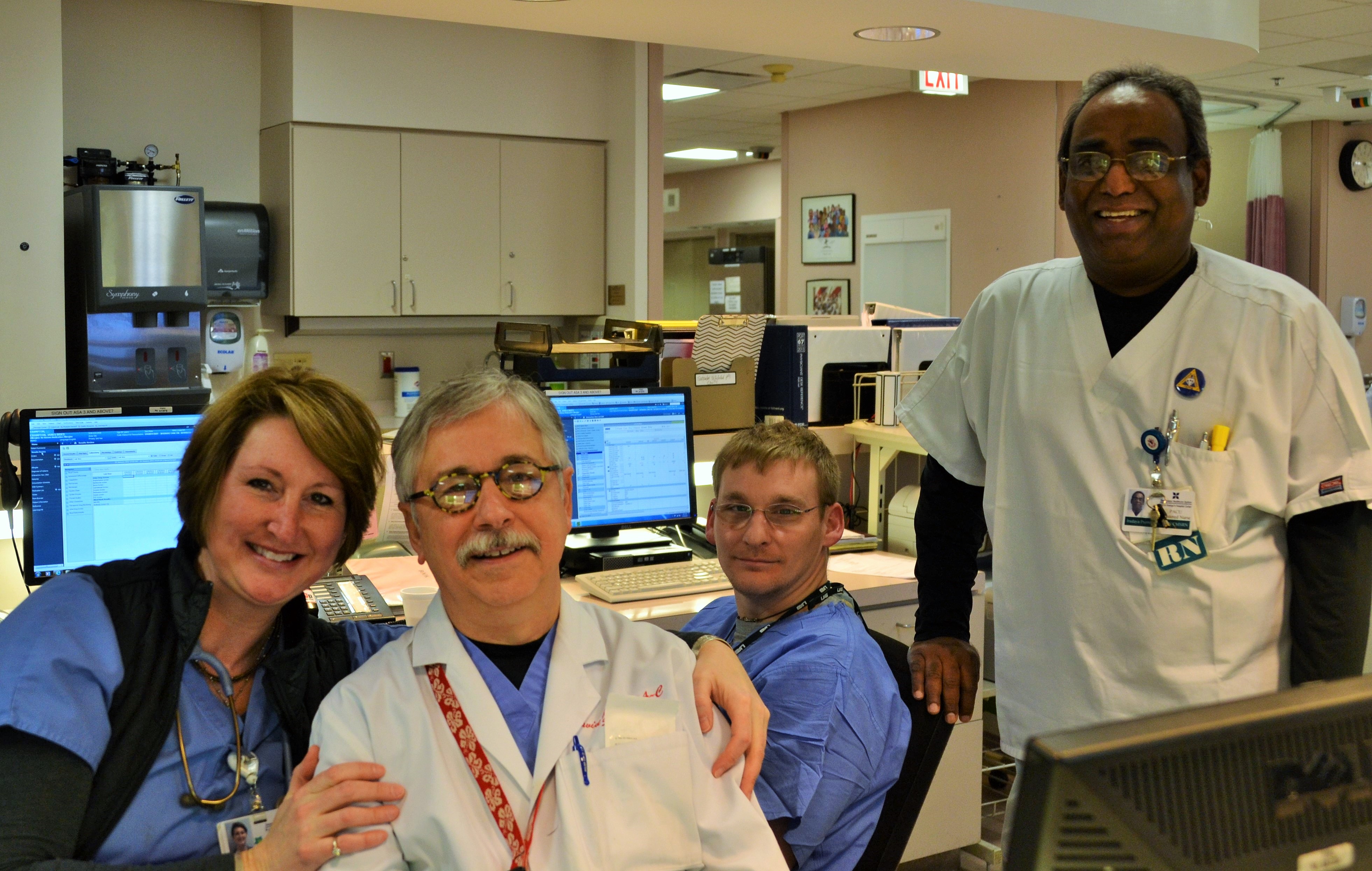
Co-workers in the PACU

Co-workers in the PACU

I spent the last few months working in the intensive care unit on the trauma service at a large, busy trauma hospital outside of the nation’s capitol.  It wasn’t quite what I expected – for all of my world travels and travel nursing, I still tend to revert back to Chicago Hope in my mind sometimes.. This was a lot more like St. Elsewhere – meaning that as a person from a rural background, I always expect to be somewhat overwhelmed in larger facilities but by the first week, it was surprisingly familiar and kind of homey feeling.  Instead of a cast of thousands, and a sea of unknown faces, it become a daily chorus of ‘good mornings’ to a close-knit group of providers.  (I was there quite a bit, which probably helped).

the view from the call room

the view from the call room

But somethings were definitely different, and it was more than just monuments, politics and presidents, and the “newsworthy” aspect of some of our patients.

just outside the federal district - and a whole different world from cardiac surgery

the federal district – (and a whole different world from cardiac surgery!)

Crash course in major trauma

Running from the police seems to be a frequent requirement for some of our admissions.  Bad jokes aside, where cardiac surgery is planned, detailed and precise, the world of trauma is often chaos, tragedy and upheaval.  A split-second accident, or fall becomes a forever life altering event.  All of the ugly of the world; crime, abuse and assault comes to our door.  Innocence smashed, so often without any sense of rhyme, reason or fairness.  Working here makes me confront my mortality in a way I’ve never had to before.

Doctors in the ICU

Doctors in the ICU

Scheduled chaos

Sure, many people have unexpected heart attacks – even people we tend to think of being ‘low-risk” – and nonsmokers have no guarantee of avoiding a lung cancer diagnosis.  But, for the most part, that’s the beauty and elegance of cardiothoracic surgery – it’s a calculated, orderly world for those of us working in it.   Cardiac surgery feeds the math-loving, logistical and analytical side, while thoracic surgery with its cornucopia and ‘catch-all’ of chest pathophysiology is a never-ending journey of the Jules Verne variety.

As comforting as this can be, it can also become a hindrance if we stay in the familiar for too long.  Sure, it’s nice to have the experience, to know most of the answers, most of the time – but these brief glimpses outside cardiothoracic surgery are crucial for staying engaged, and involved in medicine.  Even if I feel silly or stupid at times, it’s important to continue to learn new things (and dredge up older knowledge that’s been unused for a while).

The good thing is that the essentials, and the principles of caring for people never really change even if the hospital, the staff, the city and the specialty service does.   I don’t know why that surprises me anymore, but it still does.

So now that the assignment is over – I am back home.  I am planning for my next big trip (Asia, this time for a big thoracic conference), catching up on medical journals, and  a bit of continuing education while awaiting my next assignment.

Until then – we’ll get back to our usual programming!

Street of Dreams – Calle 49


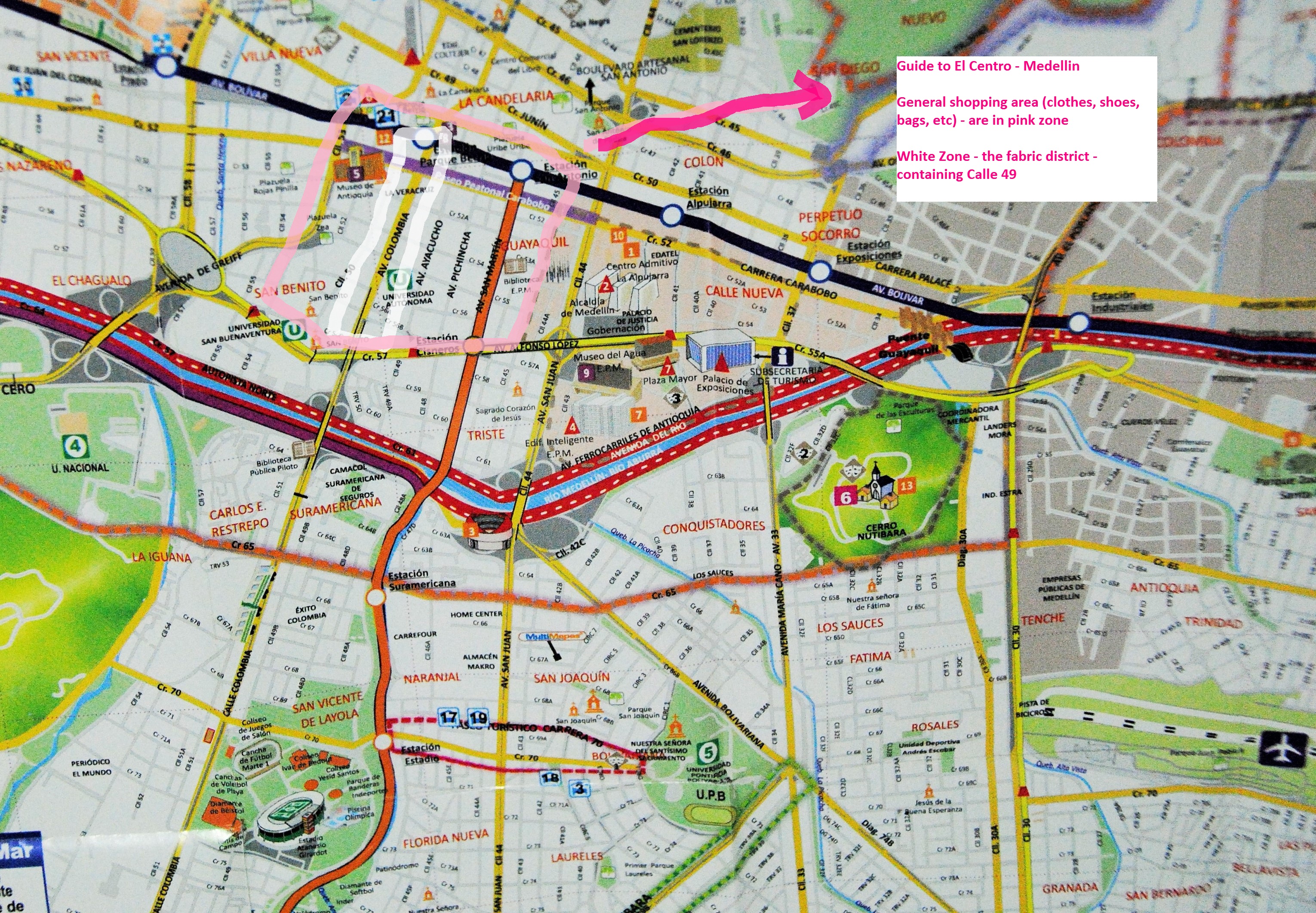
el centro map with shopping districts outlined

el centro map with shopping districts outlined -high resolution

During Colombia Moda, I met several American business people looking for more information about fabric and textiles than the small booths could provide.  Many of them wanted to go out and see the fabrics, some of the shops and the factories but no one thought to take them to see any of these things.  All of the people I met were first-time visitors to Medellin (and some may never be back).  I can’t help with factory tours (I’d like to see those myself) but I do live nearby, so I thought maybe I could help provide some information for future visitors to this fair city. Since I thought wandering around El Centro as a first-time visitor without a guide might be a little daunting, this post might help people feel more comfortable. So I spent all day Saturday wandering around the district  – to take pictures and be able to provide more information to people interested in finding fabrics and materials while in Medellin.

A note about Fabric shopping in Medellin: If you are looking for super cheap – crazy bargains, you probably won’t find them here.  But you will find a huge array of all kinds of fabric – most of it made right here in the city.  For someone like myself who is sometimes (okay, frequently) frustrated by the lack of floor space given to apparel fabrics in the United States – (where it seems like 90% of fabric is for quilting and such), it’s still a bonanza.

Also, while it isn’t made in the USA (which is increasingly rare, I know) – I still feel a bit of loyalty towards buying locally sourced items – even if Medellin is that source. Still interested?  Good.

How to get here – the real Medellin

The best fabric and general shopping in  Medellin isn’t in the fancy malls of El Poblado and Enviagado.  It’s in the busy, teeming streets of El Centro.  El Centro is also where many of the most famous tourist attractions are, so if you are interested in seeing some of the famous architecture, the Botero collection (at the Museo de Antioquia) – you can do that too.  El Poblado and Enviagado are the rich, sanitized versions of Medellin – so if you have friends that aren’t interested in shopping but would like to see more of Medellin – this is a trip to take them on…

1.  Taxi – if you want to take a taxi, ask him to take you to the Plaza Botero.  It’s a few streets away from your destination, but it’s a nice central space – especially good if you are meeting friends or other visitors.

2.  Metro Train –  the metro train is cheap, clean and quite reliable.  It’s also a good way to see a bit of the city.  Take the (blue line) train to either Parque Berrio station or the San Antonio station.  San Antonio is closer to shopping, but Parque Berrio puts you right at the Plaza.  (For more information about the Metro, see this helpful article at Medellin Living).

Get a map –  Now, I know this is a digital age, but sometimes a paper map is just easier.. Safer too because it makes you less of a target for thieves who prey on upscale tourists for all of our fancy electronic devices.

tourist kiosk with maps

tourist kiosk with maps

There are several of these kiosks located in/ around Plaza Botero and around the Parque Berrio station.  Just ask for a map “Mapa, por favor” and they will be happy to provide you with a free map of Medellin.  I used this same map for reference for the shopping areas, to make it easy for visitors to recognize where to go.

Navigating the city Places like Medellin and Bogotá are particularly easy to navigate because streets use numbers, not names for the most part.  (Once you get used to the system – our system of street naming in the USA seems needlessly confusing.) Everything is basically on a grid – Calles run in one direction and are abbreviated as Cll.  Carreras run in a perpendicular direction and are often abbreviated as Cr. It makes locating a business very easy.  For example, my favorite fabric store in Medellin is Textiles El Faison – and their address is Calle 49 #53 – 101.  This means that they are located on Calle 49, about 101 meters from the cross-street, Carerra 53.

Now that you are here – with your map Walk south towards Calle 49.  (To orient yourself – remember that Medellin is set in the foothills.  If you start walking uphill, you are heading East (the wrong direction) – towards the financial center of Medellin (near where I usually stay). On Calle 49 – turn West (or downwards on a very slight grade)  The next several streets will be crammed with shops filled with all kinds of sewing related items – thread stores, fabric stores, sewing machine repair etc.

Sewing machine repair and sales

Sewing machine repair and sales

Many of the shops look tiny compared to JoAnn’s or the big craft stores you may be used to.  Sometimes they are tiny – but sometimes, it’s just the entrance to a larger indoor mall.

Entrance to one of the small fabric markets

Entrance to one of the small fabric markets

Fabric

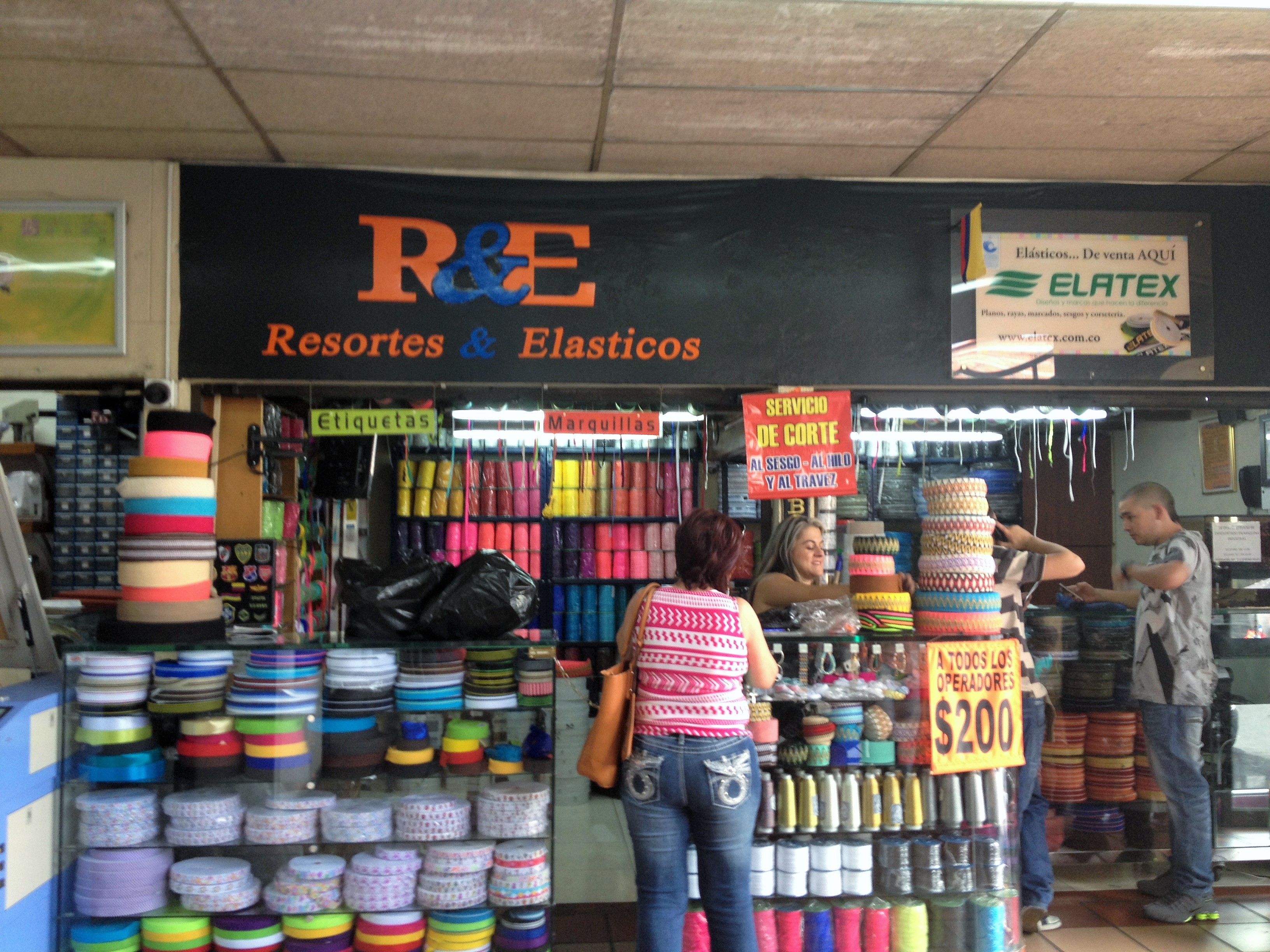
Now, the fabric stores line Calle 49 and many of the cross-streets.. But sometimes notions can be a bit trickier to track down.  A lot of tiny shops sell just one product – like elastic or ribbon trims, buttons and the like.

small shop in an indoor fabric mini-mall selling thread

small shop in an indoor fabric mini-mall (Shanghai) off calle 49 selling thread

elastics and trims

elastics and trims

As I mentioned before, my favorite fabric store from my wandering on Saturday – is Textiles El Faison.  It’s a big store, and not quite as claustrophobic feeling as some of the smaller shops.  (When the shops are crowded, and the fabric piled to the ceilings, I get a bit closed in feeling in some of the smaller shops..) Not that this would prevent me – if I saw ‘the fabric’ there.

many shops are small but piled high with fabric

many shops are small but piled high with fabric

Lots of great stuff- but limited luggage space, so I move on to the next ones.

as you can see - the width of the store is pretty narrow, maybe 12 feet in total. Now add ten customers and I get a bit 'crowded' feeling

as you can see – the width of the store is pretty narrow, maybe 12 feet in total. Now add ten customers and I get a bit ‘crowded’ feeling

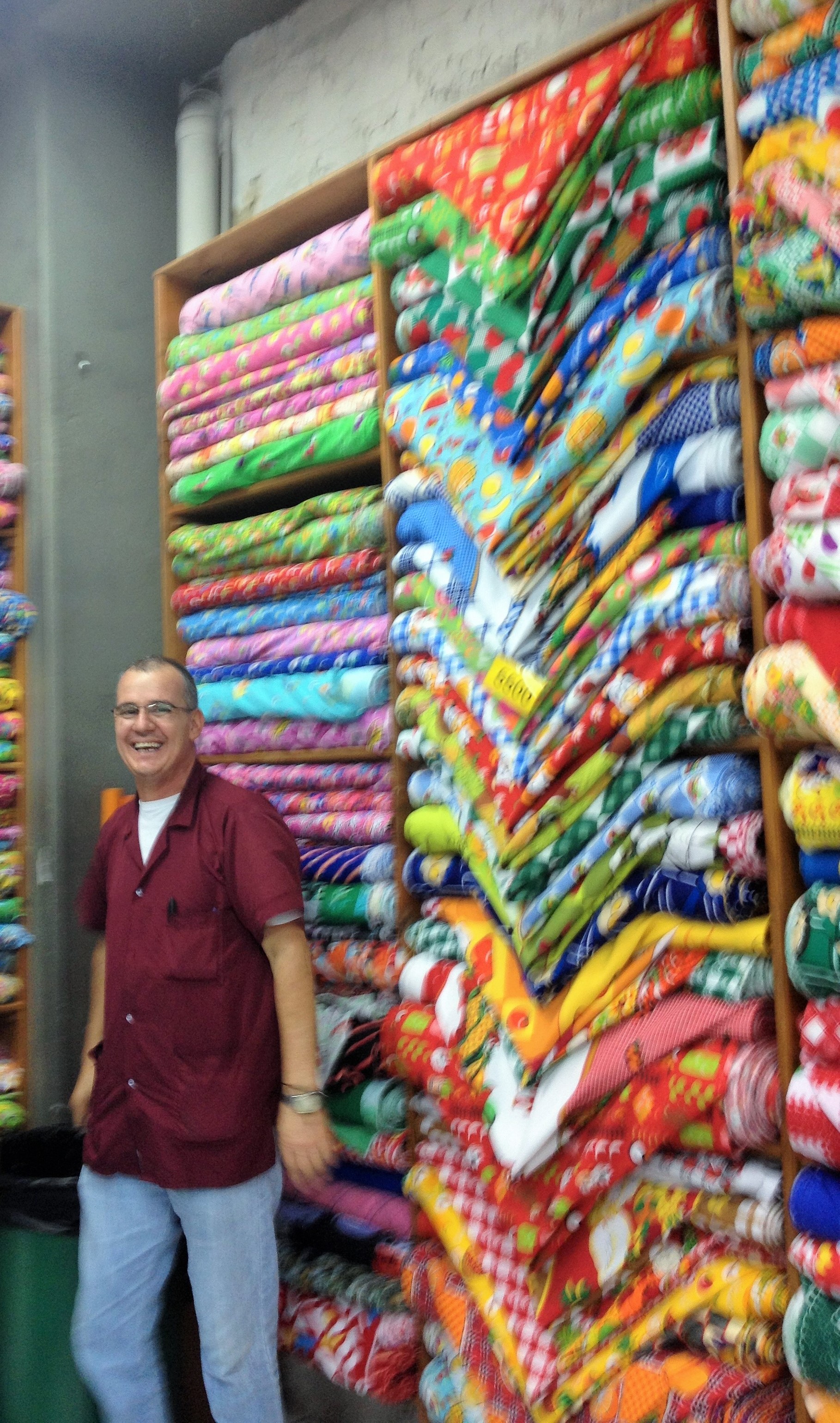
But for general browsing, or to see fabric in a shop more like what most of us are used to – Textiles El Faison is a well-lit two story shop.   Jaime Sosa is the manager there – and he is very nice and helpful.  My photos are a bit blurry because I was relying on my small phone (an older model) because I don’t like lugging my fancy Nikon down to El Centro).

Jaiime Sosa

Jaiime Sosa

Here’s the address for people who want to skip the adventures and go straight to his shop:

Textiles El Faison Calle 49 No 53 – 101 Medellin

displays piled high with fabric

displays piled high with fabric

But that’s not the only great place.. I really liked Portofino Textil too.. It’s located on the ground floor of a little textile mall.  (It’s a very interesting mall – about half the shops sell custom printed fabrics).

One of the malls for custom printed fabric

One of the malls for custom printed fabric

I was trying to cover a lot of ground, so I didn’t stop in and get all the details on custom printing – even though I saw little storefronts printing the fabric during my wandering.  (Maybe I will get a chance to go back and ask some questions.)  Custom may be the wrong word since most of it seems to be more like “Small lot pop prints” but at one shop, I did see a customer hand over a jump drive filled with images for printing).  But some of the other shops / kiosks didn’t look to have computers just their own style of pop prints (justin beiber, popular artists, other cool designs).

small storefront.. the lady in the blue tank is printing custom fabric

small storefront.. the lady in the blue tank is printing custom fabric

Portofino IMG_1881 Portofino has more of a warehouse feel  –  and a two meter minimum.  Fabric is priced by the kilogram.  I couldn’t resist one of the fabrics there – and my two meters of this lightweight lycra was 0.7kg in total.  For an example on prices – the tag on the bolt said 45,000 per kilogram but advertised a discount.. After the discount, my fabric total 27,156.  tax added a bit – for a total of 28,350 for my two meters of a 60 inch (or there about width).   According to today’s exchange rate – that’s about $15.35 (or around 7.50 a yard since a meter is a couple of inches more.)  So, like I said – not a crazy, amazing deal – except that I love the fabric, it was made right here, and it’s certainly not something I’d find at Hancocks or Joanns (if we even had one in my town). It’s actually located under another fabric store but I found it to have better selection, and salespeople that were very helpful and friendly. (Fabien was particularly nice – and patient with my limited Spanish).

I just couldn't resist..

I just couldn’t resist..

Portfino Textil #162  Carrera 53 No. 49 – 68 Medellin There were quite a few other shops – so you will just have to make you way down Calle 49 and find your own favorites. Patterns Pattern magazines can be especially hard to find – but when you do find them – they are a great deal.. Most pattern books contain anywhere from 20 to 200 patterns.  It depends on the magazine.  My favorites are Bianca, Quili and the more simply named Patrones.  Bianca has a lot of the patterns that are hard to find in the United States – like an extended variety of swimwear, lingerie and exercise apparel.  They also have a great assortment of patterns made for the new stretchy fabrics; lycra blends and modal.

Magazines containing 10 - 40 different patterns

Magazines containing 10 – 40 different patterns

Patrones is a grand brand because it has copies of a lot of the designs by major labels.  Want to wear your own Dolce & Gabbana? Then patrones is the magazine for you.  Sometimes you can find the magazines at larger newsstands or bookstores like Panoamericano.  Some of the patterns in Patrones are pretty intricate and instructions are limited (and in Spanish) but at 4,000 to 10,000 pesos (2.25 to about 6 dollars) a book – if you are an experienced sewer it is still quite the find.) patterns2 Now – for patterns on Calle 49 – the best place to go is – this little shop..

the place to buy patterns

the place to buy patterns Calle 49 #53 – 14

The place is tiny, so you have to ask to see the pattern books (or point, if necessary.)  They don’t have long aisles to browse like some of the bigger bookstores.  But the owner is very sweet – and they have a large array of titles available.

some of the patterns available at this small shop

some of the patterns available at this small shop

Yarns

Now, Medellin has that ‘perpetual spring’ climate we have been talking about, so I didn’t find as many places offering the bulky and superbulky yarns that I love.  Quite a few thread stores offered the smaller crochet threads and yarns similar to Lily’s Sugar N’ Cream but since I am on a superbulky yarn kick – I will keep looking..   I did see a couple, but shame on me because I didn’t write down exact addresses or take pictures (but since one of them is on a street close to home, I may venture out later this week – when I’ve exhausted my current supply and get some pics.)

yarns

yarns

Now before you head out for your shopping adventure  – review a few things to make your shopping more enjoyable and safe.  

In Medellin – alone or not quite ready to venture into El Centro by yourself?

I am always up and willing to lend a hand – if I am in the city.  (It’s a good guess if I am blogging about Medellin, then you can find me here.)  You can always call me/ text me at 301-706-3929 (If I am not in Colombia, I won’t answer) or email me at k.eckland@gmail.com I’d be happy to arrange to get together for a day tour of the shopping areas.  We can check out museums, eat some tasty street food, buy local produce, window shop – or hunt down that one special piece of fabric you’ve been waiting for..

If you don’t catch me on this trip – I’ll be back.. I’ll definitely be back for Colombia Moda 2015, so if you come a few days early (in July) we can have some fun.

UN resolutions, ethics and big business


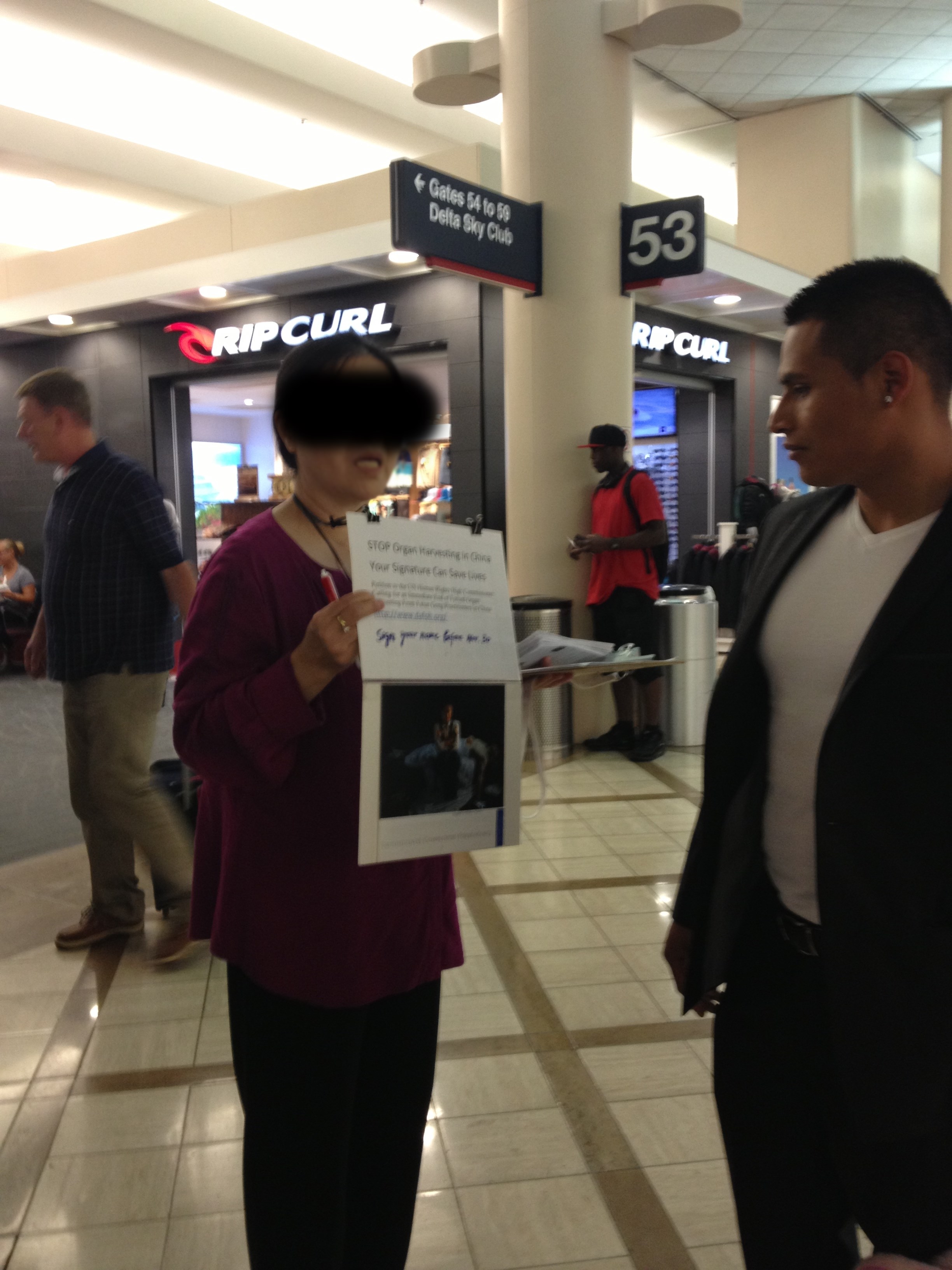
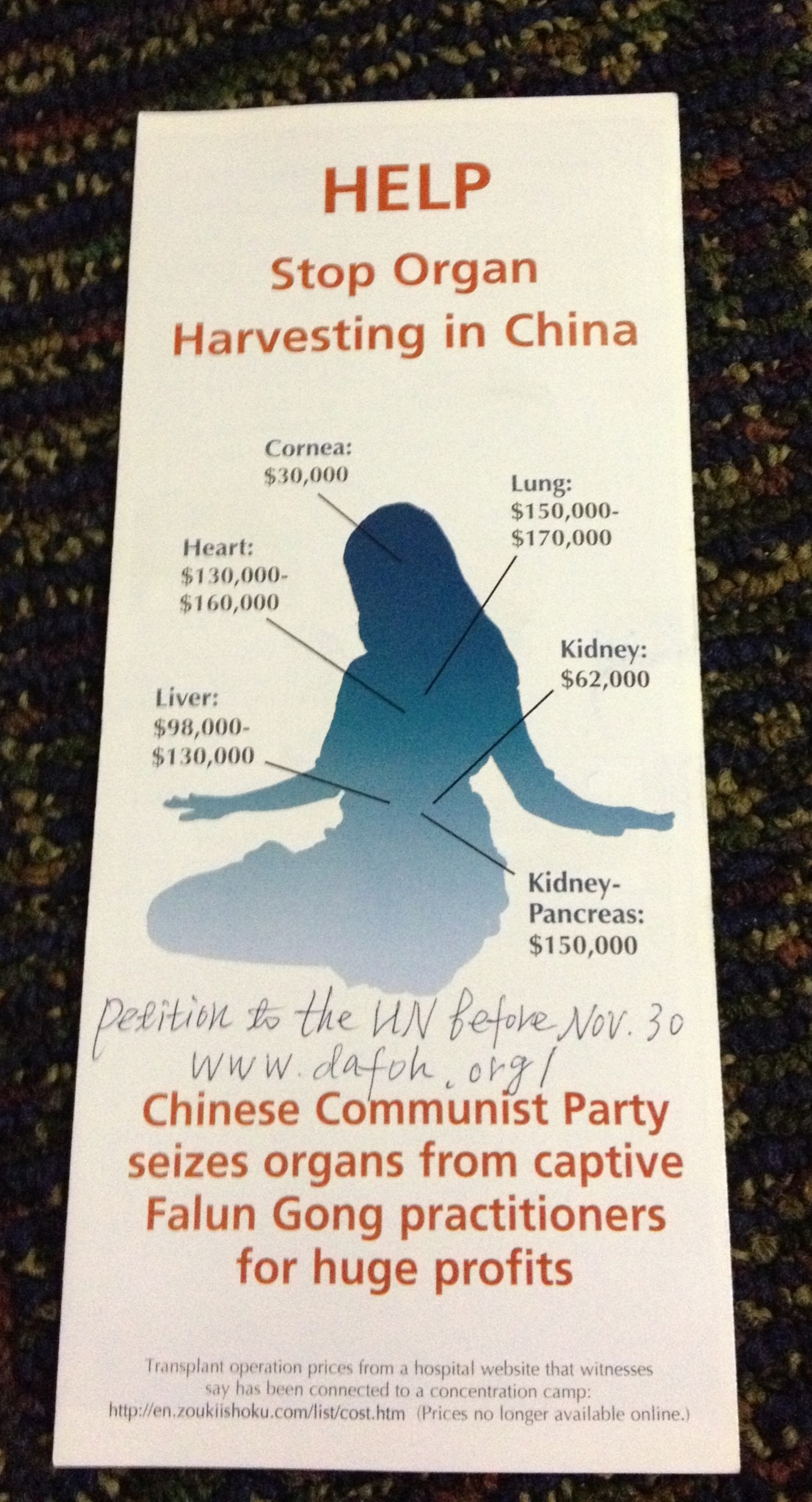
As I continue my journey home from the medical tourism trade show in Mexicali – I am reminded of the urgency of the need for industry regulation.  This reminder comes in the form, of a very nice Chinese woman in the Los Angeles Airport (LAX).

Woman soliciting signatures for United Nations petition against organ harvesting

Woman soliciting signatures for United Nations petition against organ harvesting

Now, in this photo she is talking to a traveler in the airport.  Sadly, he seemed to think she was trying to sell him something, instead of merely enlisting his aid against human rights atrocities.

(If you look close at the next photo, you can see her display).

organs (2)

I have blurred her features to preserve her privacy and safety.

We have talked about this topic before, in several previous posts, particularly when talking about transplant tourism: (with links to source articles within posts)

The Ethics of Transplant Tourism

Ethics 2

The Ugly side of Medical Tourism

But now – on the heels of a gathering dedicated to the business side of medical tourism (with nary a consideration for ethics or the need to establish a moral compass) this woman, her brochures and her sign remind me, yet again – why it is important for readers, and medical travelers to be informed.

Brochure

Brochure

But it’s not enough to be aware of the abuses and human rights violations.  It’s important that we, as consumers, service providers and yes, even as a writer, not contribute to companies, practices or services that help support the routine execution of other human beings in our own pursuit of health.  It is more than unethical – to me it is unthinkable.

So sign the petitions, research the issue  – and more importantly, research your medical tourism facilitators (travel agencies), and destinations.  Most of all – don’t buy an organ – no matter what.

Why quality of anesthesia matters: who is administering your anesthesia?


Now that Colombia Moda is over – let’s get back to the stuff that really matters.. Let’s warm up but reviewing some older posts for our newer readers.

K Eckland's avatarColombian Culture & Cuisine

I know some readers find some of my reporting dry and uninspired, particularly when talking about methodology, measurements and scales such as Surgical Apgar Scoring.  But the use of appropriate protocols, safety procedures and specialized personnel is crucial for continued patient safety.

There is a saying among medical professionals about our patients.. We want them all to be boring and routine.   That is what I strive for, for each and every one of my readers – safe, boring and routine.

Excitement and drama are only enjoyable when watching Grey’s Anatomy or other fictionalized medical dramas.  In real life, it means something has drastically and horribly gone awry.  Unlike many of its fictional counterparts – outcomes are not usually good.

In a not-so-sleepy hollow of upstate New York, a medical tragedy serves to illustrate this point, while also bringing up questions regarding the procedure.  While we don’t know the circumstances behind this case – (and don’t really want to…

View original post 1,047 more words

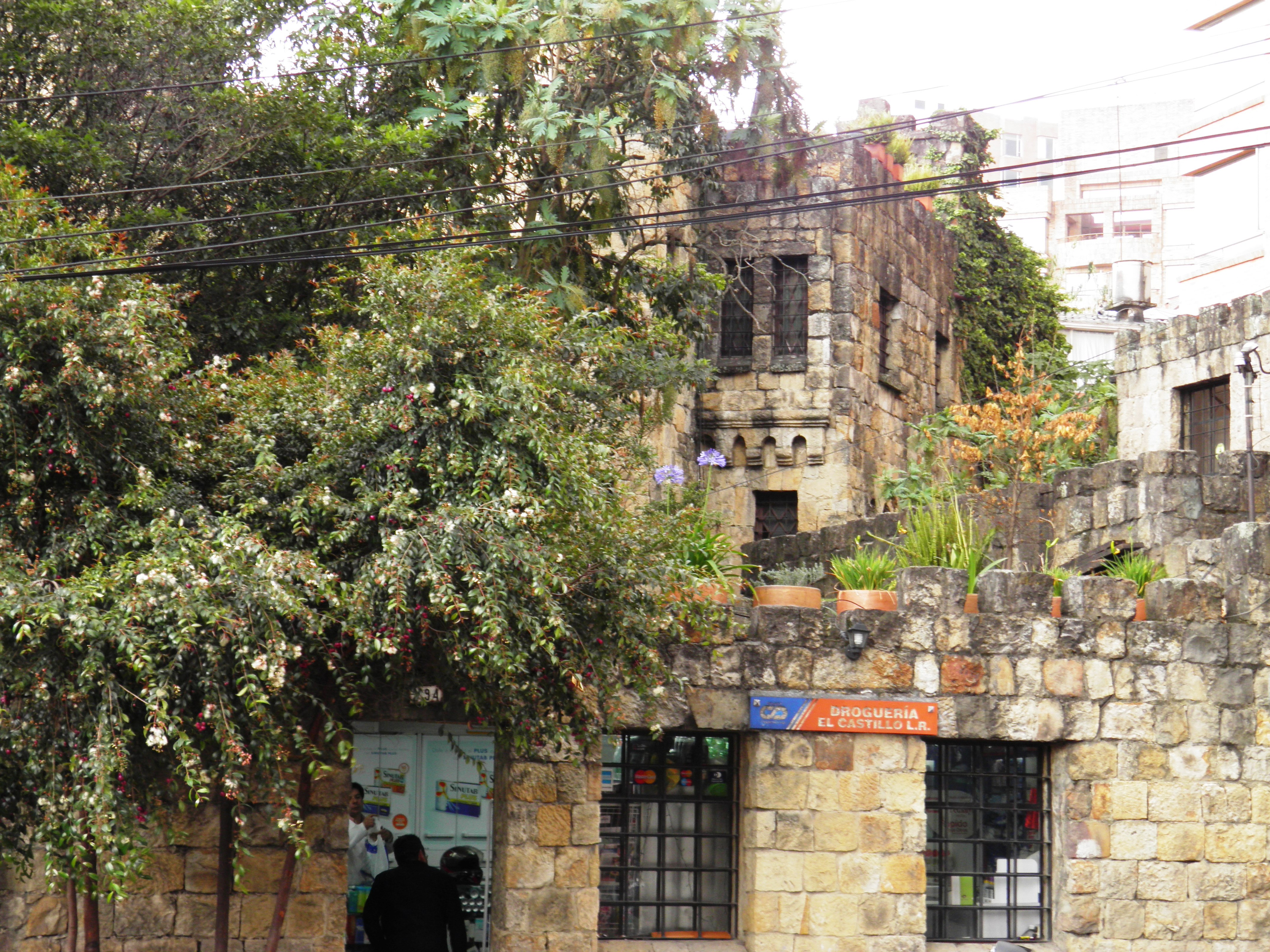
Bogota’s castle


Some of you may notice that I have temporarily changed my header – to show Bogotá’s castle.  I found it the other day as I wandered some of the carerras.  (Residents of Bogotá know that once you get into the single digit carerras – all logic and inference regarding standard directions goes out the window.)  Once you cross Carerra Septima (Cra. 7) the lovely city layout that makes Bogotá such an easy place to navigate changes into a labyrinth of twisting, winding streets reminiscent of San Francisco..

It’s part of what makes the city so interesting – and at times (such as yesterday, when I was making my way to an appointment) – a bit frustrating.  Just when you think you ‘know’ the city – you stumble upon something completely different from what you were expecting..

Not what I was expecting

The castle which is located at Cra 3 – 74 was the brainchild of Dr. Juan Osorio Morales and is called Castillo Mono Osorio.   While it has the appearance of antiquity, it’s actually only about 100 years old.

Bogotá’s castle

The creator, a local eccentric – was  Colombian cultural attaché to Brussels.   Upon his return to Bogotá, he spent the next twenty years creating the castle which later served as home to his own personal theater troupe.

Like the work of many unconventional artists, after his death the castle fell into disrepair until it was rescued in recent years by one of his descendents and repaired to its current state.

It currently houses several stores including a banquet space, a gift shop and a pharmacy.  Best of all – there is currently space for let.  A new, whimsical office, anyone?

as the mercury soars..


into the 110’s (and higher) it’s been an interesting week in Mexicali.  I’ve definitely entered new territory in my book writing venture.  In the last books, I basically didn’t see the forest for the trees – meaning that even as I raced around, and enjoyed the cities I was living in – I didn’t include any of the information about the cities themselves.. Just the surgeons, and surgery.

In retrospect – I think that was a mistake.  While I know the beautiful multifaceted Bogotá, my readers don’t.  At the time, I didn’t want to duplicate the efforts of the many talented travel writers out there.  But on consideration – living in a city is so much different from visiting one.   It takes months to see and fully appreciate the nuance of many locations – especially cities..  Anyone can talk about the historic church built in 19 whatever, but it takes time and familiarity to see the beauty of Mexicali’s Graceland, or the changing canvas of the UABC museum.  It takes time to collect the stories that bring the city to life.  So now, I am trying to do that – in a small fashion with everything I’ve collected since coming here in March.

I am not Frommer’s.. I am more like his awkward, quirky little cousin. I don’t have the manpower or the resources to talk about the hundreds of restaurants here (more than 100 Chinese restaurants alone!) but I can tell you some of my favorite places; for a casual lunch with friends, or a night on the town.  I can’t give exhaustive listings on all there is to see and do in this thriving city, but I can show you the heart of it.  I can tell you about the things that make Mexicali more than just spot in the hard-baked earth; the things that make this city real, and make it a fascinating place to be.  I can make your stay; whether just a few days, weeks or months; interesting and informative.

It’s been a fascinating and amazing journey to discover these ‘pockets of life’ and living history – and now that I am outside my realm (of medicine and surgery) one that would have been impossible without the numerous people who have embraced me, and shared their wisdom.  (It’s becoming quite the list – and I’ll share it with you all soon.)

But I certainly hope that my future readers enjoy the journey as much as I have.

How’s the book coming?


I was in the United States most of last week (at my reunion) but I didn’t stop working.  While a reunion may not seem like the most ideal situation for a medical writer – it’s actually a great opportunity to talk to people and get their opinions about health care, medicine and surgery.  After the first few minutes of catching up – talk naturally turns to everyday life, and for many of us – ‘everyday life’ involves worrying about the health of our families.. Also, many of my classmates – and old friends have been some of my biggest supporters of the blog (and my other work) so it was good to get some critical feedback.

Bret Harte class reunion

The book is coming along – almost continuous writing at this point.  While I (always!) want more interviews with more surgeons, I am now at the point where I am filling in some gaps  – talking about the city of Mexicali itself.  So I am visiting museums, archives, and talking to residents about Mexicali so I can provide a more complete picture to readers.  Right now, I would really like some information about 1920’s -30’s Mexicali – I can find a lot of interesting stuff about Tijuana, but Mexicali is proving more elusive.

It’s a bit of a change from my usual research – finding out about decades old scandals (even local haunted houses), visiting restaurants and nightclubs, but it’s been a lot of fun., even if it seems frivolous or silly at times.  I hope readers enjoy this glimpse into Mexicali’s rich history as much as I have.

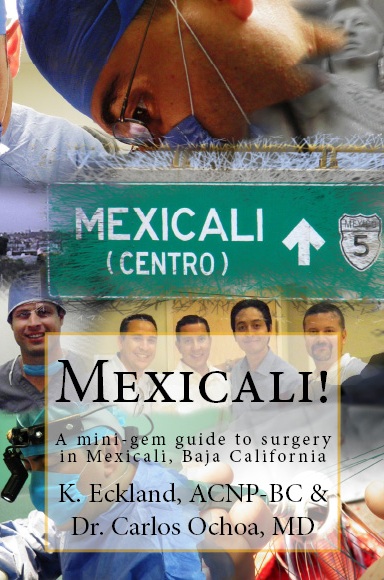
Finished the cover – which to me, is critical at this point.  (I use the cover to inspire me when it comes to the less than thrilling stage of copy editing) so I am posting an image here.

cover for the new book

Meeting with an architect later this week – to learn about, and write about some of the variety of styles here in Mexicali.  (There is such a surprising array – I thought it would be nice for readers to have a chance to know a bit more.)

Now there’s one house I’ve dubbed “Mexicali’s Graceland.”  I don’t know why Graceland comes to mind every time I go past this home (it looks nothing like Elvis’ home in Memphis) but the term has stuck.  I am hoping to get some of the history on this house because it just looks like a place where even the walls have stories to tell.

The pictures aren’t the most flattering – but I’ll post one so you can tell me what you think.  (It’s actually far more lovely in person – with the contrast between the pink walls and the white scrollwork, as well as some of the more classic design features.) I guess my imagination tends to run away with me – with images of grandeur and elegant ladies sipping champagne in the marbled halls of the past – but then – most of my usual writing is technical in nature, so I have few outlets for my creativity.

Mexicali’s Graceland

Meeting with my co-writer today to go back to the archives..

Canadians look towards medical tourism


In this story, several Canadian residents are suing the province of Alberta for the right to purchase private health insurance.  The Alberta resident who was interviewed in the story, explain that due to the prolonged wait times for medical treatment in his home country – he would like the right to pursue treatment in other countries.

One of the claimants explained that after being told that he would have to wait FIVE years for back surgery for debilitating back pain, he went to the United States for treatment.  On his return, his Canadian government refused to reimburse him for his medical treatment, stating that the treatment was available in Canada.

(BTW: the American price tag for surgery: $77,000)

Just another reason many North Americans are looking South for care.

Wrapping up and saying “Thanks!”


It’s a busy Sunday in Mexicali – presidential elections are today, so I am going to try to get some pictures of the nearest polling station later.. In the meantime, I am spending the day catching up on my writing..

a polling station in Mexicali

Lots to write about – just haven’t had the time..  Friday morning was the intern graduation which marks the end of their intern year – as they advance in their residencies.. Didn’t get a lot of pictures since I was at the back of the room, and frankly, unwilling to butt ahead of proud parents to get good pics.. This was their day, not mine and I was pleased that I was invited.

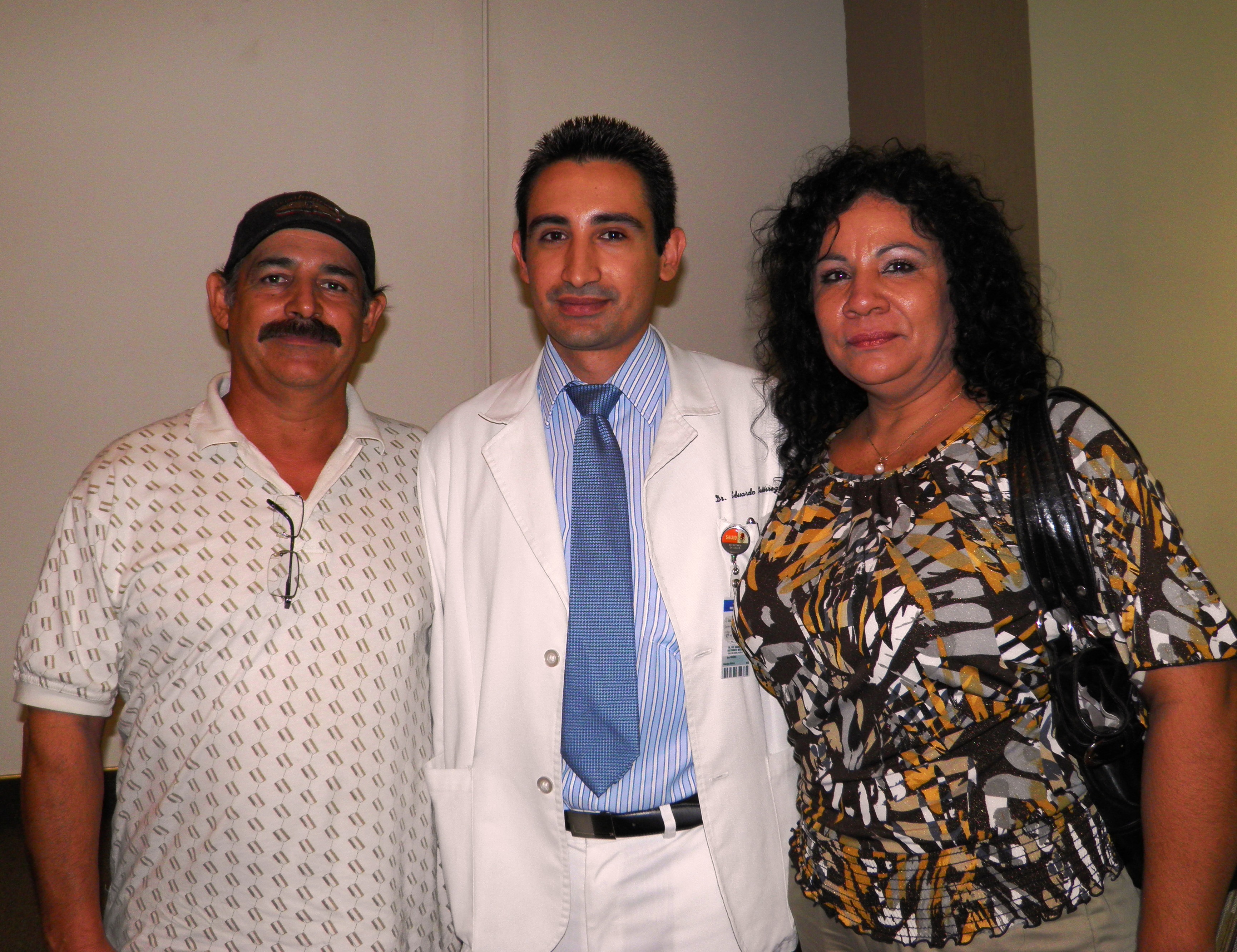
I did get a couple of good pictures of my ‘hermanito’ Lalo and Gloria after the event.  (I’ve adopted Lalo as my ‘kid’ brother.. Not sure how he feels about – but he’s pretty easy-going so he probably just thinks it’s a silly gringa thing, and probably it is..)

Dr. ‘Lalo” Gutierrez with his parents

Lalo’s parents were sitting in the row ahead of me, so of course, I introduced myself and said hello.. (They were probably a little bewildered by this middle-aged gringa talking about their son in atrocious Spanish) but I figured they might be curious about the same gringa that posts pictures of Lalo on the internet.. I also feel that it’s important to take time and tell people the ‘good things’ in life.  (Like what a great person their son has turned out to be..)

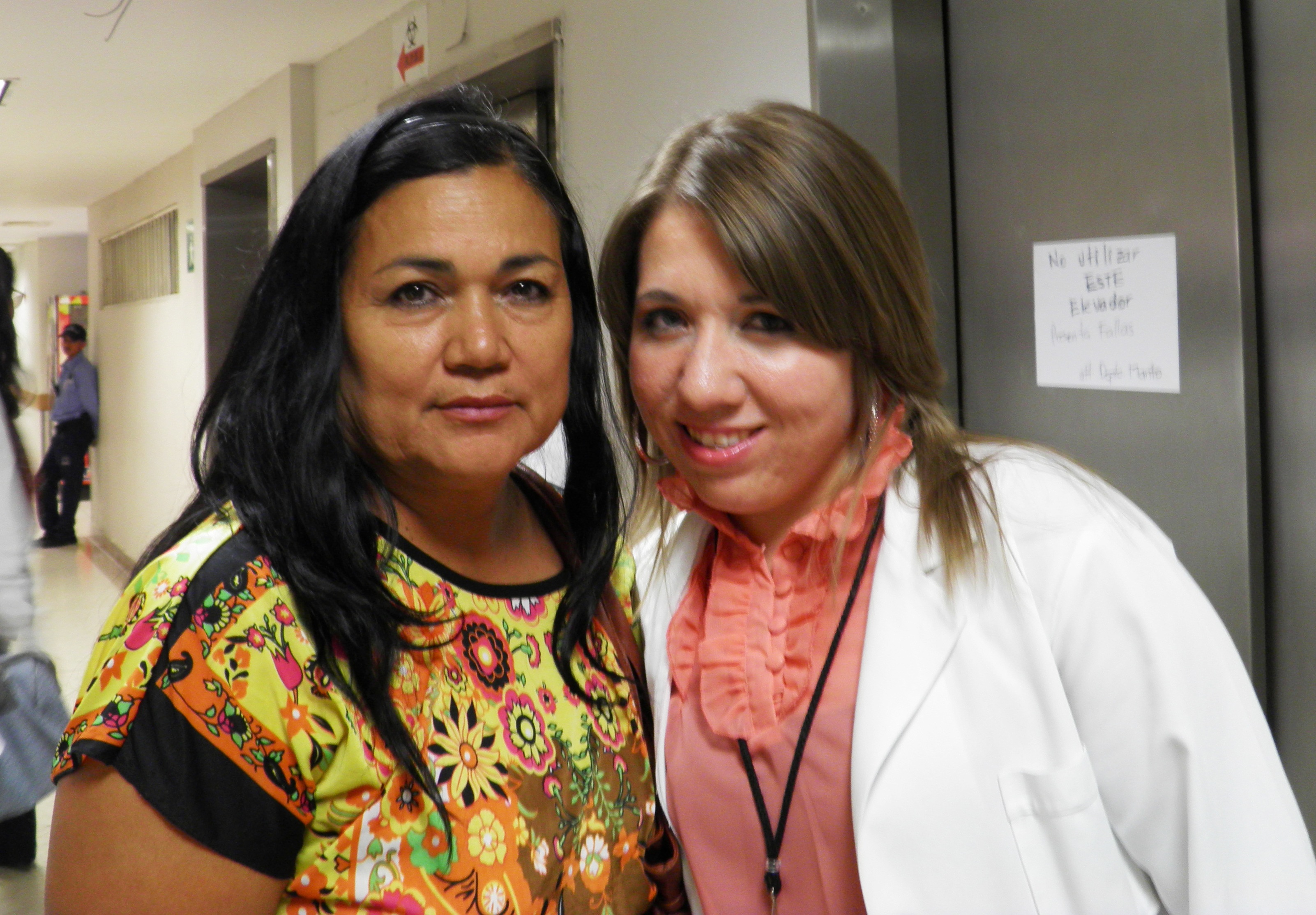
Same thing for Gloria.. She is such a hard-worker, and yet, always willing to help out.. “Gloria can you help me walk this patient?”  It’s not even her patient, (and a lot of people would say – it’s not our jobs to walk patients) but the patient needs to get out of bed – I am here, and I need some help (with IV poles, pleurovacs, etc.)  and Gloria never hesitates.. that to me – is the hallmark of an excellent provider, that the patient comes first .. She still has several years to go, but I have confidence in her.

She throws herself into her rotations.. When she was on thoracics, she wanted to learn.. and she didn’t mind learning from a nurse (which is HUGE here, in my experience.)

Dr. Gloria Ayala (right) and her mother

She wasn’t sure that her mom would be able to be there – (she works long hours as a cook for a baseball team) but luckily she made it!

Met a pediatric cardiologist and his wife, a pediatrician.. Amazing because the first thing they said is, “We want nurse practitioners in our NICU,” so maybe NPs in Mexico will become a reality.. Heard there is an NP from San Francisco over at Hospital Hispano Americano but haven’t had the pleasure of meeting her.  (I’d love to exchange notes with her.)

I spent the remainder of the day in the operating room of Dr. Ernesto Romero Fonseca, an orthopedic surgeon specializing in trauma.  I don’t know what it is about Orthopedics, but the docs are always so “laid back”, and just so darn pleasant to be around.  Dr. Romero and his resident are no exception.

[“Laid back” is probably the wrong term – there is nothing casual about his approach to surgery but I haven’t had my second cup of coffee yet, so my vocabulary is a bit limited.. ]  Once I finish editing ‘patient bits’ I’ll post a photo..

Then it was off to clinic with the Professor.

Saturday, I spent the day in the operating room with Dr. Vasquez at Hospital de la Familia. He teased me about the colors of the surgical drapes,(green at Hospital de la Familia), so I guess he liked my article about the impact of color on medical photography.  (Though, truthfully, I take photos of surgeons, not operations..)

Since the NYT article* came out a few days ago – things have changed here in Mexicali.  People don’t seem to think the book is such a far-fetched idea anymore.  I’m hopeful this means I’ll get more response from some of the doctors.  (Right now, for every 15 I contact – I might get two replies, and one interview..)

Planning for my last day with the Professor  – makes me sad because I’ve had such a great time, (and learned a tremendous amount) but it has been wonderful.  Besides, I will be starting classes soon – and will be moving to my next location (and another great professor.)

Professor Ochoa and Dr. Vasquez

But I do have to say – that he has been a great professor, and I think, a good friend.  He let me steer my education at times (hey – can I learn more about X..) but always kept me studying, reading and writing.  He took time away from his regular life, and his other duties as a professor of other students (residents, interns etc.) to read my assignments, make suggestions and corrections when necessary.    and lastly, he tolerated a lot with good grace and humor.  Atrocious Spanish, (probably) some outlandish ideas and attitudes about patient care (I am a nurse, after all), a lot of chatter (one of my patient care things), endless questions…  especially, “donde estas?” when I was lost – again.

So as I wrap up my studies to spend the last few weeks concentrating on the book, and getting the last interviews, I want to thank Dr. Carlos Ochoa for his endless patience, and for giving me this opportunity.  I also want to thank all the interns (now residents) for welcoming me on rounds, the great doctors at Hospital General..  Thanks to Dr. Ivan for always welcoming me to the ER, and Dr. Joanna for welcoming me to her hospital.  All these people didn’t have to be so nice – but they were, and I appreciate it.

* Not my article [ I wish it were – since I have a lot to say on the topic].

Kim Kardashian’s Mexicali secret.. (ads, that is)


Kim Kardashian on the red carpet – photo credit unknown

Looks like Dr. Victor Ramirez, the plastic surgeon in Mexicali that we previously interviewed here has ignited a firestorm of controversy by using the unauthorized likeness of Kim Kardashian (of reality television fame) to advertise his surgical skills.

While I don’t condone this behavior – the irony of the situation is unmistakable since Ms. Kardashian first shot to fame (and public attention) through public exposure of another sort entirelyIn fact, she along with Paris Hilton are two of the very ‘celebutards’ that popular media love to exploit while simultaneously decrying their actions.

Mexicali ad courtesy of Perez Hilton.com

Is the outrage against Dr. Ramirez, expressed by Kim Kardashian based on true or genuine anger or frustration against unwanted (and unpaid!) advertising, or just another slick publicity stunt in the wake of negative public sentiments regarding her highly profitable (yet amazing brief) marriage?  Even now, tales of her bickering and fighting over money with her ex still dominate the internet, tv and gossip columns..

Especially since the timing coincides nicely with the opening of her new lingerie line, the Kardashian Kollection..

Ms. Kardashian’s recent twitter pix,

Now, I’ve never met Ms. Kardashian, and I’m sure this situation might be aggravating, but at the same time – isn’t it just a bit flattering too?  That other people might choose to have a surgical procedure so that they can attempt to mimic your beauty?  If I were Kim – I’d sit down with Dr. Ramirez and work out some sort of agreement – for advertisements and endorsements..  But, wait..

Isn’t this the same woman who sued Old Navy for hiring a model for looking “too much” like her?

But then again – I’m just a nurse.

I’ve emailed Dr. Ramirez for his side of the story, (for more about the real Dr. Victor Ramirez – read our post here).

More on this story – elsewhere on the net

Fox News

Orange County Register

Now available in the Kindle Lending Library!


Now you can read Bogotá! for free in the Kindle lending library..  (I hope this inspires some generosity among critics for impoverished medical writers – leave some positive feedback about the book!!)


2011 in review: State of the Blog


Thank you to everyone for making Bogotá Surgery.org a phenomenal success!  Surprisingly – this annual report shows a few less views than our own counters – but we are thrilled all the same..  Here’s hoping for more and greater successes in 2012!

Here’s an excerpt:

The concert hall at the Syndey Opera House holds 2,700 people. This blog was viewed about 9,700 times in 2011. If it were a concert at Sydney Opera House, it would take about 4 sold-out performances for that many people to see it.

Click here to see the complete report.

The Motley Fool & Medical tourism


The Motley Fool takes on medical tourism.  For you aren’t familiar with this site, it’s a very popular financial blog with stories on the economy, popular stock picks, predicted trends and investment strategies for retirement planning.  I am only passing familiar with the site myself since I come from a family of economists, but you can imagine my surprise (and delight!) to see medical tourism given serious consideration and discussion on their blog.

It’s about time that people talk about medical tourism in a fair and realistic fashion.   It tends to be sensationalized in extremes either fantastic! amazing! awesome! extreme plastic surgery makeover style or devastating.  graphic. and disturbing horror stories.

But this is a more rational and balanced discussion of health care and medical tourism – by the numbers, so to speak.. and it’s about time.

Colombia and cultural standards of beauty


This article on Sabotage Times talks about some of the different cultural ideas of beauty – in this case, the cultural and historical appeal of the large behind or bottom in Colombia.  (This is definitely a case of Latin influence on the United States – as this beauty ideal has been rapidly adopted here at home) – leading to an increase in the number of ‘booty enhancement procedures’ for American patients.

These different cultural standards of beauty are also something we have talked about before – and how Latin America is setting the styles for USA and much of the world.  These ideals have been quickly adopted into the mainstream American beauty ideals of the 1990’s and beyond.

(If you remember the late 1070’s and 1980’s – most of us up here in North America [and our mothers] – were out there starving and aerobicizing ourselves to try an obtain the tiny, flat bottom of a 12 year old boy.)

While some of this is undoubtably related to the large population of American residents with hispanic origins and the reflection of their beauty ideals – Colombia, Brazil, and Argentina have long been trend setters for fashion and beauty (which includes plastic surgery.)  This is one of the trends that makes these destinations so popular for plastic surgery.

For more on Bogotá plastic surgeons – see here, here and here.

For more on plastic surgery and ‘booty enhancement’ gone wrong – see here at our sister site.

Celebrating National Nurse Practitioners Week


In honor of the profession that has brought me so much career and personal satisfaction – I am posting several links about Nurse Practitioners, and National Nurse Practitioner week.

This evening, I had the privilege of speaking with Dr. Angela Golden, DNP.  Dr. Golden is a family nurse practitioner here in Flagstaff, an Associate Professor at the Northern Arizona University (NAU) School of Nursing as well as the president-elect of the American Academy of Nurse Practitioners (AANP).  She’s a fascinating lady, and she was talking about the Institute of Medicine’s  recent statement of the Future of Nursing – and what it means for Nurse Practitioners and the future of health care in the United States.

But, as you know – national borders have never hampered my vision, and I am happy to say that nurse practitioners are growing (and thriving!) in Canada, New Zealand, the United Kingdom and other countries around the world.  We’ve talked about the efforts of surgeons in Japan and other countries in establishing the NP role..

New Zealand poster

This local (Arizona) organization has a nice explanation about nurse practitioners and the services many of us provide.

New Jersey (NJ.com) blog talking about the contributions NPs have made to health care.

NP Fact sheet – AANP information about NPs

NP & PAs – timelines of the Nurse Practitioner profession

US congress recognizes NPs

Nurse Practitioner week article – Amarillo, TX

AANP statement

Meta-analysis of NP care

More about NPs, MDs and Midwives

Just a small selection this evening – I hope you’ve enjoyed.

The Medical Tourism Association, Quality and Accountability


Over at the Traveling 4 Health blog, I’ve been talking to Ilene Little and reading about the Medical Tourism Association’s (MTA)newest publication promoting Las Vegas as a new medical tourism destination for both American and International patients.

The irony of this destination is highlighted by the city’s own newspaper, The Las Vegas Sun, which has an extensive series, ‘Do No Harm: Hospital Care in Las Vegas’ detailing recent health scandals in Las Vegas hospitals, as well as 2010 reports ranking several of the facilities in Las Vegas among the worst in the nation.  In fact, the opening sentences in the article series are, ” There’s a running joke about hospitals here: “Where do you go for great health care in Las Vegas?”

“The airport.”

It’s a disappointing entry by an organization I admire – but unfortunately, it highlights the lack of accountability by medical tourism companies to their clients. Someone needs to care about the quality of the product (providers and services) that they are promoting.  Too bad it isn’t the MTA since they are certainly among the movers and shakers in the international medical tourism industry.  The rest of us are just tiny fish in a great big pond of obscurity.

New article on HIPEC


There’s a new article on the HIPEC procedure that’s a nice read for people interested in this procedure.  The article is unrelated to medical tourism – it’s about the first application of hyperthermic intraperitoneal chemotherapy at a private facility in India.  (As you can imagine – I wouldn’t recommend that anyone have a procedure at a facility where doctors have just started trialling the technique.) That being said – the article gives a nice overview of the procedure itself.

iTunes book catalog


It looks like after several weeks of tedious reformatting to meet Apple’s strict e-book standards – the revised 2011 edition of Cartagena! will be in the Apple iBook catalog.  I’m still working on re-formatting The Thoracic Surgeons, and I have barely begun Bogota.

However, the Spanish translation of Bogota! is complete – so once I finish some formatting and final editing – I’ll be publishing Bogota! en espanol to Amazon.com. Loks like I have a couple of weeks in front of the computer ahead of me but let’s hope that everything goes smoothly.

Diabetes – Global epidemic, part II


As reported at Medpage – the latest Diabetes estimates were released by the International Diabetes Foundation (IDF) this week at the EASD (European Association for the Study of Diabetes) as the news was even grimmer than predicted just a few short months ago: Researchers now estimate 366 million people HAVE diabetes worldwide – greatly surpassing all previous estimates – causing 4.6 million deaths every year.

Leading physicians at this year’s conference continued to stress the importance of Early diagnosis and treatment of Diabetes to prevent serious complications (and death).  This is something we’ve talked about here at Cartagena Surgery – the need for early diagnosis, prompt treatment and aggressive risk reduction.

Preventing diabetes remains a key element of this strategy, but one which we are failiing miserably.  Simple dietary changes such as reducing the consumption of sugar-laden beverages appears to be impossible to implement as we are hopelessly entrenched in American diets (and Indian, Chinese and other nations – as they adopt our fast-food habits).

As many of my face-to-face patients already know, one of the best lines of defense is also one of the oldest in our arsenal of oral anti-glycemics.  For all of my patients who have heard my metformin spiel in person, feel free to skip ahead.  As we’ve discussed in lectures and presentations – Metformin, that simple drug from the 1970’s (one of my $4 faves) has so many side benefits – and the potential cancer benefits are encouraging.. [what’s not encouraging  – is the difficulty getting patients to take their medications regularly – even humble Metformin which is one of the safest, most effective – (clinically proven!) and cheapest diabetes drugs available.]

*as many readers and patients know – this is the one topic where even Cartagena Surgery gets overwhelmed at times.. There is just so much disease/ disability and suffering but it seems like no one is listening or cares enough about themselves to change their habits.**  Please – dear readers – prove me wrong, and write me letters to let me know how you are taking control of your diabetes and your health..

Goodreads Giveaway ends Sept 18th!


Just a reminder – your chance to win a free autographed copy of (the newly revised) Bogotá! a hidden gem guide to surgical tourism ends September 18th.  You can still enter here!

If you aren’t familiar with Goodreads – it’s an on-line ‘Book Club’ that allows people to share their reviews of their favorite (and not so favorite books.)  It also allows readers to catch up with and connect with their favorite authors..

All apologies


to my dear readers and loyal supporters.  On reviewing the most recent batch of books, I noticed several heinous spelling errors!  I find this horribly disturbing – as I mentioned previously – I had several edits, with different proof-readers including a PhD in English.

Perhaps it’s a case of too many cooks in the kitchen, but in any case – I am absolutely horrified – and am re-reviewing the entire manuscript for re-submission.  Abject apologies..

E-formats and other things..


Still working on creating the e-formats of Bogotá!  Due to my unstoppable love for footnotes, re-formatting the manuscript for electronic formats is a slow, tedious and painstaking process.  After several days of working at it (25 + hours so far – I am only on about page 80) but as annoying as re-formatting is – it’s also necessary so that my e-reader using buyers have a high quality, easy-to-read book.

I’ve hired a translator to start working on creating a Spanish version of the book, for all the native Bogotanos (only seems fair that they should be able to use my book) – as well as my other Spanish readers.  Should be about a month to complete – and then I’ll start formatting that book into electronic formats as well.  So there is still a lot of work ahead of me, but that’s the life of the independently published writer.  I don’t have an army of minions to do these things for me; I am writer, investigator, fact-checker, publicist, graphic artist, typesetter, publisher and the IT department all rolled into one.

It’s definitely been an interesting process this time around, and I don’t regret self-publishing because I like having creative control.  I think that’s essential in a project like this when your integrity, and your honesty is the basis for the product.

Another beautiful Sunday in Bogota


where ten million people stop to enjoy the day, walk and ride bikes – spend time with their families.  My friends are off flying kites today.  How old were you when you last flew a kite?  (I know I was about ten years old – and had some keen idea about combining it with my skateboard.  Needless to say – it didn’t go well.)  That’s Bogotá in a nutshell – where traditional so-called ‘small town’ values like Sunday afternoons with family is enmeshed with big city sophistication.

El Dorado Airport,  Avianca terminal –

waiting for my plane to Cartagena.  Leaving Bogotá always breaks my heart just a little – all of Colombia has this effect, but particularly Bogotá.  Colombia is a country looking forward, full of hope and opportunities for the future.  Some of my  fellow American friends here liken it to The United States in the early 80’s kind of feel – and that’s very true.  You don’t realize how much that feeling is now missing in the United States until you come here.  The daily weight of inflation, unemployment and our continuing recession drag down on all of us so deeply that we miss the small pleasures all around us.

But Bogotá, and Bogotanos still have that zest for living – with continuing economic growth, and expanding financial opportunities.  Everywhere you turn – there is expansion, improvement and new ventures being created.  It’s an exciting time to be in Bogotá.  The medical industry here in no way exempt from all of this – several hospitals unveiling new programs, expansion plans and new technologies.  It’s refreshing to see after several years of watching continuous downturns, program closures and economic hurt at home.

Of course, as a very large city, Bogotá struggles with many of the same problems as its global counterparts – poverty, inequity, and other social problems remain commonplace.  But for the medical tourist – and medical writers like myself – it remains an interesting and fascinating place for opportunities for state-of-the-art health services and medical care.

Book Party!


Signing a book for Dr. Freddy Sanabria


Author’s Cafe,

Bogotá, Colombia

Had a wonderful event to share my book with and thank all of the people who made it possible.  (No surgeons, no book).  It was wonderful to see everyone – and I want to thank all the surgeons – who literally came straight from surgery to give their support of this project.  Some of the great friends I have made from all walks of life (outside the hospital) were also there – which means a great deal – I know that I live and breathe writing and surgery, but I also know that this is not true for most people.

That’s been the theme of all of my visits to Colombia; kindness, caring and support.  So many people; from surgeons, nurses, to taxi cab drivers and even random strangers in passing have been kind to the little (sometimes lost) American.

What’s next?

About 1/3 complete on formatting the e-version.  It’s a tedious job, but once it’s complete – it will give me the freedom to do instant book updates as needed.

Also hoping to translate the book into Spanish versions. It’s been difficult to find someone due to the technical/ medical language.

Now that the Bogotá project is essentially complete – I anticipate that this blog may change in focus – similar to Cartagena Surgery.  There will be more of a focus on medical tourism and medical news, now that interviews will be few and far between.  (Never done entirely.)


Another fraudulent surgery clinic


this time in Los Angeles, where several individuals were posing as licensed physicians.  A sting operation was conducted after several patient complaints – and injuries.  The story in the Manila paper is here. The LA Times initially broke the story.

Notably, the clinic operators had posted fake degrees and credentials on the walls.  (This is why it’s important to independently verify credentials with state licensure boards).  Anyone with a scanner, and basic computer literacy can print up and fake any document they want..

I’ll keep posting these stories as a reminder for people to use credible sources for information about their doctors (such as well researched books like mine) or licensure boards.

(While most of the stories appear to originate in the United States I think this is probably just a result of our media interests – and what makes national and international headlines.  There are frauds everywhere, who just want people’s money – they don’t care if people get hurt or die in the process.

Unfortunately, many of these people operate for years before they get caught, if ever.

In international news, the need for investigation and medical scrutiny of medical tourism is becoming more and more apparent.  (I told you that Cartagena Surgery was a trendsetter.)  Now, if only we could translate that into book sales.

Final drafts.


Looks like I am getting closer to the finish line; I submitted what is (hopefully) the last and final draft last week.  After one last round of review – it will be off to the publisher.. (This is the most frustrating part of the process – it’s all formatting issues – unrelated to content.)

Otherwise – the book looks pretty darn good!

Proof copies!

Proof copies!!


Interview with Sanivisit in Reston, Virginia


This morning I met with executives from Sanivisit, a new medical tourism company based here in Reston, Virginia.  This company is affiliated with the Colsanitas corporation in Bogotá, Colombia.

I met with Mr. Alberto Ospina, a native Bogotano and President of Sanivisit and his colleague, Ms. Monica Wainbarg, Medical Tourism Advisor.  Both of them were very gracious and interested in this project.

I was surprised and pleased to see that both of these individuals have certainly done their homework.  In this past, I have had mixed experiences with medical tourism companies.  Some have been excellent, but others like the LaMontes, (interviewed for Cartagena surgery project) were blatant opportunists with little understanding or caring about the specialized needs of the medical tourist.

This was not the case with Sanivisit.  Both of the executives I met with have personally visited and met with all of the physicians involved.  They have toured and inspected travel facilities, and have arranged for VIP services for their clients.  As Mr. Ospina explained, “I’ve been in every hotel, measured the rooms, talked to the staff.  I make sure that rooms are clean, and comfortable.  I make sure that there is room for wheelchair accessibility. I talk to everyone. I make sure that everyone involved knows what we are doing.”

This includes arranging for transportation, diagnostic testing, doctors appointments, private nursing care after surgery, and even physician house calls, if needed.

Right now, they are trying to get the Colsanitas hospitals included in some of the medical tourism pilot projects (as alternatives to India) with several health insurance companies.  As readers know, several other large health insurance companies already support and encourage medical tourism excursions, and have establish separate divisions to assist medical tourism efforts.  (Unfortunately, in many cases these divisions exclusively work with Indian hospitals.  As we’ve discussed at Cartagena Surgery on multiple occasions, and published elsewhere on-line – India is a less than ideal location for American patients for several reasons.)

Since the company is in its infancy. the next year will be the trial by fire for Colombian medical tourism, Sanivisit and Colsanitas.  They seem like genuine, and caring individuals.  I wish them the best of luck.

In the future, I hope to interview some of their returning clients for readers here – to get their perspectives and experiences.

Disclosure: 

For the sake of absolute transparency and honesty, I would like to disclose that I have offered several of my articles on Medical tourism to Sanivisit for their use (with no compensation or remuneration.)

Update: October 2011

Sanivisit participates in medical tourism conference

American Hospitals get into the act: Bariatric Surgery


After recent changes in the recommendations for the treatment of obesity and diabetes supporting the use of surgery (as previously discussed here) American hospitals have begun aggressively campaigning for medical tourists.. Several hospitals in Tennessee have created Bariatric programs to steer interested patients to their clinics – and in some cases are using TennCare dollars to do so. (TennCare is the Tennessee medicare program – which has been plagued with problems since it’s inception.)

With the FDA lowering the BMI restrictions for Lap-band procedures in particular, this procedure which is often marketed as the ‘easy bariatric surgery’ has taken off in popularity.  This is concerning since much of the research shows this device to be limited in effectiveness, particularly in the treatment of diabetes.

These BMI restrictions which were reduced from a BMI of 35 (with diabetes)  down to 30 can also be viewed as a government endorsement of the Lap-Band device since similar recommendations regarding the more definitive procedures such as Roux-en-Y have not been addressed.  It looks like a double win for this private company (Allergan) as the FDA prepares to approve this device for use in teenagers as young as 14, despite criticisms from the medical community.

Now in the past, I have strongly advocated for better and more aggressive treatment recommendations for diabetes and morbid obesity – but I have also believe in following the scientific data and research findings – which just don’t seem to support Lap-Banding for permanent / effective weight loss or blood sugar reductions.  Like we’ve seen several times before, these ‘easy’ quick fix solutions to try to take short cuts around surgery don’t always work – and in the end, you end off worse off then someone who didn’t have any procedures at all.  If patients want effective solutions to real problems – we should give it to them.  But we need to stop candy coating the risks and dangers, and hard selling devices, and give patients the actual facts.

I’d also like to recommend that interested readers sign up for Medscape.com accounts – it’s free and they have an entire section devoted to obesity/ diabetes/ bariatric procedures that highlights all of the research related to different procedures, and treatments.  I try to re-post when I can but it’s difficult for lengthy articles.

In that spirit – I have re-posted the latest gastric bypass article from Heartwire below.  (Interesting commentary that heartwire has a bariatric surgery section now.) It’s another Reed Miller report dated May 2, 2011:

Gastric Bypass Does More than Reduce Weight

April 29, 2011 (New York, NY) — Gastric-bypass surgery may provide benefits to patients with type 2 diabetes beyond the benefits that can be directly attributed to weight loss, a new study finds [1].

According to Dr Blandine Laferrère (St Luke’s Roosevelt Hospital, New York, NY) and colleagues, recent studies that show a strong correlation between the concentrations of plasma branched-chain amino acids (BCAAs) and related metabolites with insulin resistance and loss of insulin sensitivity raise the possibility that the rapid remission of diabetes seen in many diabetic patients after gastric-bypass surgery may be related to the pronounced changes in BCAAs or other metabolites and not the weight loss alone.

In a study published in the April 27, 2011 issue of Science Translational Medicine, Laferrère et al found the total amino acids and BCAAs decreased in the gastric bypass surgery group but not in a similar group of patients who lost the same amount of weight (10 kg) with diet alone. Also, the metabolites derived from BCAA oxidation decreased only in the surgery group. Levels of acylcarnitines and BCAAs and their metabolites were inversely correlated with proinsulin concentrations, C-peptide response to oral glucose, and the insulin-sensitivity index after weight loss, whereas the BCAAs and their metabolites were uniquely correlated with levels of insulin resistance.

These data suggest that the enhanced decrease in circulating amino acids that follows weight loss after gastric-bypass surgery is caused by a mechanism other than weight loss and may be related to why gastric-bypass patients often show more rapid improvement in glucose homeostasis than similar patients who lose weight without surgery, Laferrère et al conclude. However, the authors caution, “Whether the decrease in these metabolites and the implied activation of fuel oxidation is a cause or consequence of the diabetes remission after gastric bypass remains to be determined. . . . Future studies will further characterize the pathways involved in these metabolic alterations and will seek to understand whether the specific metabolic signature of [gastric-bypass surgery] is related to changes in gut peptides after surgery.”

In an accompanying perspective [2], Drs Robert E Gerszten and Thomas J Wang (Harvard University, Boston, MA) agree that “further work is needed to establish whether the reduction in concentrations of circulating amino acids after weight loss is the cause or a consequence of improvements in insulin sensitivity.”

Circulating amino-acid concentrations are likely to be determined partly by genetics and partly by environmental and nutritional factors, they explain, so “dissecting these effects will require nutritional manipulation studies with a variety of amino acids to be conducted in human subjects, especially given the availability of profiling technologies that permit characterization of the molecular consequences of such interventions,” the editorialists state.”

To the multiple readers who emailed me for more bariatric surgery/ diabetes information – I usually post whenever new or interesting information gets published. If you send specific questions about procedures, indications or related matter – I will try and address it in a future post.

Dr. Albert Klein


Met with my not-so-hidden co-writer to go over our notes, and to start the editing process.  Dr. Klein has written all of the drug content (he’s a clinical pharmacist), and much of the Bogotá city chapter.  We’ll be getting together again this week to go over the book, in-depth and try to get a little closer to publication.  It’s the first time I’ve seen him since leaving Bogotá, so it was great to get together again.. Now it will be a lot coffee (and sushi – our brain food) until the book is finally complete.