A full year after we reported it here (and several years after initially being reported in the literature), mainstream media has finally picked up the story about gastric bypass surgery for the definitive treatment of diabetes. The story made all of the heavies; the Washington Post, the Wall Street Journal, and the Los Angeles Times.
Unfortunately, all of these outlets seem unaware of the existing literature in this area – these results while encouraging, are not surprising. Similar results have been demonstrated in several other (but smaller) studies for the past ten years, which led to previous recommendations (last summer) for the adoption of gastric bypass surgery as a first-line treatment for diabetes in obese patients.
The publication of two new studies showing clear benefits for diabetics undergoing bariatric surgery has brought this news to the forefront. In both of these studies, diabetic patients were able to stop taking oral glycemics and insulins after surgery within days..
You heard it here first. For more information on this topic, see our tab on Diabetes & Bariatrics under the ‘surgery’ header. We’ve included a small selection from our archives here.
This study which was performed using data from European cardiologists (who have been using this technology longer) were unsurprising – with a higher risk of stroke and overall mortality. Notably, this study was performed on patients deemed to be ‘at high risk’ for surgery, not ineligible for surgery. As we’ve discussed before, the term ‘high risk’ is open to considerable interpretation.
“ A total of 996 frail, elderly patients at high risk for heart surgery were implanted with Medtronic’s CoreValve device, used to treat severe narrowing of the aortic valve. Mortality rates at one month and six months were 4.5% and 12.8%, respectively. Stroke rates were 2.9% and 3.4%.
Medtronic said the rates were consistent with previously reported data from national registries in Europe.”
Unfortunately, the general media’s coverage of these findings have been less than straightforward as Bloomberg proclaims in blazing headlines, “Edwards heart valve skirts rib-cracking for a 2.5 billion dollar market.” That’s a pretty eye-opening headline that manages to avoid mentioning the real issues – longevity and durability.
Another article from business week proclaims, “Heart Valves found safe.” Safe, I guess is a relative term – if you aren’t one of the 12.8% that died within six months..
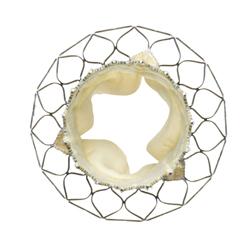
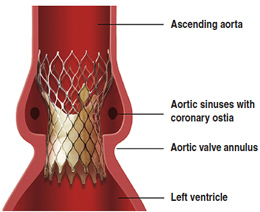
Illustration showing the core valve in place
More about Aortic Stenosis and Valve Replacement therapies at Cartagena Surgery: (you can also find a link to these stories under the TAVI tab on the sidebar.)
As you all know, thoracic surgery is my life, and my love. But it has been a while since I’ve hit the road and done some serious writing. A year ago, I was researching and writing my second book, living ‘on location’ in Bogota, Colombia – and I miss it!
I miss the life of a traveling writer; meeting new people, and learning (learning, learning, learning!) new things, and writing about all of it; the highs, the lows, the things that are mundane in everyday life but somehow become new and interesting when you are doing it somewhere else.. Why is riding the bus in your hometown boring and frustrating, but that same bus in Madrid, Bogota or London becomes a mini-adventure in itself? (It’s not just the second story in London that makes it fun.)
But at the same time, it is always so difficult for me to be away from my patients, thoracic surgery and nursing – all the things that I do so much better than my mediocre writing.
Now I have a chance to do both. It’s a dream come true, even if like most dreams – the nitty-gritty details don’t always stand out; no salary (yet again), but I am thrilled with the opportunity nonetheless. I’ll be studying as a student at the elbow of a young, energetic and up- and-coming thoracic surgeon. In him – I’ve met my match (and then some!) He has the energy and the passion for thoracics that brings joy to long days, and hours on your feet.. But he is also a talented surgeon, who is excited about teaching – and that pleases me to no end.
Right now, my family is preparing to move; boxing up our lives, and getting ready to immerse ourselves into my newest endeavor – and I am taking all of my readers with me. It will be a change from the usual posts, but one I hope that everyone will enjoy.
In Mexicali for a few days, to find an apartment and get ready for the big move. Looked around but the ‘Kim’ billboard is gone.
I’ve already gotten a new SIM card for my cell watch. (Yes, my newest tool is the cell phone I can’t lose or forget – because it’s strapped to my wrist..) Luckily, it has bluetooth so I don’t have to talk into my watch – though when the 007 mood strikes me, I’ll be able to.
Not as innocent as the Corn Refiners Association would have you believe.
In a courtroom in Los Angeles, a fierce battle is being pitched right now – one that affects almost every person in this nation.. It’s a lawsuit from the nation’s sugar producers accusing the corn industry of false advertising.. That’s right – it takes industry giants to take on those ridiculous, and mis-leading ads.
But, here (finally) is a response to those ads – that uses science, not fallacy to refute those claims.
At the same time, the Corn Refiners Association has filed a petition with the Food & Drug Administration to change the name of their product from ‘High-fructose corn syrup” to the more innocuous-sounding “Corn Sugar,” which is just another attempt to deceive the American public.
Unfortunately, corn syrup in our everyday products in not usually so easy to identify.
A soda a day raises CHD risk by 20% – Lisa Nainggolan
March 12. 2012
Boston, MA – Sugary drinks are associated with an increased risk of coronary heart disease (CHD) as well as some adverse changes in lipids, inflammatory factors, and leptin, according to a new analysis of men participating in the Health Professionals Follow-up Study, reported by Dr Lawrence de Koning (Children’s Hospital Boston, MA) and colleagues online March 12, 2012 in Circulation [1].
“Even a moderate amount of sugary beverage consumption—we are talking about one can of soda every day—is associated with a significant 20% increased risk of heart disease even after adjusting for a wide range of cardiovascular risk factors,” senior author Dr Frank B Hu (Harvard School of Public Health, Boston, MA) told heartwire. “The increased risk is quite substantial, and I think has important public-health implications given the widespread consumption of soda, not only in the US but also increasing very rapidly in developing countries.”
The increased risk is quite substantial, and I think has important public-health implications given the widespread consumption of soda.
The researchers did not find an increased risk of CHD with artificially sweetened beverages in this analysis, however. “Diet soda has been shown to be associated with weight gain and metabolic diseases in previous studies, even though this hasn’t been substantiated in our study,” says Hu. “The problem with diet soda is its high-intensity sweet taste, which may condition people’s taste. It’s still an open question whether diet soda is an optimal alternative to regular soda; we need more data on this. ”
Hu says water is the best thing to drink, or coffee or tea. Fruit juice is “not a very good alternative, because of the high amount of sugar,” he adds, although if diluted with water, “it’s much better than a can of soda,” he notes.
And Hu says although the current results apply only to men, prior data from his group in women in the Nurses’ Health Study [from 2009] were comparable, “which really boosts the credibility of the findings.”
Inflammation could be a pathway for impact of soda upon CHD risk
Hu and colleagues explain that while much research has shown a link between the consumption of sugar-sweetened beverages and type 2 diabetes, few studies have looked at the association of these drinks with CHD.
Hence, they analyzed the associations of cumulatively averaged sugar-sweetened (eg, sodas) and artificially sweetened (eg, diet sodas) beverage intake with incident fatal and nonfatal CHD (MI) in 42 883 men in the Health Professionals Follow-up study. Beginning in 1986 and every two years until December 2008, participants answered questionnaires about diet and other health habits. A blood sample was provided midway through the study.
There were 3683 CHD cases over 22 years of follow-up. Those in the top quartile of sugar-sweetened-beverage intake had a 20% higher relative risk of CHD than those in the bottom quartile (RR 1.20; p for trend <0.001) after adjustment for age, smoking, physical activity, alcohol, multivitamins, family history, diet quality, energy intake, body-mass index, preenrollment weight change, and dieting.
Adjustment for self-reported high cholesterol, high triglycerides, high blood pressure, and diagnosed type 2 diabetes only slightly attenuated these associations, which suggests that drinking soda “may impact on CHD risk above and beyond traditional risk factors,” say the researchers.
Consumption of artificially sweetened drinks was not significantly associated with CHD (multivariate RR 1.02; p for trend=0.28).
Intake of sugar-sweetened drinks, but not artificially sweetened ones, was also significantly associated with increased triglycerides and several circulating inflammatory factors—including C-reactive protein, interleukin 6 (IL-6), and tumor-necrosis-factor receptor 1 (TNFr1)—as well as decreased HDL cholesterol, lipoprotein (a) (Lp[a]), and leptin (p<0.02).
“Inflammation is a key factor in the pathogenesis of cardiovascular disease and cardiometabolic disease and could represent an additional pathway by which sugar-sweetened beverages influence risk,” say Hu et al.
Cutting consumption of soda is one of easiest behaviors to change
Hu says that one of the major constituents of soda, high-fructose corn syrup, is subsidized in the US, making such drinks “ridiculously cheap” and helping explain why consumption is so high, particularly in lower socioeconomic groups.
Doctors should be advising people with heart disease or at risk to cut back on sugary beverages; it’s almost a no-brainer.
“Doctors should set an example for their patients first,” he stresses. “Then, for people who already have heart disease or who are at high risk, physicians should be advising them to cut back on sugary beverages; it’s almost a no-brainer, like recommending that they stop smoking and do more exercise. The consumption of sugary beverages is a relatively easy behavior to change.”
And although this particular study included mostly white subjects and there are few data on the risk of cardiovascular disease associated with the consumption of soda in people of other ethnicities, there are data on its effect on type 2 diabetes in these groups, he says.
“It has been shown for minority groups—such as African Americans and Asians—that they are more susceptible to the detrimental effects” of sugary drinks on diabetes incidence, he notes.
This, along with recent economic developments in the tourism industry are encouraging signs of an economic upswing for Colombia, Cartagena and all of Latin America. Intercontinental Hotels Group is also planning on building several new properties in Colombia – including Bogotá, Barranquilla and Cartagena.
Recent arrests of several leaders of FARC along with successful negotiations and changes in drug enforcement legislation, along with President Juan Manual Santos continued popularity help boost the appeal of Colombia to investors. But – as readers know – finance is not my area of expertise.. So I have asked several financial and economic analysts for their thoughts..
If this whirlwind tour of Colombia isn’t enough for you – there are Bolivian and Panama add-on options. Or you could always rent an apartment and stay a while (like I did.)
For a more tailor-made tour of Colombia, contact Mantaraya Tours. This Colombian travel company offers a multitude of options to fit your budget (and your dreams!)
I wrote this post for the friends and family who were fascinated by my travels to Colombia – and wanted to see for themselves. I have no affiliationor relationships with either of the companies listed. (But if they are reading this – hope they buy a copy of the book).
Another story on the tireless efforts and surgical excellence of Bogotá surgeons – this time, Dr. Giovanni Castano, an opthalmologist. While I have never had the opportunity to interview Dr. Castano personally, I am not surprised that he donates his time and services to patients in remote parts of Colombia.
This tireless dedication to service is an integral part of Colombian medicine and Colombian surgeons themselves. As part of their health care training, Colombian doctors and nurses spend anywhere from several months to a year in rural parts of Colombia as part of a government service program. This serves as a foundation for a lifetime of service for many of these individuals and is a hallmark of the care I witnessed and received during my time in Bogotá.
Now, I’ve never met Ms. Kardashian, and I’m sure this situation might be aggravating, but at the same time – isn’t it just a bit flattering too? That other people might choose to have a surgical procedure so that they can attempt to mimic your beauty? If I were Kim – I’d sit down with Dr. Ramirez and work out some sort of agreement – for advertisements and endorsements.. But, wait..
In another disturbing sidenote out of Nevada – Teva pharmaceuticals settled a case against them for the distribution of propofol outside of proper channels/ and in improper quantities. (If you remember, this is how Dr. Conrad Murray obtained the anesthetic for use on Michael Jackson.) As a result of this distribution of multi-use medications that should be exclusively used in hospital settings – several patients were inadvertently exposed to Hepatitis C (including the plaintiff who developed Hepatitis C as a result.)
[Multi-use vials mean that the same container of medication is used for multiple people – if the medication is drawn up using needles or other instruments that have already been exposed to patients – this places future patients in contact with blood and infectious agents.] Multi-use vials are a cost-containment measure for many institutions.
I hope that someone takes issue with out-patient colonoscopies as a whole since this in itself can be a very dangerous practice – and the research proves it. (The issue behind outpatient procedures such as colonoscopies is the use of unmonitored anesthesia. Most patients aren’t on monitors, no anesthesiologist is present, and the doctors performing the procedure are often unprepared in the event that a patient loses his airway (or stops breathing.) There was a landmark study several years ago – that showed that 70% of nonaesthesiologists underestimated the level of sedation in patients undergoing out-patient / office procedures. [I will continue looking for the link to this source.]
There’s a new medical tourism report written by an economist which takes issue with many of the ‘reported facts and figures’ which are bandied about by the medical tourism industry. As we’ve discussed on previous posts – many of these numbers are fairly nebulous and impossible to verify. (Afterall, there is no exit surveyor at airports to ask, “During your stay in Mexico, did you undergo any surgical procedures?”)
The report sounds interesting – but at a cost of 800 pounds – it’s out of reach for people like myself. By the same token, I’d like to know by what methods Ian Youngman was able to quantify his results – since the problems of obtaining accurate numbers is fairly universal.
However, it’s an interesting glimpse into an industry that promotes a lot, but often proves little.
Update :
Another new report – this one by TreatmentAbroad which states that in a survey of their customers – 9 out of ten would do it again. The press release describes their survey methodology and the company offers readers more information, and invites questions about the project.
But truthfully, not bad, case western, not bad at all.. It’s a good article with a nice explanation for people new to Hyperthermic Intraperitoneal Chemotherapy – (and I am always happy to see more state-of-the-art treatments offered to people with cancer.)
That’s one of the reasons we’ve championed HIPEC here at Bogota Surgery – state-of-the-art cancer treatment with an excellent track record according to medical literature and published research. Too often patients, particularly patients with cancer or other serious medical illnesses are preyed upon with junk or uncertain science, like super-vitamin supplement programs, Laetrile clinics and quasi-futuristic stem-cell therapies.
We first encountered HIPEC in Bogotá at the hands of Dr. Fernando Arias at Fundacion Santa Fe de Bogotá. In our continued quest for information (see our series on HIPEC) – he continues to be at the forefront of HIPEC treatment with more experience than doctors like Dr. Trey Blazer at Duke, teams at Case Western, and the other scattered programs throughout the United States. With the exception of its creator, Dr. David Sugarbaker – Dr. Arias has as much experience, evidence and training as anyone I’ve encountered..
See our tab labelled Cytoreductive Surgery for more on HIPEC
(If you remember – the kind-hearted, and gracious surgeon shrugged off any accolades during our interview – and said he and his team travel to these remote areas to prevent further hardships for his patients.) He also shrugged off any concerns for his own welfare despite the fact that some of these areas are close to / are located in areas with a heavy FARC presence.
So even if the Los Angeles Times doesn’t congratulate Dr. Pineros and his team for all their amazing work – we here at Bogota Surgery haven’t forgotten..
Dr. Diego Pineros (second from left) and his surgical residents at Clinica San Rafael in Bogotá
The New York Times just published a new article that echos my concerns with the validity of anonymous on-line physician reviews (fakery/ fraudulent reviews, skewed perceptions and biased evaluations.)
Don’t get me wrong – the internet is an incredibly powerful tool (after all – that’s how you found about this blog, and my independent review project.) But it needs to be upfront and above-board. Anonymous postings have little value in a competitive market like healthcare and often amount to little more than propaganda (if positive) or even spam or harassment (if negative). Also multiple studies have shown that unhappy clientele (for any service, not exclusively healthcare) are 20 TIMES more likely to mention their experience to others and mention it to 5 times as many people as people who are content/ happy or satisfied with their encounter.
That being said – I admit that I often sneak over to Healthgrades.com myself to see what former patients have posted about me.
(Ft. Lauderdale/ Miami/ Orlando) are the ‘gateway to Latin America’ for most commercial airlines. While I am a huge fan of Avianca, with the latest labor disputes and multiple cancellations – Jet Blue remains a stellar choice. (Both of these airlines remember how to treat their passengers – and do so with style, at lower costs than many of their competitors..)














 Colombian Culture & Cuisine