Lost post 2014: Juan Valdez


**I recently found a hidden folder with several drafts from 2014 – 2018 that were never published. I decided to revisit and update these posts while I am working a nursing assignment in the Northeast, USA**

For everyone who is wondering: Does this post mean that I am headed to the cafetero (coffee region) of Colombia?  Sadly, no – that journey will have to wait for a future trip (Oct 2023) to Colombia. Instead – it’s time to talk about the ubiquitous “I must be in Colombia” Juan Valdez.  He’s kind of like the North American Marboro Man – except his product won’t kill us. (Equally addictive in my opinion, but oh so deliciously!)

Most people think it’s just a brand name for the Colombian version of Starbucks but that’s just one of it’s latest incantations.  The symbol of Juan Valdez, harvesting coffee beans, has been around a lot longer (since 1958), and represents more than just upscale marketing of an almost universally used product.

When I originally wrote those words, almost 8 years ago – I was thinking about Juan Valdez as the eternal symbol of Colombia – and how as a symbol it has a bit of a double edged sword, as it gives rise to the idea that ALL Colombians are “campesinos” or rural farmers, instead of doctors, lawyers, judges, designers etc.

This can lead into dangerous territory because of the long and tortured history between campesinos and paramilitaries in Colombia. This has been particularly bad for the small independent (and usually poor) farmer in the southern regions of Colombia, where the FARC and other groups still hold considerable power. I was going to write more about this imagery as well as some of the more sophisticated imagery regarding Colombia and Coffee. But that was before I bought my own tiny finca – and began to learn about coffee agriculture.

Now that we are knee deep in classes and books on growing coffee, sustainable and nonchemical practices – it all seems a lot different. But the idea of the uneducated peasant farmer still robs Colombia’s people of the dignity that they deserve. They may not have a college degree in all of this – but the agriculture and economy around coffee growing is pretty complicated/ and sophisticated.

There’s more than varieties of coffee, there are differences in caffeine content based on altitude. We are still preparing the finca for a spring planting (March – April) of an Arabica bean variety popular in our region of Colombia. That means ensuring that we have adequate shade coverage for the plants – which receive a calculated amount of sun-shade for the best bean development. Our coffee will be shaded by plantains – and avocados. (There are some other scattered fruit trees, but we concentrated these for the best shade coverage).

Coffee beans develop and have to be harvested every two weeks. That’s still a manual process. Once the beans have been picked – industrial or large fincas can move on to large scale or mechanized means of preparing the beans to eventually be ready for your coffee cup.

Photo by Livier Garcia on Pexels.com

But we are small – and the coffee beans are for our personal use (and some select friends) so it’s all going to be manual production on our farm. We will be doing it the same way that small farmers have been doing it for hundreds of years; drying the beans, sorting and shucking the outer skin, and then taking our small quantity of beans to the Coffee Growers Association and the larger farms to have them carefully roast the beans to our desired roast. It’s time-consuming, and it’s hard work – and that’s why I think I am so drawn to it.

Since we are just starting out – don’t head out to the farm to visit just yet – it takes a minimum of three years for plants to mature enough to provide beans suitable to coffee. (Good thing because we still have so much to learn!) That sounds like a long time, but then I remember that I’ve been writing this blog since 2010, back when I visited Bogota for the first time. (I was supposed to stay a few weeks and then head to San Pedro Sula for a Spanish program.) San Pedro Sula never happened – and the Spanish program has been me, basically winging it – watching a lot of Netflix in Spanish and having (mostly) only Spanish-speaking friends. (A little English always sneaks in – usually folks wanting to practice).

Additional links and information

Juan Valdez official site:  site with information on Juan Valdez and Colombian coffee.

Flavors of Bogota: this is a coffee company that offers courses/ classes for Baristas, and potential coffee shop owners (or anyone who wants to sell coffee, in any form). The people who run the website, Karen and Peter are pretty interesting too. She teaches about coffee at one of the local universities.
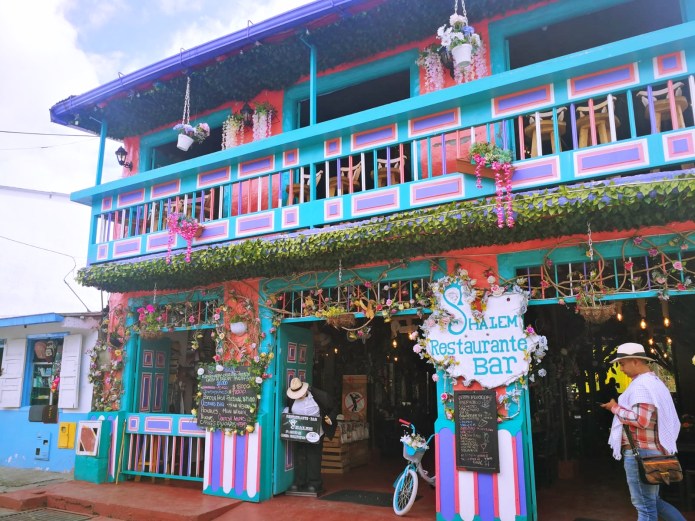
The charming and colorful town of Salento


The trip has gone better than expected so far. In the last decade of so, I have developed a very poor heat tolerance – which makes traveling difficult sometimes. I feel overheated on a sunny day 70 degree day in Bogota (I have several fans installed at my house to the complete horror of my friends and neighbors.) Sometimes, I am sweating and overheating when my friends are putting on sweaters.. It’s kind of frustrating to deal with – but now I travel with my own fan, and ice packs. So, I was worried about traveling to the Eje Cafetero, because some areas are fairly warm, like Pereira but Andres was careful to plan most of our trip in the cooler areas. Not as cool as Manizales, which is my general comfort zone, but quite pleasant so far in our journey.

Salento is quite close to Valle de Cocora, and during our stay, the weather was cool, with rain overnight. Salento is one of those picture postcard towns, that as much as it’s a touristy place, it still manages to be charming, which was a pleasant surprise. (I am sure volume of tourists plays a big part – we were there during the week, just prior to school vacations (semana de receso) so while there were other tourists around, there weren’t any lines, nothing was crowded, merchants were pleasant, friendly and not at all pushy.

I like color – it’s one of my signatures in both interior design and fashion. I strongly believe that we should “live life in color” and I despite that all white cold, institutional look that is so popular these days. Same thing for grey, and beige schemes – which predominate in Bogota design. My own house in Bogota is a riot of color, and a color scheme that changes on a whim.

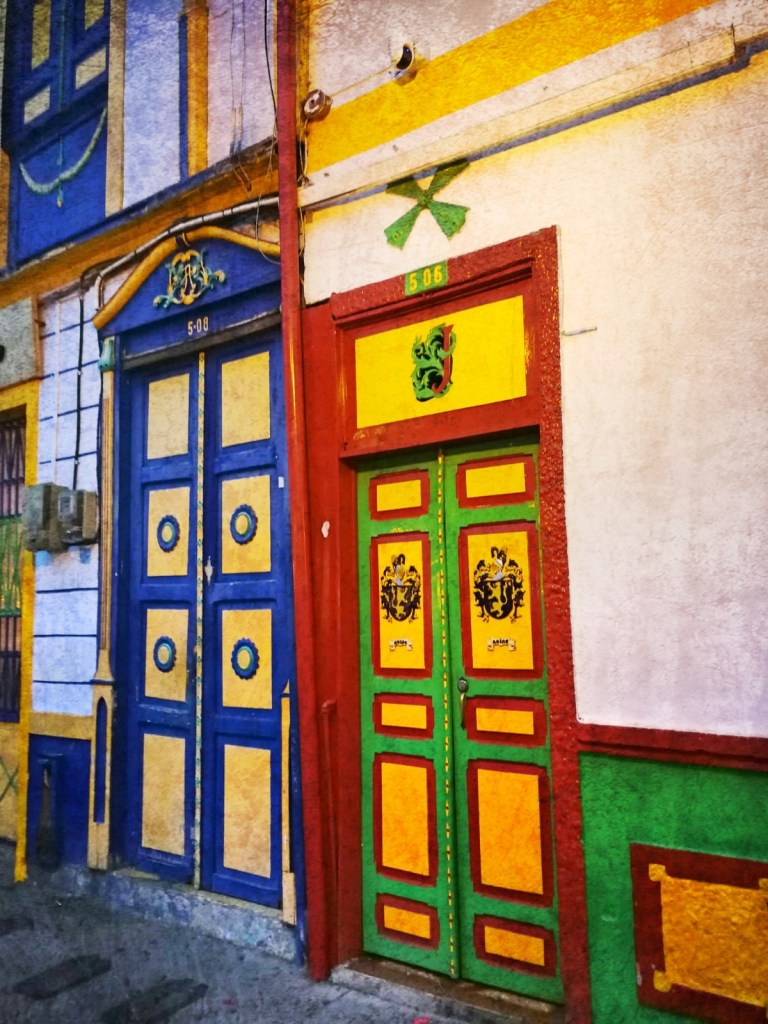
Salento is the same, rich with color – in the bright fashion of the coast, and the Caribbean versus the painted ladies of San Francisco. The other nice thing is that it isn’t just one or two streets – it’s the majority of the town.

We stayed at a lovely apartment hotel that was close to the center of town. We were able to walk everywhere. The apartment was well-appointed, and we could make our own breakfast in the morning. Our host, Mario was very nice and happy to accommodate our plans.

After we got settled, we walked downtown – and to the Mirador, which is a point above Salento that allows you to see the entire city below – once you climb the steps to get there. (There’s a less strenuous path to the Mirador, but I needed the exercise).

It’s 256 fairly steep steps, (less than half the steps of La Piedra del Penol, and only a quarter of the climb up Monserrate but it’s enough to make you breath pretty hard.

I found the actual city view a little underwhelming, but maybe I’ve been spoiled by all the beautiful Bogota vistas..

But once you reach the top, there is a trail that leads to another view point – and this one is breathtaking. Instead of city scapes, it’s a panaramic view of the valley and the mountains that surround Salento.

Panarama of view from Salento

I could take a million pictures and probably never do it justice.. So here’s a couple more.. Just click on the image if you want to see the whole thing.

The older I get, the more I am awed by nature. It’s funny how that happens. Sometimes, I think that we need to see a lot of ugly to truly appreciate the beauty in the world.

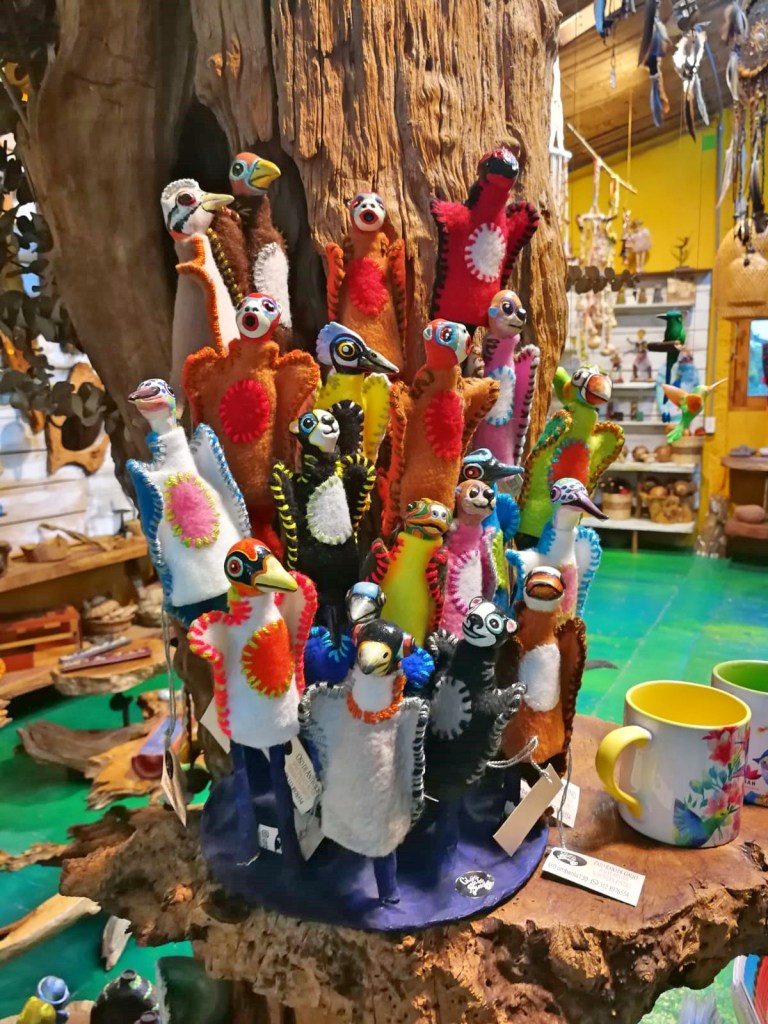
On the way back, we did a little bit of shopping to celebrate Andres birthday – and so I could take pictures of some of the crafts. (I know, it’s in almost all my Colombia posts – but the different kind of artisanal art and indigenous and traditional craft here is so beautiful. I don’t need to buy it – because how many mochillas, bags, hats and other things does a person need? Then again – I do try to support local craft by buying it whenever I need a gift because why would you buy someone mass market crap when there is a plethora of beautiful handmade items that actually mean something out there.

(Not this time – this time Andres actually picked out the beautiful leather bag he wanted – and I’ll get a picture of it tomorrow.) But there is such a variety of so many lovely things, that I just can’t help but take pictures of it when they let me..

After that, we took some more pictures – found a nice restaurant before heading back to the hotel to sleep..

Tomorrow – Santa Rosa de Cabal and the thermal springs..

Coffee as a superfood round-up


Update:  New article published on MSNBC –  25 May –underscores health benefits of coffee –  and further proves premise of optimal coffee ingestion at five to six cups.  (Previous studies showed the majority of benefits at five cups/ day.)

Posting this for a friend, who wasn’t quite convinced by my arguments for coffee..  Added the video just for a light-hearted touch..and who doesn’t like David Bowie..

Happily,  the majority of people have gotten away from the incorrect notion that coffee is somehow harmful, the “I gave up cigarettes and coffee” mentality.. It always irks me a bit when coffee drinking is lumped into a group of unhealthy behaviors….Stay away from coffee… and crack cocaine, people… But seriously, this is one beverage that has been mislabeled over the years – undeservedly.

With so many honest – to-  goodness harmful food additives,  fast food and other ‘junk‘ we put in our bodies – misidentifying coffee is a tragedy (albeit, a small one.)  Admittedly, it is hard on my dental enamel – but otherwise, it is a welcome part of my daily routine.

So today, we are going to review some of our previous posts and the latest published information on coffee and it’s health effects..

For starters, we are going back to a post dated March 2011 – where I first reviewed my love of the hot, rich beverage, along with a summary of health benefits..

We talked about preliminary research suggesting coffee may be protective against strokes.. An additional study on this was actually just published last month, as reported in Medscape.com, Moderate coffee intake protects against stroke, (11 May, 2012) on a meta-analysis presented at the European Society of Hypertension (ESH) European Meeting on Hypertension 2012 by Dr Lanfranco D’Elia. 

Then – a year ago (May 2011) we brought you more information about coffee as a potent anti-oxidant, and potential implications for preventing cancer (and refuting claims that it caused cancer.)

Following that – in July of 2011 – we went as far as proclaiming ‘superfood status’ when preliminary research suggested coffee ingesters were less likely to have MRSA colonization.

We haven’t even touched on the diabetes, and pancreatic cancer angle today, but suffice to say that research shows that the pancreas has a definite affinity for coffee..

Now, on the heels of reports of the underdiagnosis and increasing incidence of fatty liver disease – comes a study in the Annals of Hepatology entitled, “High coffee intake is associated with lower grade nonalcoholic fatty liver disease: the role of peripheral antioxidant activity.”  Translated for readers, this small study by Gutierrez – Grobe, et. al (2012) suggests that high coffee intake is actual beneficial and may have a protective effect on the liver.  Now – don’t get too excited – since it was just a very small study, of 130 subjects – coffee and noncoffee drinkers, 73 without liver disease and 57 with liver disease.  So clearly, we need to look at this more closely..

But in the meantime, you can keep drinking your coffee.

Sugary drink follow up (as promised!)


If you remember, in my blogs about the health benefits of coffee (here, here and here) as well as a previous blog on the health risks related to sugary soft drinks, I promised to bring you more information about our favorite devil-in-disguise, Starbucks.  (I will give them credit for making this information easily accessible, even if it is tiny print.)

I call Starbucks this because on initial consideration..

Coffee: Good!      Big super-sized coffees: Even Better!  and look – a Regular black coffee, no cream, no sugar, any size (including their super-size Venti) is only FIVE calories..

Coffee loaded with cream and sugar:  Not so good.  (How bad is it – you ask? or you should be asking)

well once you start drinking their specialty drinks (and I must be the only person who drinks regular coffee anymore) – that’s when you get into trouble.. so knowing that everyone loves their super-sized coffees, I’ve skipped right to the “Venti” calorie counts..

Cafe Latte with skim milk: 170 calories

Cafe Latte with 2% milk:  240 calories and NINE grams of fat

Cafe Mocha (without whipped cream in these examples)

with nonfat-milk: 280 calories

with 2% milk: 340 calories and 10 grams of fat (that’s a reasonable sized salad with a vinaigrette dressing and maybe cheese or not-so-healthy add-ons)

Vanilla (or other flavored) Lattes:

with non-fat milk: 250 calories (all sugar)

with 2% milk: 320 calories and eight grams of fat

Even the ‘skinny’ lattes have 160 calories..

The specialty espressos are no better (in fact – some are worse, as you will see)

Carmel macchiato:

 with non-fat milk: 240 calories, one gram of fat

with 2% milk:  300 calories, 8 grams of fat

White chocolate mocha (without whipped cream – I think they were afraid of putting the whipped cream calorie counts on this brochure)

with non-fat milk: 450 calories and 7 grams of fat (that’s a decent meal’s worth of calories!!)

with 2% milk: 510 calories and fifteen grams of fat – for a ‘coffee’ !  (I think you can see here how a few of these coffees a week can certainly pile on the pounds.)

Now, if you think that’s no big deal – go on over to www.Fitday.com (and don’t lie to yourself about your exercise) and put in your information (they have free accounts) and figure out how much walking, jogging or aerobics you have to do to equal out that one coffee.. Hint: It’s a lot more than you’d think – or we wouldn’t be in this mess!

The other items on the menu (including the teas) are no better once you pile in the milks, sugars and other garbage.

What about coffee with soy milk?  Isn’t that supposed to be good for you?  Well, in theory, perhaps.. But actually, for some products, the fat and calorie counts for Starbucks products with soy milk go way, way up.

Cafe Latte with soy milk: 220 calories, 6 grams of fat

Cafe Mocha (no whipped cream) with soy milk: 320 calories, 8 grams of fat

Vanilla Latte with soy milk: 300 calories with 6 grams of fat

Carmel macchiato with soy milk: 280 calories with 6 grams of fat

White chocolate mocha: (no whipped cream): 490 calories, 12 grams of fat

all of this – for a little eye-opener in the morning – time to stick with the regular coffee!

In fairness – I am not picking on Starbucks, they are just the most popular.  Even the local 7 – 11 has a coffee flavored slushy drink that is packed full of sugar and calories.  Of course it’s delicious – but really, that’s besides the point.  Obesity and diabetes are just a mathematical formulation – and it seems many of us are failing the subject entirely.

The Lancet, a well reputed medical journal has just published a series on Obesity, and the numbers are frightening – researchers estimate that by 2030 – (really not that far away) over 165 million Americans will be obese.

The costs of this to society are enormous, and frankly staggering.  Bloomberg published a story estimated an additional 66 BILLION dollars PER year in obesity related costs.  That isn’t just a threat to our health as a nation, but our financial future.